



By Soumoshree Mukherjee
Editor’s note: This article is based on insights from a podcast series. The views expressed in the podcast reflect the speakers’ perspectives and do not necessarily represent those of this publication. Readers are encouraged to explore the full podcast for additional context.
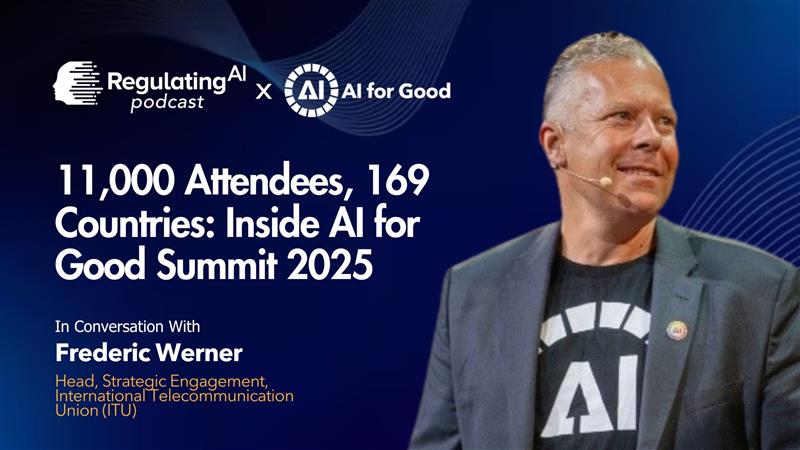
In the heart of Geneva, the AI for Good Summit 2025 buzzed with electric energy, drawing over 11,000 attendees from 169 countries and 20,000 virtual participants into a vibrant tapestry of innovation. This wasn’t just a conference, it was a global movement, a kaleidoscope of minds united by a singular vision: harnessing artificial intelligence to reshape the world for the better.
Held at the United Nations’ ITU headquarters, the Summit wasn’t just another tech event filled with buzzwords and jargon. It was a hands-on, eyes-wide-open convergence of minds, machines, and missions.
READ: Knowledge Networks teams up with AI for Good to advance dialogue on global AI governance (July 18, 2025)
Picture this: sleek robots gliding through exhibits, brain-computer interfaces sparking imaginations, and quantum computing displays hinting at a future just within reach. The summit, hosted by the International Telecommunication Union, showcased AI’s transformative power across sectors like healthcare, arts, and disaster response. But beneath the shiny surfaces was a deeper conversation: How can AI serve as a global equalizer rather than a divider?
Frederic Werner, one of the event’s key voices, stressed that AI for Good “more than a summit,” it’s an ecosystem. The Chief of Strategy and Operations at AI for Good, ITU, shared with “Regulating AI” podcast host Sanjay Puri that “in the form of robotics, brain-computer interface technologies, autonomous driving, quantum computing, art, agentic AI—you name it. It’s all here.” The focus extends beyond technological advancement to building a global community that shares knowledge, strengthens skills, and ensures that no country is left behind.
That commitment to inclusion was on full display with initiatives like the AI Skills Coalition, which is breaking down barriers to AI education worldwide. Meanwhile, the Innovation Factory, a global startup pitching competition, gave stage time to bold entrepreneurs solving real-world problems with AI.
The event got even younger (and smarter) with the Robotics for Good Youth Competition, where school-age teams presented robots designed for disaster response, offering a glimpse into a future generation that doesn’t just consume AI, but creates it with purpose.
READ: Harnessing AI for healthcare, agriculture, and disaster relief: Dr. Bilel Jamoussi unpacks ‘AI for Good’ (June 13, 2025)
Perhaps, the most significant yet understated part of the summit was its multistakeholder governance platform. With over 300 standards in development, the initiative is laying the groundwork for ethical, equitable AI frameworks that unite tech visionaries, policymakers, and activists from across sectors and borders.
The AI for Good Summit didn’t just imagine a future shaped by artificial intelligence. It invited the world to build it together.
As Werner said that the conversation doesn’t end here. It’s just beginning. With global competitions, online events, and hands-on learning continuing year-round, this is less of a moment and more of a movement one where AI is not just smarter, but kinder.
Werner urged the audience to “get involved,” adding: “Help us build skills. Help us build capacity. Join our challenges. Join our competitions. Build standards. And join the movement.”