



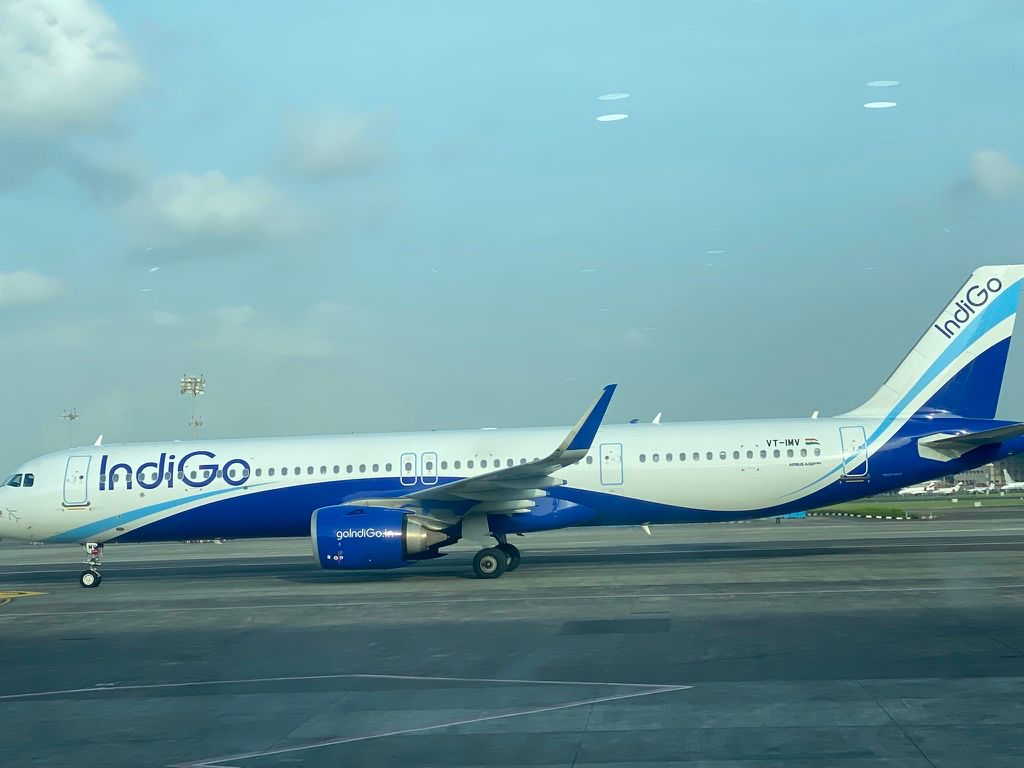
A massive operational collapse at IndiGo, India’s largest airline, has stranded tens of thousands of passengers and created scenes of chaos at airports nationwide.
On Friday alone, the airline scrubbed more than 400 flights, while many others were hit by delays of over 12 hours because of a spiraling pilot-rostering crisis.
IndiGo, cofounded by Indian American aviation executive Rakesh Gangwal and Indian businessman Rahul Bhatia in 2005, may not be a formal monopoly, but with a staggering 65 to 70 percent share of the domestic market as of October 2025, the airline effectively dominates the skies. Its scale is so vast that when it falters, the shockwaves ripple across the entire network, revealing how deeply reliant India’s air travel ecosystem has become on a single carrier.
READ: Airbus claims recalled A320 jets have now been fixed? (December 1, 2025)
The fallout was visible everywhere.
Passengers protesting at airports, snaking queues, piles of misplaced baggage, and people sleeping on cold terminal floors were clear signs that this was not just an internal workforce imbalance. It was a reminder that when the country’s biggest airline by fleet and passenger load hits a wall, the whole system buckles. Critics who often describe the aviation market as a “near monopoly” or at best a skewed duopoly with the Air India Group found their warnings playing out in real time.
Trying to contain the widespread anger, IndiGo announced on Friday that all passengers affected by cancellations between December 5 and 15 would receive full refunds. The airline said the reimbursements would be credited automatically to the original mode of payment, a step meant to ease at least one layer of frustration.
Meanwhile, the Directorate General of Civil Aviation stepped in swiftly. The regulator called IndiGo officials for an urgent meeting and expanded its probe into the airline’s extraordinary number of cancellations and delays. In what will be disappointing news for travelers, IndiGo told the DGCA that it does not expect to return to full operational stability until February 10, 2026.
To manage the volatile situation, the airline plans to push ahead with more cancellations over the next few days. Beginning December 8, it will cut back its flight schedule in an attempt to prevent further breakdowns. The carrier has also asked the DGCA for exemptions from certain Flight Duty Time Limitation rules for its A320 fleet, a request that highlights the severity of the pressure on its pilot roster.
As frustration spilled over across the country, IndiGo CEO Pieter Elbers issued a public apology on Thursday. Hundreds of flights had already been disrupted by then, and an internal email he sent to employees acknowledging the airline’s failure to serve its customers began circulating widely on social media. His note attempted to quell the growing sense of disappointment as the airline scrambled to regain its footing.
Social media flooded
The chaos soon erupted across social media, which turned into a running diary of the crisis. Photos and videos from airports nationwide captured the exhaustion and anger of passengers stuck for hours with little clarity on when they would fly. Travellers were seen lying on airport floors, struggling to get updates from helpless staff, and forming queues that stretched endlessly through terminals.
Among the many stories that surfaced, one incident in Hubballi stood out for its emotional weight. A wedding reception in the Karnataka city had to go ahead without the bride and groom because the couple was stranded hundreds of kilometres away. Megha Kshirsagar and Sangam Das, both software engineers, were scheduled to fly from Bhubaneswar to Hubballi via Bengaluru for their reception on December 3. The cascade of cancellations and delays trapped them mid-journey. With relatives already travelling from different cities and all arrangements in place, the bride’s family made the difficult decision to continue the event. The newlyweds joined by video call as Megha’s parents stepped in to perform the rituals on their behalf. What was meant to be a joyous milestone became an unexpected hybrid ceremony that captured both the heartbreak and resilience at the center of IndiGo’s meltdown, earning admiration across social platforms.
Flight prices hike
The crisis did not stop at grounded flights. Once IndiGo’s operations collapsed and thousands of seats vanished from the system almost overnight, the rest of the aviation market reacted instantly. With supply gutted, last-minute fares across major routes exploded to levels passengers had never imagined. Fares that typically sit around ₹60,000 (about $725) suddenly shot far beyond reach.
On travel portals, the numbers were astonishing. For the Delhi–Bengaluru route, one-stop tickets on other airlines were listed at more than ₹1,00,000 ($1,205), while the remaining non-stop seats ranged between ₹70,000 ($845) and ₹93,000 ($1,120).
The Delhi-Mumbai corridor saw non-stop fares climb to ₹48,000-₹55,000 ($580–$660), while one-stop alternatives touched ₹70,000 ($845). Some return fares even hit ₹60,000 ($725).
Delhi-Chennai passengers faced last-minute prices between ₹62,000 ($750) and ₹82,000 ($990).
The turbulence wasn’t limited to big-city routes. A Kolkata-Visakhapatnam ticket shot up to around ₹70,000 ($845), and a Goa-Kolkata flight crossed ₹42,582 ($513).
These extreme fare spikes made it painfully clear how much IndiGo’s dominance shapes the market. With the country’s largest airline crippled, the sudden shortage of available seats allowed other carriers to push prices to punishing highs. Many travellers, still waiting for their IndiGo refunds, had no financially realistic way to rebook. The fare frenzy became another reminder that this was not just an airline meltdown but a shock to the entire aviation ecosystem.