



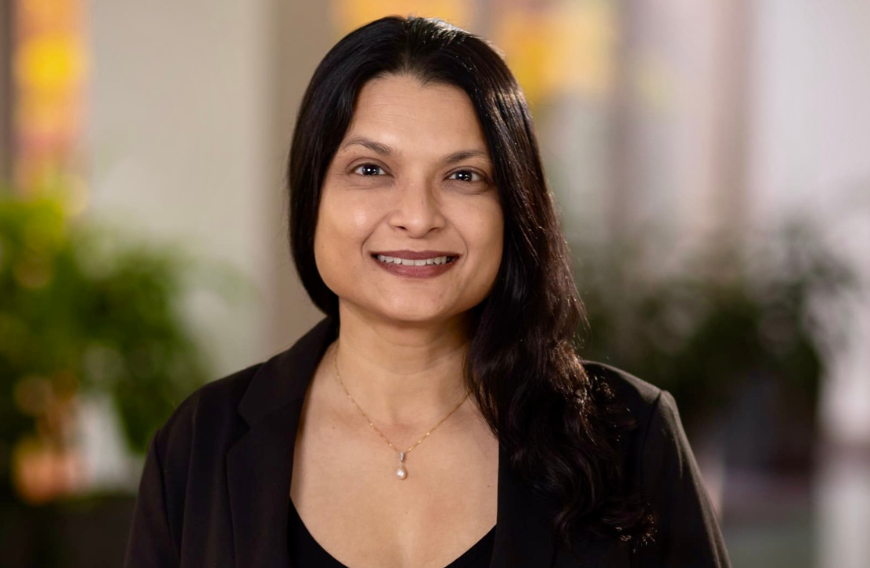
Shaili Gupta, an Indian American professor at Yale School of Medicine (YSM) has developed a new residency program bridging medicine and AI technology to revolutionize how medicine is practiced and how it’s taught.
“With AI, the output is only as good as the input,” says Gupta, MBBS, MHS, associate professor of medicine (general medicine) at YSM.
This mindset inspired Gupta, who also serves as associate program director of the Yale Internal Medicine Traditional Residency Program, to develop a specialized curriculum aimed at preparing physicians-in-training to approach emerging technologies with confidence, curiosity, and critical thinking.
The program, now formally known as the AI and Innovation in Medicine Distinction Pathway (AIMDP), launched this past year for internal medicine residents interested in engaging more deeply with this evolving field, according to a media release.
“We want trainees to know how to question what AI produces – when to trust it, when to challenge it, and how to ask better prompts so the technology helps them think more critically,” says Gupta.
READ: When Penn Medicine wins, humanity wins (
Residents start the pathway by learning the basics of coding and understanding large language models. They then proceed to explore how AI and machine learning may be applied in clinical care, medical education, and research.
Faculty experts from a variety of fields, including medicine, law, computer science, digital ethics, and data science, all contribute sessions to the curriculum.
Gupta says the goal is to bring together professionals across these domains to give trainees a broad foundation for using AI responsibly in their future practice.
Among the first to engage with this new curriculum is Kanika Sehgal, MBBS, a chief resident in the Yale Internal Medicine Traditional Residency Program.
“It’s exciting to see this pathway take shape at a time when AI is rapidly transforming how we analyze data, interpret evidence, and make clinical decisions,” says Sehgal. “I’m particularly excited about the opportunity to engage with innovators across disciplines and learn to leverage AI to improve patient outcomes.”
Gupta hopes residents will come away from the pathway with greater comfort in navigating AI tools, as well as in pitching new ideas and exploring unfamiliar territory.
READ: Dr. Girish Nadkarni’s global vision for future of AI in healthcare (
Equally important, says Gupta, is training physicians who can engage AI critically and responsibly. “AI is like a sponge; it absorbs everything it sees,” she says. “If we train it on our own biases, we lose its potential to make care more equitable. We want to build systems that help us recognize and correct those biases, not replicate them.”
For the residents participating, the pathway also represents a chance to define their relationship with AI.
Mark Siegel, MD, professor of medicine (pulmonary) and program director of the Yale Internal Medicine Traditional Residency Program, says the new pathway highlights Yale’s commitment to helping residents grow as innovators and leaders in an era defined by technology.
“AI will undoubtedly become a central tool used by internists,” says Siegel. “A core goal of our program is to ensure that all trainees understand how to use AI effectively and wisely, understanding both the opportunities and risks.”
Dr. Gupta has been serving as research supervisor, thesis advisor and mentor to students, residents, fellows and faculty for more than a decade. She completed her fellowship training in Infectious Diseases at Yale in 2008, and currently divides her time between providing patient care for veterans admitted to the VA hospital, education for trainees, and medical education research.