



For more than two decades, I have had the privilege of sitting at the roundtable on Inside Story, the Greater Philadelphia’s favorite local politics television show, airing every Sunday morning at 11:30 on 6ABC, where a panel of Insiders dish on what’s happening in the halls of power and what people in the know are talking about. For decades, political junkies and politicians themselves have been watching Inside Story to be in the know. That is no small thing. Week after week, through elections and crises, through budget battles and cultural upheavals, through moments of civic grace and moments of civic failure, the show has been a mirror held up to this city, this commonwealth, and this republic.
I have watched hosts come and go. I have watched panelists grow from observers into participants in the events we were once merely analyzing. I have watched Philadelphia transform around us, its skyline, its neighborhoods, its politics, its demographics, even as the fundamental questions the show raises remain stubbornly, productively the same: Who holds power? How is it used? What do the people of the Delaware Valley deserve from those who govern them? These are not small questions. They are, in fact, the questions the republic was founded to answer.

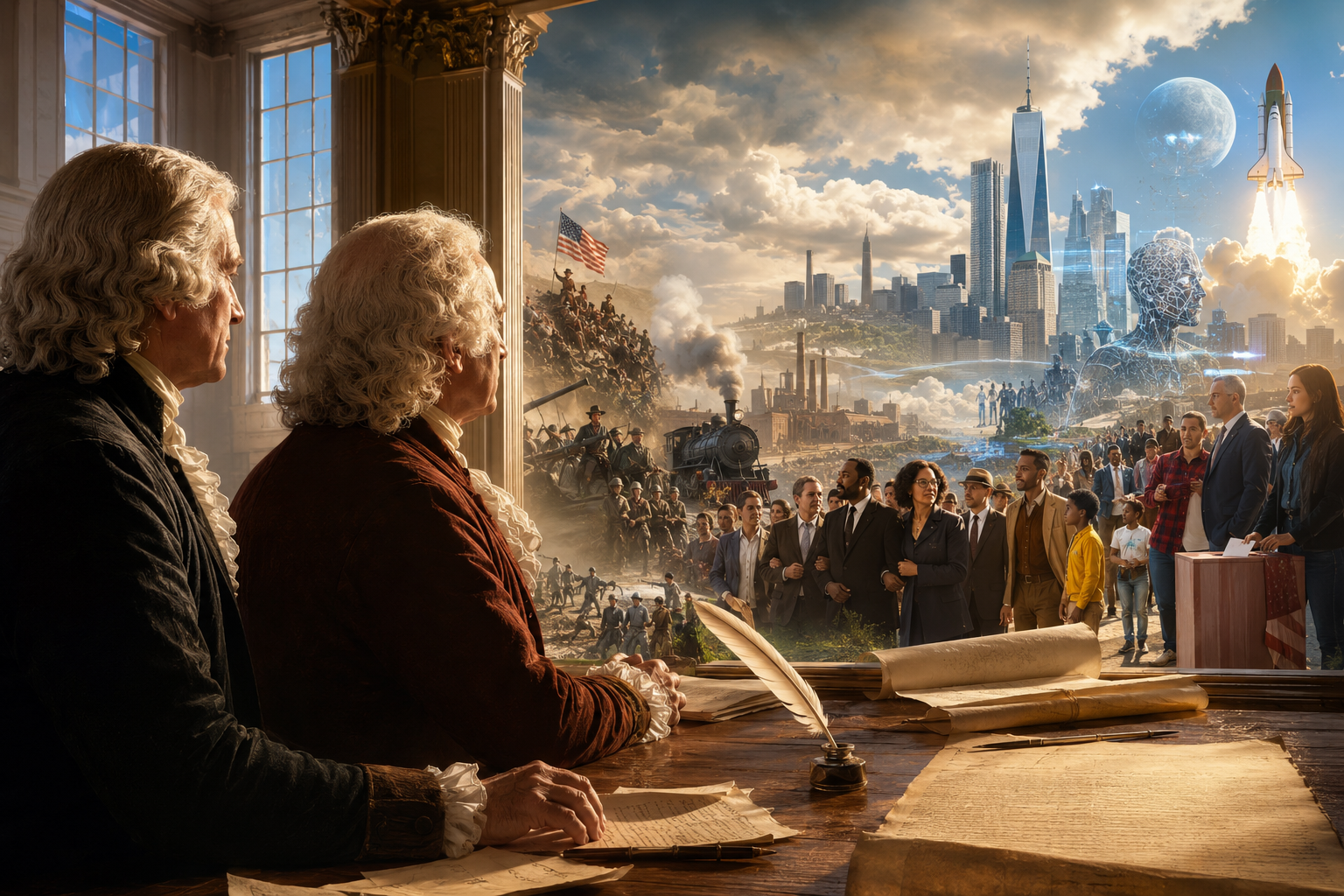
But in all my years on that set, I have never witnessed an episode quite like this Sunday’s. Matt O’Donnell, co-host of Inside Story and co-anchor of Action News Mornings, a man who has covered three political conventions, interviewed two presidents, and spent decades telling the stories that shape this region, did something that was, in the fullest sense of the word, historic. He brought to the studio two actors inhabiting the souls of Thomas Jefferson and John Adams, and he asked them to look across 250 years: to reckon with what their experiment had become, to offer their wisdom to the fractured present, and to cast their eyes forward toward another 250 years not yet written.
It was, for me, the most extraordinary episode in the show’s long history. Not because of spectacle, though there was spectacle, but because of the depth of the questions it forced us all to confront. We are thirty-two days from July 4, 2026, when our nation will commemorate the 250th anniversary of the signing of the Declaration of Independence. Philadelphia, as the birthplace of the United States, will be the heart of a year-long celebration, and Inside Story, broadcasting from this city, was already its beating intellectual pulse long before the bunting went up. This was the show that spanned the full arc of American existence and dared to look forward at the next 250 years. I was honored to be at the table.
What follows are my reflections on the questions Matt posed, sharpened by the data and the history that I believe Jefferson and Adams would have demanded we bring to bear.
There is something almost Shakespearean about the conceit itself. Jefferson, the eternal optimist, the man who could hold a slave in one hand and a quill drafting all men are created equal in the other. Adams, the irascible truth-teller, the man who predicted that posterity would never fully understand what his generation had risked. The two of them, long enemies, late reconciled, dying on the same Fourth of July in 1826, sat together once more in a Philadelphia television studio, thirty-two days before the nation they invented turns 250. What would they think? Let me take a long walk through the questions Matt posed, because the answers are not comfortable, and they are not simple, and they are, for all of us sitting on that roundtable, deeply personal.
Would They Recognize This Country?
They would be, simultaneously, astonished and unsurprised. Jefferson once wrote that he hoped future generations would alter the Constitution every nineteen years, roughly one generation, because he believed the living should not be chained to the dead. He would be startled that his document has survived, amended only twenty-seven times in 235 years, yet still governing 335 million people across a continental empire that stretched, in his imagination, only to the edge of the Louisiana Territory he purchased.
Adams would squint at the numbers first. He was always a man of facts. A nation of four million in 1776, three million of them free, one million enslaved, a bitter math Jefferson never fully reckoned with, has become the third most populous country on earth, the world’s largest economy by nominal GDP at roughly $30 trillion, the possessor of the world’s most powerful military, and, until very recently, the unchallenged architect of the global liberal order. Adams would grudgingly approve of the durability. Jefferson would be moved by the scale.
But both men came from a tradition of classical history. They had read Gibbon on Rome’s decline and Thucydides on Athens’s hubris. They would not be naïve. They would also see the fault lines.
What Would They Think of Our Political Parties?
They would be grieved, and guilty.
The Constitution made no provision for political parties. This was not an oversight; it was a conviction. The framers viewed political parties as a necessary evil, seeing them as corrupt relics of the monarchical British system they wanted to discard in favor of a truly democratic government.
In his Farewell Address in 1796, President George Washington cautioned Americans about the divisive nature of political parties, fearing that factionalism would create an “us versus them” mentality, eroding the common good in favor of narrow, partisan interests. He wrote that the “alternate domination of one faction over another, sharpened by the spirit of revenge, natural to party dissension, which in different ages and countries has perpetrated the most horrid enormities, is itself a frightful despotism.”
James Madison, in writing Federalist No. 10, discussed factions in detail and considered them to be a disease in the body politic, fearing that “when a majority is included in a faction, the form of popular government enables it to sacrifice to its ruling passion or interest both the public good and the rights of other citizens.” And yet, just a few years later, Madison and Thomas Jefferson would create a political party to fight the policies of Treasury Secretary Alexander Hamilton. They warned against the disease, then administered the first dose themselves.
Jefferson, always self-aware enough to live with contradiction, might at least smile at the irony. Adams would not. He would look at two parties that have calcified over nearly two centuries, the Democrats and Republicans dominating a system he never intended to be binary, and see in them precisely the tyranny of faction he feared.
The data would horrify them both. Americans increasingly see the country as more divided than at any time since the Civil War. Pew Research Center polling reveals a sharp rise in partisan hostility: by 2022, 72% of Republicans and 63% of Democrats viewed the opposing party as more immoral than other Americans, up dramatically from 47% and 35% in 2016. Among U.S. respondents surveyed between January and December 2025, 12 percent placed themselves on the far left and 20 percent on the far right of the political spectrum.
Today, political divisions are shattering friendships, tearing apart families, and fueling a deepening hostility between everyday Americans. In recent polling, forty-seven percent of Democrats reported having experienced such a rupture. And nearly a third of Republicans experienced political breakups.
Jefferson would recognize something ancient in this. He lived through the election of 1800, which many historians regard as the first great partisan crisis, a moment when the republic genuinely might have collapsed into faction. He survived it. He would counsel that we have survived crises before. Adams, more bleakly, would note that the Civil War, the crisis they didn’t survive peacefully, cost 620,000 lives.
The Review by Ajay Raju: What President Trump packed for the Beijing Trip (May 24, 2026)
What Would They Think of the Revolutionary Nature of Some of Our Politics?
Both Jefferson and Adams were, of course, revolutionaries. Jefferson wrote that the tree of liberty must periodically be refreshed with the blood of patriots and tyrants. But both men were also, ultimately, architects of institutions, men who understood that revolution without order produces not freedom but anarchy. Jefferson’s personal hero was Isaac Newton, a man of law-governed systems. Adams built the Massachusetts Constitution, perhaps the most enduring state charter ever written.
They would look at our current moment, populist insurgency, institutional assault, the longest government shutdown in U.S. history at 43 days in late 2025, partisan disputes over executive infringements on Congress’s spending authority leading to that shutdown, and they would see familiar patterns rendered in unfamiliar technological garb.
Jefferson would be troubled by the centralization of executive power, which he spent much of his presidency both resisting and, when convenient, practicing. He believed that the consolidation of federal authority at the expense of states was the long road toward authoritarianism. Adams would be disturbed by something different: the disregard for institutional norms. He was a man who believed in law above personality. The spectacle of American politics conducted as personal theater, through social media, through reality television archetypes, would strike him as the precise degradation of republican virtue he warned about.
How Surprised Would They Be That We Are Still a Nation?
Profoundly. And perhaps more than any other question, this one would move them to silence before speech.
The framers, steeped as they were in the history of republics, Athens, Rome, Carthage, Venice, knew that republics do not last. Rome’s republic endured roughly five centuries before it became an empire. Athens’ golden age of democracy lasted perhaps sixty years. The framers gave themselves perhaps two or three generations before the great experiment failed.
Adams, writing to Jefferson late in life, captured their shared anxiety: they knew they had built something extraordinary, and they were not confident it would hold. The republic they invented has now survived longer than any of the historical democracies they admired. It has survived a civil war that nearly destroyed it, two world wars, a Great Depression, the nuclear age, and 47 presidential transitions, every one of them peaceful or legally adjudicated.
Jefferson, the optimist, would weep with something approaching gratitude. Adams, the realist, would remind us that 250 years is not forever, and that the republic’s survival is not proof of its invincibility, but proof of the courage of each generation that chose to preserve it. The generation that must now choose is ours.
What Wisdom Might They Offer Us Today?
Several things, I believe.
First, on trust: Public trust in the U.S. federal government fell from 77% in 1964 to 17% in 2025, according to Pew Research, near the lowest level ever recorded in the survey’s nearly seventy-year history. Just 2 percent of Americans trust the government to do what is right “just about always,” with only an additional 15 percent trusting it “most of the time.” Adams, whose great obsession was the moral character of republican citizens, would say that government without civic trust is a building without a foundation. He would call for a return not to any specific policy, but to the habit of argument in good faith, the willingness to disagree without delegitimizing.
Second, on wealth: The wealthiest 1% now hold about $55 trillion in assets, roughly equal to the wealth held by the bottom 90% of Americans combined. As of January 2026, the collective net worth of America’s top 12 billionaires surpasses $2.7 trillion, more than quadrupled from $608 billion in March 2020. Jefferson, the agrarian republican, feared exactly this: an aristocracy of wealth displacing the aristocracy of birth, producing the same tyranny in different dress. Madison himself wrote in Federalist 10 that the “most common and durable source of factions has been the various and unequal distribution of property.” He saw it coming. He warned us. By 2024, 100 billionaire families spent $2.6 billion, fully 16.5 percent of all political contributions, to influence an election. In 2000, that figure was just $18 million. The Founders would call that oligarchy, dressed in the language of free speech.
Third, on unity: Madison’s great insight in the design of the republic, that a large, diverse nation would produce so many competing factions that no single one could dominate, was a structural solution to a moral problem. He believed that the architecture of government could substitute for virtue. He was partially right. But he would tell us today that architecture alone is not enough. Benjamin Franklin warned that virtue and morality were essential for maintaining a free society. Franklin, the oldest and perhaps the wisest voice at the Constitutional Convention, would look at the numbers and say: the machine still runs. But the fuel is running low.
The Review by Ajay Raju: Philadelphia is hosting an Open House in 2026 (May 18, 2026)
What Would They Think of Our Innovations?
Here both men would be rendered speechless, then reborn with wonder.
Jefferson was an inventor. He designed a moldboard plow, a wheel cipher for cryptography, a clock driven by cannonballs, and a portable music stand. He spent years obsessing over a device to copy his letters. He would stand in awe before the smartphone, a portal to all human knowledge, a cryptographic instrument, a musical repository, a mapping device, a communication tool of incomprehensible reach, and he would immediately want to understand how it worked, and then immediately begin worrying about how it might be used against liberty.
The global artificial intelligence market was estimated at $371.71 billion in 2025 and is projected to reach $2.4 trillion by 2032, growing at a compound annual rate of 30.6%. These are not merely economic numbers. They describe a civilizational transformation. Jefferson, who believed that knowledge was the foundation of freedom, who founded the University of Virginia on the premise that an educated citizenry was democracy’s only real safeguard, would see in AI both the greatest expansion of human intellectual capacity in history and the greatest potential instrument of mass manipulation and thought control.
Adams, ever the lawyer, would go directly to the question of accountability. Who is liable? Who governs this? When a machine can draft a law, generate a disinformation campaign, diagnose a patient, or write a treaty, who is the principal, and who is the agent? These were Adams’s questions at heart: questions of power, of restraint, of who watches the watchers.
As for space flight, men on the Moon, a rover currently operating on Mars, private companies racing toward lunar colonization, Jefferson would see in it the fulfillment of the Enlightenment’s deepest ambition: the expansion of human knowledge beyond all previous horizons. He sent Lewis and Clark west. He would send us to the stars without hesitation. Adams would insist, characteristically, that we first decide what laws govern us when we get there.
What Would We Say to Those Who Inhabit This Land in 2276?
I believe, we would say: we knew.
We knew the climate was changing. We knew the wealth was concentrating. We knew the institutions were eroding. We knew the polarization was deepening. We knew the technology was outpacing our wisdom. We possessed, as no generation before us has possessed, the data, the science, the historical perspective, and the material resources to act. The question that our successors 250 years hence will ask, with whatever instruments of inquiry they command in the year 2276, is whether we summoned the will.
The Founders could plead a partial ignorance. They did not know that their compromise with slavery would require a Civil War to resolve. They did not know that their omission of women from the franchise would take 144 years to correct. They did not know that the industrial economy would create the concentrated wealth that Madison feared. Their great sins were the sins of their time and their incomplete imagination.
We do not have that excuse. The essays have been written. The reports have been published. The data exists. The question is whether, like the generation of the Founders, who overcame their considerable differences to build something lasting, we can subordinate the immediate to the enduring.
To those in 2276, I would say: we tried. We failed often. We rose sometimes. We were a people who believed, despite all evidence to the contrary, that the arc of history bent toward justice. Whether that belief was wisdom or delusion may depend, entirely, on what you do with what we left you.
Last Word
We are, as I sit at the Inside Story table, living through something that the Founders both predicted and could not have fully imagined. The polarization is measurable and severe. The wealth disparity is at a 30-year high. The trust in institutions is near an historic nadir. The technology is accelerating past our governance frameworks.
But here is what the Founders would tell us, I think, if they sat long enough in that studio with Matt O’Donnell: they did not build this republic because the odds were good. They built it because the alternative was unacceptable. John Adams, in his old age, wrote that the American Revolution was not the war because the war was merely an effect. The Revolution was in the minds and hearts of the people, a change in their religious sentiments, their duties, and their obligations. That revolution, he insisted, was complete before a single shot was fired.
The revolution we need now is also, at its core, a revolution of the mind and heart. Not a revolution against institutions, but a revolution toward the harder, older virtues: civic courage, honest argument, the willingness to see fellow citizens as compatriots rather than enemies, the patience to tend the garden of democracy knowing that its fruits are never guaranteed.
The journey toward this 250th milestone is an opportunity to pause and reflect on our nation’s past, honor the contributions of all Americans, and look ahead toward the future we want to create for the next generation and beyond.
Jefferson ended many of his great letters with a variation on the same sentiment: that the cause of freedom, though it may suffer reverses, will ultimately prevail because it is written in the nature of human beings. He was an optimist by constitution. Adams was an optimist by discipline. Adams believed in the republic not because it was easy to believe, but because it was right to try.
In thirty-two days, Philadelphia, my Philadelphia, the city where this republic was conceived, the city where Inside Story has taken the pulse of American democracy every Sunday morning for decades, will be the center of the world’s attention. The Declaration will be read again. The bells will ring. And somewhere in the echoes of Independence Hall, two old men who argued their whole lives and loved their country fiercely will be listening to see if we understood what they were trying to say.
I believe we can. I believe we must.