




By Zeba Shameer
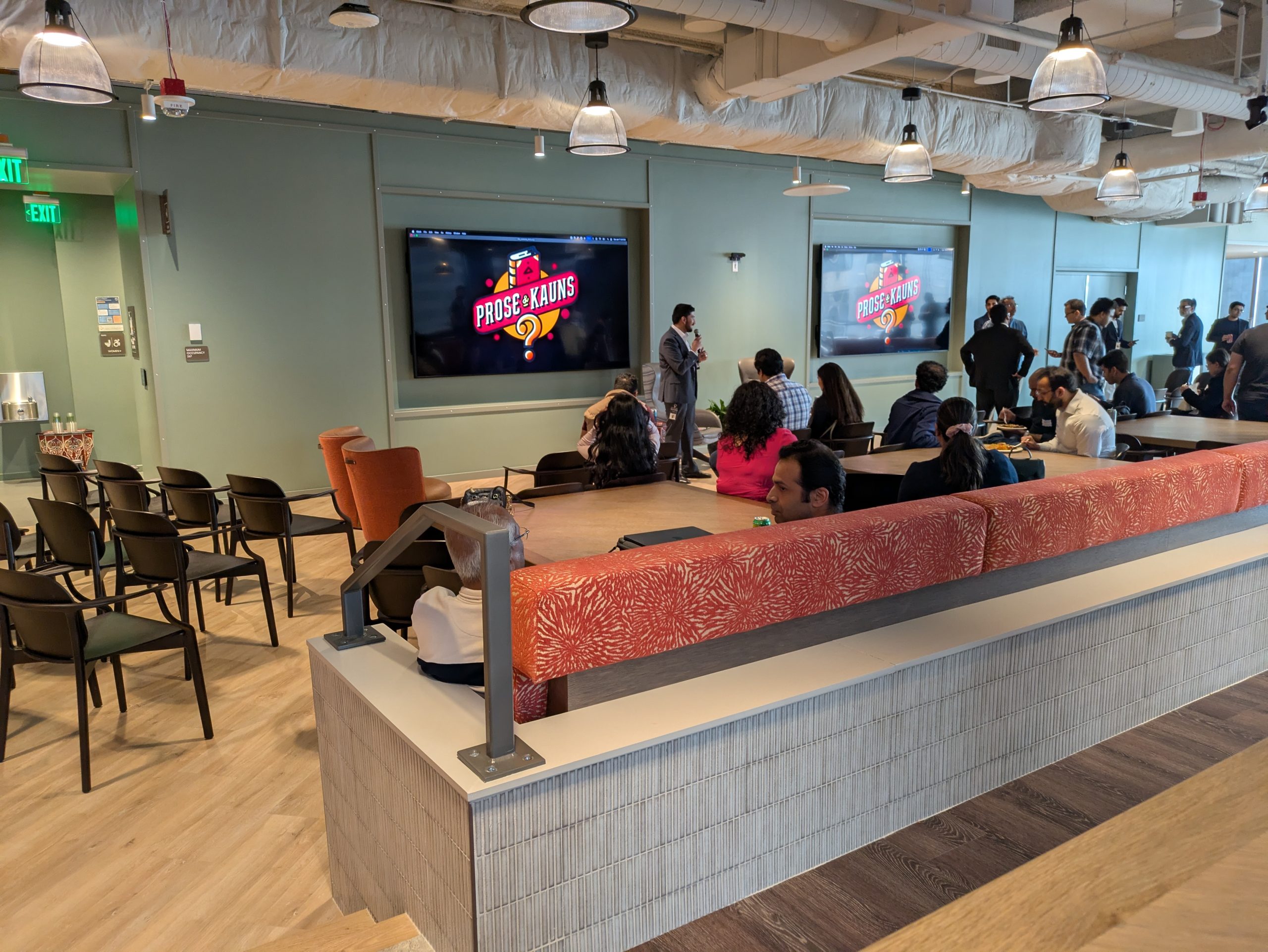
Saurabh Mukherjea, founder and chief investment officer of Marcellus Investment Managers and bestselling author of “Coffee Can Investing,” spoke about India’s economic future and growth potential during fireside chat on June 7 at Remitly headquarters in Seattle.
Drawing approximately 40 attendees from Seattle’s Indian American tech, finance, and entrepreneurship community, the conversation was moderated by Kushal Shah, senior product manager at Remitly and cofounder of the Washington State-registered nonprofit, Prose and Kauns.
The event was the inaugural conversation in the Prose and Kauns Conversations series, presented by Remitly. Opening remarks were delivered by Soumith Raju, Deputy Consul General of India in Seattle, and Pankaj Sharma, Chief Business Officer at Remitly.
Mukherjea spoke about India’s future and growth trajectory, and how AI will dramatically alter the structure of the job market, manufacturing industry, and the education industry. Leading the discussion with a reference to the “red pill” and “blue pill” metaphor popularized by “The Matrix,” Mukherjea challenged attendees to choose between a comforting narrative and a candid assessment of India’s economic future. The audience overwhelmingly opted for the latter.
READ: Maryland District 23 candidate Raaheela Ahmed on education, transparency, and public service (June 11, 2026)
Mukherjea offered a clear-eyed assessment of the structural pressures facing Indian markets in 2025-2026, followed by a substantive case for how India will reinvent itself over the coming decade. He identified four key challenges the country faces — stagnant job creation for college graduates, high costs of living, increased output from individuals lowering the threshold for the number of employees needed, and surging debt fueled by people taking out overwhelming numbers of loans.
The recovery, he states, will come from the country entering a period of significant economic transformation. The current IT services model faces pressure from AI, and a manufacturing boom will emerge in its place.
“For the first time since independence, we will have a big manufacturing boom,” said Mukherjea. “For the last 50 years, every prime minister I’ve known has wanted to revive manufacturing. Not a single prime minister succeeded. As the currency overvaluation goes away over the next 2, 3, 4 years, manufacturing exports will take off.”
He pointed to specific geographic centers where the recovery is already underway:
“Coimbatore, Hosur, parts of Gujarat, parts of Telangana, parts of Andhra, NCR, Ludhiana, these places will boom. The recovery’s already begun. If you go to Ludhiana, if you go to Coimbatore, if you go to Hyderabad, you can see it.”
On how AI is reshaping work for younger Indians, Mukherjea described an optimistic transition; one where the substitution of jobs will be followed by a wave of complementary job growth centered on global freelance and flexibility.
“What AI has done is reduce the size of the project that is commercially viable. A decent coder systems architect can do a small project for $50,000, deliver it in 2-3 days to an SME client. So a lot of youngsters are saying, ‘why do I want to deal with the traffic of Bombay or Bangalore? Let me stay in my hometown, do gig work across the world, earn money, build a small business’ if they want. That’ll be the future.”
The conversation covered several themes of particular relevance to diaspora investors, including the current state of Indian markets, the “demographic dividend” thesis and the challenge of creating jobs for eight million annual graduates, how diaspora investors should think about India allocation in their portfolios, and cautionary insights on Indian mutual funds and real estate for diaspora investors.
Speaking on the role of GIFT City in reducing friction for non-resident Indian investors, Mukherjea highlighted GIFT City as a significant development.
READ: Gubernatorial candidate Nirav Shah makes final pitch to Maine voters (June 8, 2026)
“You can sit in the comfort of your residence in Seattle and open a PMS account in GIFT City. You can invest in dollars, you won’t pay any taxes there, you simply file your tax returns here. It’s a remarkable construct,” he said. He explained what makes GIFT City unique, stating “GIFT City next to Ahmedabad is a dollar jurisdiction. Everything is in U.S. dollars. The banking system there is regulated by the Reserve Bank of India. You will not pay capital gains tax in India. From there, you can access everything in the world.”
On the topic of portfolio allocation for Indian American investors, he was specific. “For a typical affluent NRI, I haven’t seen the logic of why any more than 15 to 20 percent should be in India, because you’re living in a market which gives you far more. The 10-year returns from the American market are 15 percent. The 10-year returns from India are 8 percent in dollar terms.”
Mukherjea ended on a forward-looking note about India’s place in the global economy.
“India rewards you if you understand it and realize that this is actually a country with lots of bright, hungry people who will overcome setbacks. If Microsoft India were listed, it would be by far the largest listed company in India. We are already part of the global mainstream.”
The conversation concluded with an audience Q&A in which attendees raised questions about foreign institutional investor flows, India’s fertility rate and population dynamics, India’s manufacturing competitiveness relative to China, and specific investment strategies for diaspora investors.