



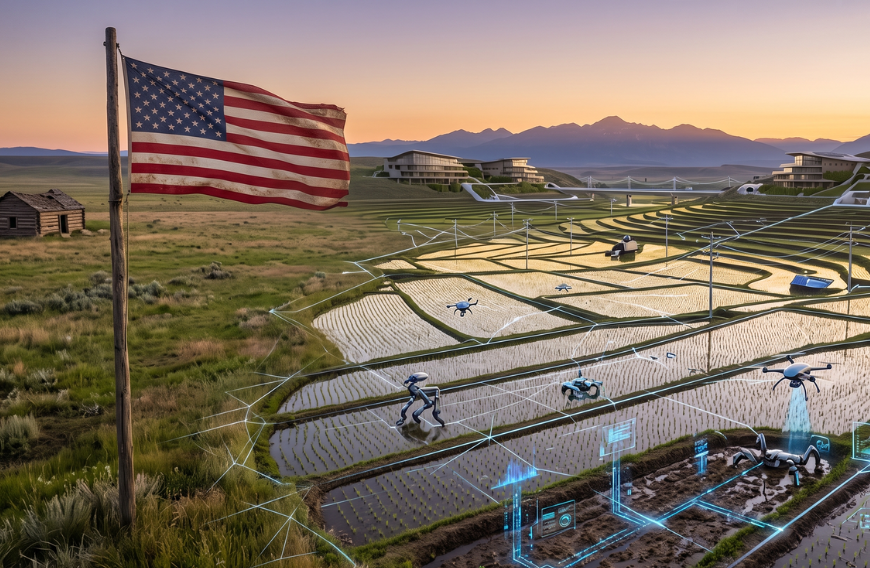
I grew up watching Westerns. Not casually, devotionally. I always identified with that solitary man living in that house surrounded by nothing, who comes out with his shotgun when he sees a speck on the horizon approaching his sovereign boundaries. This fantasy of radical autonomy, I now realize, was never just entertainment. It was aspiration. It was the American dream rendered in dust and silence and the absolute right to be left alone.
So when I recently began searching for a second home for my aging parents, something near my own residence in Philadelphia, comfortable, secure, easy to maintain, the logical answer was a full-service condominium. My realtor agreed and practical considerations confirmed it. But, every time I walked through a well-appointed unit with its homeowners’ association bylaws, its committee votes on exterior paint colors, its shared governance over guest parking, something visceral recoiled in me. The collective rules felt instinctively oppressive, even when I could not rationally defend that reaction.

I chose a townhouse instead. My parents’ house. Their rules. Their sovereign domain.
I chose wheat over rice. Allow me to explain.
The fields that made us
In 2014, Thomas Talhelm and his colleagues published a study in Science that has since become one of the more discussed frameworks in cultural psychology. Testing 1,162 Han Chinese students, they found that those from historically rice-growing regions exhibited measurably more holistic thinking and deeper loyalty to their social groups, while those from wheat-growing areas showed greater individualism and analytical thinking, despite sharing the same ethnicity, language, and modern urban lifestyle.
The mechanism is agricultural and utterly logical once you see it. Rice paddies require coordinated irrigation. Wet rice cultivation demands tight social networks and synchronized labor. Miss your timing and you don’t just hurt yourself, you compromise the entire village’s yield. Wheat, by contrast, is a rainfall crop. Plant it, tend it individually, harvest it alone. Your success or failure is largely your own affair.
A 2024 paper in Nature Communications extended this further, finding that farmers quasi-randomly assigned to rice versus wheat cultivation showed measurable differences in collectivism within a single generation, lending the theory new causal weight. For this essay, I am using the rice-wheat framework as a cultural metaphor, not as fully settled science, and as a lens for reading American political geography in 2026.
Rice inheritance, wheat promise
I inherited a rice brain from my grandfather who spent his entire life in rural Kerala, overseeing acres of farmland, including rice paddies, that required the coordinated labor of dozens of families. His survival depended on collective action, synchronized flooding, shared irrigation. His neighbor’s water management directly affected his harvest. But his grandson, yours truly, four decades into American life, recoils from rules that require collective coordination as though it were a minor tyranny. What happened to me?
America happened. America rewired me. Specifically, the version of America that is now slowly coming apart.
The traditional American story is written in wheat. European immigrants brought wheat culture from regions where rainfall-dependent agriculture had shaped social structures for centuries. The homestead, the family farm, the rugged individual breaking virgin prairie became the operating system of American civic mythology. Individual sovereignty. Self-reliance. The belief that your harvest is your own business, your success your own achievement, your failure your own fault.
READ: The Review by Ajay Raju | Two wars, one nation, citizens divided (June 25, 2026)
For much of the twentieth century, that mythology was not merely inspiring, but functional. A factory worker could buy a house. A union electrician could fund a retirement. The wheat promise held because the economy delivered enough individual accumulation to make collective solutions feel unnecessary, even vaguely un-American. The free market, left to breathe, would lift enough boats that the man with the shotgun could reasonably expect his sovereign domain to be within reach.
I bought that story. Completely and without reservation. Four decades of American life convinced me that the free market, individual initiative, and the sovereign right to make your own choices were not just political preferences but moral truths. The condominium’s collective rules didn’t just irritate me, but offended something I had come to regard as foundational.
But here is what I could not see from inside my own preferences: the wheat mythology was mostly a story told by and for the people it was working for. And for a growing number of Americans, who are concentrated in the cities, credentialed and striving, carrying rice-paddy cognitive inheritance from cultures older than the republic, it has stopped working. Not because they lack initiative, but because the math has changed in ways that individual effort cannot solve.
Manhattan’s median rent hit $5,000 per month in early 2026, an all-time record, up six percent annually, while inventory contracted for the nineteenth consecutive month. For perspective, Asian American households carry a median income of $116,503, the highest of any racial group in the country, and still cannot achieve the stability that the wheat mythology promises. Credential yourself, work relentlessly, play by the rules, and still find yourself priced out, structurally precarious, prosperous on paper but existentially exposed.
When the wheat promise breaks down in a wheat-mythology country, people don’t simply update their politics. They remember something older.
The rice memory returns
The Asian American population has reached nearly 25 million, more than doubling since 2000, now comprising seven percent of the total U.S. population, the fastest-growing major racial group in the country. Indian Americans alone number approximately 5.2 million, a 174% increase since 2000. The vast majority of Asian Americans trace ancestry to rice-cultivating regions: the Gangetic plains, the Mekong Delta, the backwaters of Kerala. These communities are concentrating, densely and deliberately, in the coastal cities where the wheat promise has collapsed most visibly.
And artificial intelligence is accelerating the rupture beyond what housing costs alone could accomplish. The wheat promise was always grounded in labor; the idea that individual effort, reliably applied, would produce individual reward. AI is severing that connection with a speed that policy has not begun to absorb. White-collar jobs that rice-inheritance immigrants spent decades and fortunes preparing for, legal analysis, financial modeling, software development, medical coding, are being automated at scale. The return on individual human capital investment is compressing precisely as the cost of urban life is expanding.
This is a structural disruption and it is hitting the communities that most recently and most completely bought into the wheat mythology, the first-generation professionals, the children of immigrants who were told that education was the irrigation system of the American dream. When AI begins harvesting the fields they were promised, the wheat logic doesn’t simply fail, but is revealed, retroactively, as a promise made to people who were never fully invited to collect on it.
We are now beginning to see the political consequences. Communities that carry rice-paddy cognitive inheritance, the deep instinct that coordinated response to shared threat is not weakness but survival, are the ones most rapidly activating that inheritance. Not because they arrived at democratic socialism through ideological persuasion. But because the math is forcing a reckoning that individualism cannot solve alone. The paddy’s oldest lesson is reasserting itself: your neighbor’s water management affects your harvest.
READ: The Review by Ajay Raju | The Long Gaze: From Paris to NY to Bombay (June 19, 2026)
The irrigation has reached city hall
In November 2025, Zohran Mamdani, a state assemblyman from Queens, a democratic socialist, the son of an Indian-born postcolonial scholar, defeated Andrew Cuomo and became New York City’s first Muslim and first South Asian mayor, the youngest to hold the office in more than a century. His coalition was both demographic and ideological: South Asian, East Asian, Southeast Asian, and Latino voters organized around rent stabilization, city-owned grocery stores, universal childcare, and free public buses. Rice brain organizing a wheat-brain city.
His signature early achievement, a proposed rent freeze on nearly one million stabilized units, was not simply a housing policy, but a declaration of a different operating logic. When water is controlled by the few, the many coordinate or they drown. His administration simultaneously pushed a plan to construct 200,000 permanently affordable units on public land over ten years, and a pied-à-terre tax on luxury second homes projected to generate approximately $500 million annually. The rice-paddy logic, translated into municipal governance: coordinate the water, share the yield, price the hoarding.
Seven months later, in May 2026, Chris Rabb, a democratic socialist who had spent years challenging Philadelphia’s political establishment, won the Democratic primary for Pennsylvania’s 3rd Congressional District with 44.2% of the vote, defeating State Senator Sharif Street’s 29.5% and physician Ala Stanford’s 24.1%. The party machinery had rallied around Street, a centrist with a long endorsement list. It did not matter. In a district stretching from Mount Airy through West Philadelphia, where rice-culture immigrant communities have grown alongside historically Black neighborhoods long underserved by the very establishment Street represented, the synchronized irrigation logic found another channel.
Rabb and Mamdani do not share ethnicity or geography. They share a common logic. Both ran explicitly against their party’s institutional machinery. Both activated, rather than persuaded, voters who had been performing wheat individualism and finding it structurally punishing. Both understood that collective rules, however irritating to the wheat-trained sensibility, exist because the free market stopped solving problems it once seemed capable of solving on its own.
The contradiction we all carry
I suspect my discomfort is widely shared and rarely admitted. I hold both rice and wheat patterns, and they do not coexist peacefully. They fight for dominance depending on context.
I vote for collective solutions, healthcare, education, affordable housing, infrastructure. My rice-paddy inheritance runs deep enough that I have spent decades in civic service, compulsively showing up for communities even when the governance structures chafe. But when forced to deal with collective rules, like homeowners’ associations, partner meetings, and neighborhood associations, I flinch. The shotgun homesteader in me wins those battles.
I recognize the hypocrisy, the specific confusion of someone who absorbed the wheat mythology so thoroughly that its individual freedoms have begun to feel like natural rights, even while the rice-paddy inheritance keeps pulling me toward community, coordination, and collective responsibility.
I am not alone in this confusion. In 2024, Asian voters favored Harris at 57%, while 40% cast ballots for Trump, up from 30% in 2020. Latino voters supported Harris at 56%, down from Biden’s 63%. Every major community of color moved toward the Republican candidate, not away. Rice-inheritance communities, under economic pressure, did not vote in a straight collectivist line. They split, hedged, experimented, contradicted themselves, exactly as you would expect from populations caught between an inherited cognitive logic and a mythology they spent decades trying to inhabit.
But, what the most recent primary elections suggest, however, is that this contradiction is resolving, not through philosophical persuasion, but through the blunt math of rent, automated displacement, healthcare costs, and stagnant wages. Mamdani defeating Cuomo. Rabb defeating Street. These are not general election stories. They are stories about what happens inside a party when economic pressure reaches a threshold and dormant rice memory reactivates.
What the next decade looks like
Can this insurgency win elections? Yes, it has already won elections. But, what will they produce when they govern? Can the governance hold against the structural pressures that created it?
The policy agenda taking shape in New York is instructive: housing supply at public expense, rent controls that redistribute the cost of scarcity, wealth taxes designed to fund collective services, childcare as infrastructure rather than personal expenditure. These are not radical departures from American governance. They are recoveries of the mid-century compact that made the wheat promise broadly accessible in the first place. What has changed is who is demanding them, why, and with what urgency.
READ: The Review by Ajay Raju | 28-3 & 29 Points: The Greatest Comebacks (June 14, 2026)
When Rabb reaches Washington, the coalition will have representatives in both city hall and Congress simultaneously. That is when irrigation becomes infrastructure. That is when a cultural tendency becomes a legislative agenda. And the AI disruption will accelerate this timeline. As automation compresses the return on individual human capital, the political demand for collective solutions will not remain confined to coastal primaries. It will move. The rice-paddy logic has always followed pressure, not ideology.
Census projections confirm the nation will become minority-white in 2045. South and East Asia accounted for 24% of new arrivals between 2021 and 2023, while Europe and Canada together contributed only 12%. The demographic math, compounded by AI displacement, compounded by the collapse of affordable urban life, are producing not a linear progressive march but something more turbulent and more durable: a fundamental contest over which agricultural mythology will govern American policy in the decades ahead.
Last word
The collective rules that once felt like the enemy of the American dream are increasingly becoming the mechanism capable of making any version of that dream accessible. That is an uncomfortable truth for someone who grew up with the shotgun homesteader as his template for a life well lived.
The defining tension in American politics has always been between individual liberty and collective responsibility, between “don’t tread on me” and “we’re all in this together.” What is new is the economic context in which that tension is now being resolved, by demographics, by AI, by the widening distance between effort and security in the cities where the next America is being made.
The wheat mythology is losing its grip. In its place, something older is returning; the paddy’s fundamental lesson, written into the cognitive inheritance of the fastest-growing populations in the country, reactivated by economics when argument alone could not revive it.
Mamdani’s rent freeze is a crack in the old mythology. Rabb’s primary victory is a crack. The AI displacement of credentialed labor is a crack. Individually, each looks like a local story. Together, they are a fault line, and fault lines, once opened, do not quietly close.