



Scoreboards are not partisan.
They don’t care about your history. They don’t know your name. They simply state what is, and dare you to argue.
In the long annals of sport, the most mythic figures are precisely those who looked at the scoreboard, understood exactly what it said, and then proceeded to make it irrelevant.
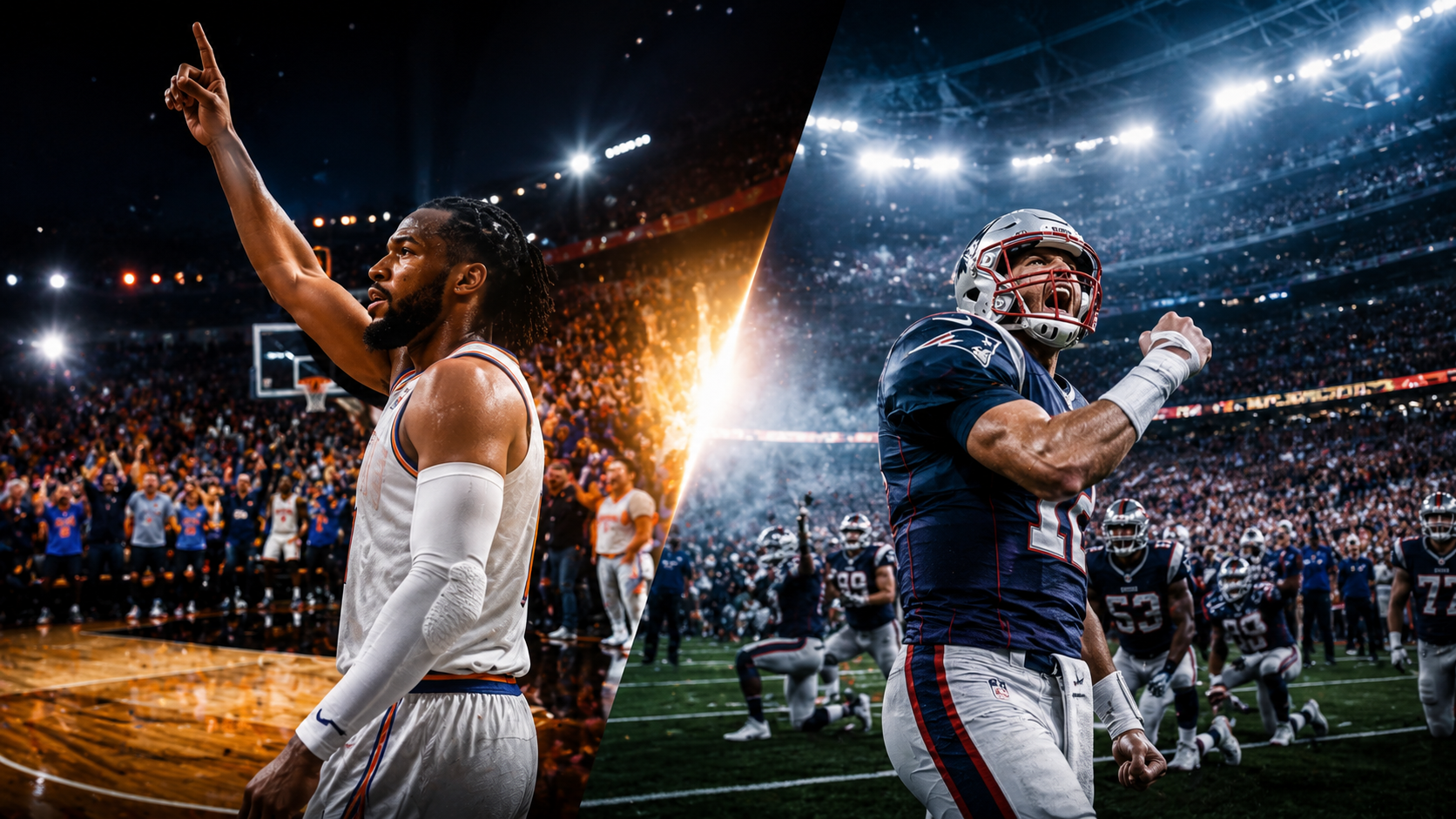
I thought about this last night, watching Jalen Brunson walk off the court in San Antonio with forty-five points and a championship trophy he had been carrying in his chest for years before anyone put it in his hands. I thought about Tom Brady in 2017, down twenty-eight to three at halftime of the Super Bowl, wearing that same expression, not defiance, not denial, but informed refusal. The full knowledge of the situation, paired with the absolute rejection of its finality.
These moments don’t just entertain us, but instruct us.
The Weight of History
The Knicks last won a championship in 1973. Fifty-three years. Entire lifetimes have passed. New York, the city that defines itself by an almost pathological confidence in its own greatness, had been living on borrowed mythology, surviving on the memory of Willis Reed limping out of a tunnel and a city erupting in something that felt like collective prayer answered.
For half a century, that prayer went unanswered.
What does it do to an organization, a fanbase, a city, to carry that kind of weight? It creates a particular hunger. Not the sharp hunger of recent heartbreak, but the deeper, more complex ache of deferred belonging. The Knicks didn’t just want a championship. They needed to reclaim something that had calcified into myth.
And then there was Jalen Brunson.
In five games against the San Antonio Spurs, the Knicks rallied from double-digit deficits in all four of their victories. Not once. Not twice. Four consecutive times, they fell behind by double figures. Four consecutive times, the scoreboard made its cold declaration. Four consecutive times, Brunson and his teammates looked at that declaration and chose not to believe it.
In Game 4 alone, the Knicks erased a twenty-nine point halftime deficit, the greatest comeback in NBA playoff history, winning 107-106. Twenty-nine points. At halftime. Against a team with the most extraordinary young talent the sport has produced in a generation.

Twenty-eight to three. Until it wasn’t.
Twenty-nine at the half. Until it wasn’t.
History doesn’t repeat itself, the saying goes, but sometimes, it rhymes and makes you wonder whether certain souls are simply born to occupy these moments.
The Alien
First, a word about Victor Wembanyama, the future Goliath.
The Spurs defeated the Oklahoma City Thunder in seven games in the Western Conference Finals to reach the championship round, and this from a franchise that, just seasons ago, was understood to be in the patient, deliberate process of rebuilding. Wembanyama took a young team to the doorstep of history. He blocked shots that should not have been blockable. He scored points that should not have been possible. He played with the fluid authority of someone who has been sent here from some other dimension where the physics of basketball operate under different rules.
In Game 5 alone, Wembanyama blocked five shots before halftime. The Spurs led by sixteen points. They had won the first quarter of every single game in the series. San Antonio won the five first quarters by a combined fifty-seven points. They were the better team in the first act of every performance. The problem was that these games have four acts, and Brunson was writing the final one.
Afterward, in the immediate rawness of loss, Wembanyama said something that struck me as the statement of a man who is in the middle of a story, not at its end. “This is the biggest lesson of my life,” he said. “The biggest learning moment.” This is not the language of defeat, but the language of a champion who hasn’t yet won.
There is a reason we remember David. It is because there was a Goliath. The giant doesn’t diminish David’s story, the giant is the story. Without the impossible odds, without the larger adversary, the sling is just a sling. Wembanyama, in losing, gave Brunson and the Knicks the proportions that myth requires. The Spurs will return. The learning moment Wembanyama described will compound with interest, the way preparation always does when it is honest about failure. San Antonio is not at the end of something. They are, unmistakably, at the beginning.
But beginnings are not remembered. The finished arc is remembered. And this particular arc, in 2026, belongs to New York.
The Review by Ajay Raju | The three Philadelphias: Inward, backward, forward (June 11, 2026)
Forgetting Second Place
Second place in sports exists to be erased.
The Falcons scored twenty-eight points and led by twenty-five with nineteen minutes left in the most-watched sporting event on the planet, playing perhaps the best first half of football in Super Bowl history. Matt Ryan was the league’s Most Valuable Player. Their offense was historic. And yet we do not discuss the 2016 Falcons when we talk about that Super Bowl. We discuss Brady. We discuss the comeback. The Falcons exist in that story only as the necessary mountain, present to be climbed, defined entirely by their failure to hold the summit.
This is consistent in iconic sport: the losing side provides the altitude. The higher the peak, the greater the achievement of the climber. And so the Falcons, in one of the most agonizing defeats in the history of their sport, inadvertently made Brady’s legacy larger. The Spurs, in holding those double-digit leads, in winning those first quarters with such dominance that it seemed like category error to imagine a different outcome, made what the Knicks did more extraordinary.
We will not remember 2026 as the year the Spurs led by twenty-nine at halftime of a Finals game. We will remember it as the year the Knicks erased twenty-nine points at halftime of a Finals game. Same fact, same scoreboard, but two entirely different stories, depending on who you are.
Practicing Extraordinary
What we witness in moments like 28-3 or a 29-point halftime deficit overcome is not the extraordinary. It only appears extraordinary because we are watching the output. What we cannot see, what the scoreboard will never capture, is the decades of preparation that make the extraordinary possible.
Brady’s mind was calm in that third quarter because he had trained his mind to be calm for twenty years. Every fourth quarter comeback in the regular season, every two-minute drill in a December game that no one remembers, every film session, every practice repetition under fatigue were not preparations for that specific moment. They were deposits, made without knowledge of exactly when they would be withdrawn, into a mental account that earns compound interest.
Brunson was named Finals MVP after scoring forty-five points in the clinching game, but his true shooting percentage across the series was among his least efficient of any playoff run he’d played. This matters. He was not at his statistical peak. He was not in a zone where everything was easy. He was grinding, finding points in difficult ways, making the hard shot when the easy one wasn’t available, which is exactly the skill you develop over years of being underestimated, of building yourself up in gyms that nobody was watching, of carrying Villanova to moments larger than most people expected from him and then carrying the Knicks through playoff run after playoff run until the culmination arrived.
Lessons: do the work, perform the next play, throw the next pass, and take the next shot. Release the outcome from your grasp, because grasping at it is precisely what makes it impossible to hold.
Brady understood this. He didn’t play nineteen minutes. He played the next play, and the next, and the next. Brunson understood this. He didn’t attack a twenty-nine point deficit. He attacked the next defensive possession, and the next, and the next, until the math gradually, improbably, completely relented.
Impossible Circumstances
Rumi wrote that the wound is the place where the light enters you.
The deficit is the wound. Twenty-eight to three. Twenty-nine at the half. These are not just obstacles, they are, in some profound sense, the very conditions that make greatness possible. In a close game, a competent player can win. In an apparently decided game, only a mythic one can.
The Review by Ajay Raju | Breaking: Jefferson and Adams debate 250 on 6ABC’s Inside Story (June 6, 2026)
This is why we watch sport. Not for the outcome, which could always simply be computed. We watch because human beings, under the most extreme psychological and physical pressure imaginable, occasionally do something that transcends the merely excellent and enters the genuinely mythic. And in doing so, they hand the rest of us something we desperately need: proof that the scoreboard, whatever it says, is not the final word.
There are people who watch sports and see games. And then there are people who watch and see something else: a compressed, accelerated, exquisitely pressurized version of what the rest of life demands of us on a longer timeline. We all have our 28-3 moments. Our deficits that, by every reasonable measure, should not be surmountable. Our halftimes where the locker room is quiet and the rational mind is composing a graceful concession.
What Brunson and Brady and the lineage of competitors they have joined are teaching us, what they have always been teaching us, is that the composition of that concession is premature. The game isn’t over. It only feels over. And feeling over and being over are separated by precisely the distance that human will can travel, if it has been trained, if it has been prepared, if it has learned to live in the present moment rather than the scoreboard’s verdict.
Some things that take fifty-three years to arrive are worth the wait. Not because the waiting was good, but because the waiting is exactly what made the arrival this large.
Twenty-eight to three. Until it wasn’t.
Twenty-nine at halftime. Until it wasn’t.
Fifty-three years. Until it wasn’t.
The scoreboard doesn’t have to be the last word, but merely the most recent one.