



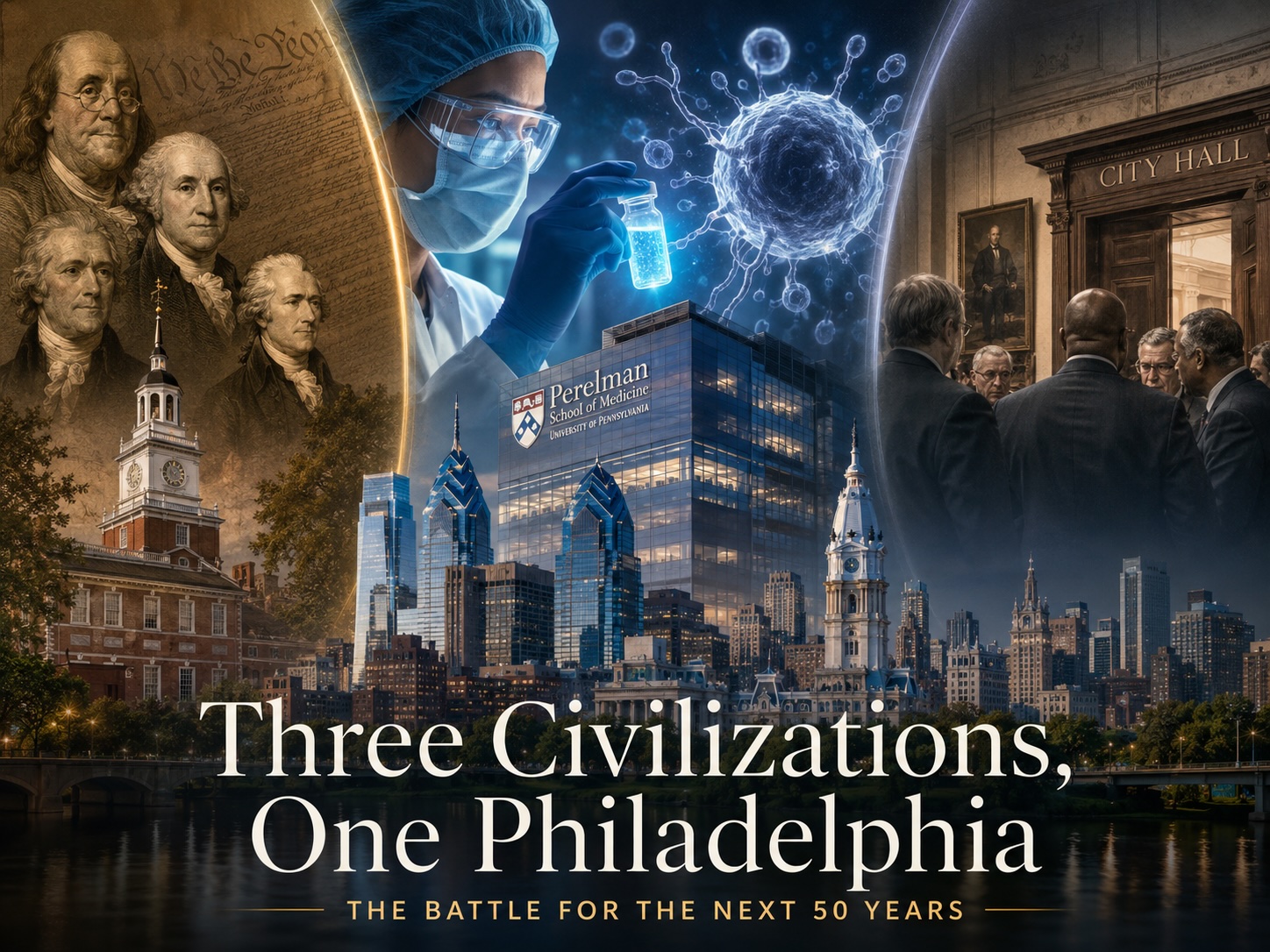
Every city contains multitudes, but Philadelphia contains something more specific: three distinct civilizations, occupying the same geography, drawing from the same history, but pulling the city in incompatible directions. They do not often collide. They barely speak. And the question of which one shapes Philadelphia’s next fifty years is, in the spring of 2026, more open than at any point in recent memory.
Think of them as three concentric rings, not of geography but of orientation. The first faces inward, toward the city’s existing power and patronage. The second faces backward, toward a comfort that technology and time are conspiring to dissolve. The third faces forward, so far forward, in fact, that its inhabitants have largely stopped noticing the city around them. Each of these groups is real. Each has a claim on Philadelphia’s future. And the one with the least civic power may hold the greatest transformative potential this region has ever seen.
Before we get to this present moment, let’s start where Philadelphia itself started: with what happens when exceptional minds congregate in one place and are given time and permission to think.
The original gravity
In 1743, Benjamin Franklin, printer, postmaster, sometime politician, and one of the most restlessly curious minds in the Atlantic world, published a modest proposal for a society devoted to “useful knowledge.” The American Philosophical Society that grew from that proposal became the intellectual center of a revolution. Its membership roll was effectively the founding generation: Washington, Jefferson, Adams, Hamilton, Madison, Paine. Jefferson served as its president for seventeen years, longer than he served as president of the United States.
 Philadelphia was the ideal vessel for this convergence. The largest city in British North America, it sat at the crossroads of colonial commerce. Its Quaker inheritance created a culture of tolerance that permitted heterodox ideas to circulate. And it produced Franklin, the rare figure who was simultaneously scientist, inventor, diplomat, journalist, legislator, and civic entrepreneur, and who understood, better than anyone of his era, that proximity among brilliant people was not incidental to discovery but essential to it.
The Review by Ajay Raju | Breaking: Jefferson and Adams debate 250 on 6ABC’s Inside Story (June 6, 2026)
The words produced in those rooms and taverns have not merely echoed down 250 years, they have structured reality itself. “We hold these truths to be self-evident…” “We the People…” “Congress shall make no law…” These phrases still govern the lives of more than 330 million Americans and inspire democratic aspirations across the world. That is what a genuine intellectual hub produces: not just innovation for its moment, but a structure for the future.
Philadelphia was, in other words, once home to a third civilization of the kind I am describing, the one that faces forward. Back then, it was the dominant force. The insiders and the nostalgists existed then too, but the gravitational pull of the visionaries was strong enough to overcome them, at least for few generations.
Two and a half centuries later, that ratio has, for most of Philadelphia’s modern history, reversed. The last eighty-plus years were dominated by the Insiders. But something is shifting again, at least in one hermetically sealed corner of the city. The dormant third civilization is growing in global prominence, its stories told not in City Hall press releases or ward committee minutes, but in the pages of the most prestigious medical journals in the world.
The discovery
On June 3, 2026, the New England Journal of Medicine published results from a clinical trial led by Dr. Ali Naji, the Jonathan E. Rhoads Professor of Surgery at the University of Pennsylvania’s Perelman School of Medicine. The study reported something that would have seemed like science fiction a decade ago: researchers used CAR T-cell therapy, originally developed at Penn to fight blood cancers, to reset the immune systems of patients so severely sensitized that they had been effectively barred from kidney transplantation, sometimes for years, sometimes forever.
As of December 2025, approximately 94,015 Americans were waiting for a kidney transplant. Of those, roughly 5,000 are classified as “highly sensitized,” patients whose immune systems have developed such overwhelming levels of antibodies against donor tissue that finding a compatible organ approaches statistical impossibility. Eleven people die every day on the kidney transplant waitlist. For the highly sensitized, the odds of dying there are worse.
What Dr. Naji’s team accomplished is extraordinary in its execution. They engineered each patient’s own T-cells to hunt and eliminate the B-cells and plasma cells manufacturing the hostile antibodies, draining the immune barrier that had made transplantation impossible. The result: patients who had been written off by immunological fate became candidates for transplant within months.
For Andrew Boyd, a 48-year-old Frankford resident and call center manager, this was not a statistic. Boyd had received his first kidney transplant at age 14 at the Children’s Hospital of Philadelphia, his second at Penn in 2009. By 2018, his second kidney was failing and his antibody levels had reached nearly 100 percent. Seven years of dialysis followed, three sessions weekly, each one a reminder that another donor match was almost certainly beyond reach.
Beginning in early 2025, Boyd enrolled in the Penn trial. Within weeks of receiving his re-engineered immune cells, his antibody levels began to fall. By August 2025, he received his third kidney. Now more than nine months post-transplant, he is free of the machine and no longer a hostage of dialysis.
This breakthrough did not emerge from nothing. Its genealogy runs through Penn’s foundational immunology work, through the first clinical CAR T trials in adult leukemia patients in 2010, through the pediatric ALL trials at CHOP in 2012, through the August 2017 FDA approval of Kymriah, the first CAR T-cell therapy ever approved, the first gene-transfer therapy authorized in the United States, and the first therapy to receive a unanimous recommendation from the FDA’s Oncologic Drugs Advisory Committee. That was one platform. Dr. Naji asked a different question of the same architecture and opened a door for five thousand people the medical system had quietly given up on.
The Review by Ajay Raju: What President Trump packed for the Beijing Trip (May 24, 2026)
This is the third Philadelphia. Busy, brilliant, largely invisible to the city’s political and civic machinery, and producing work whose consequences will outlast every zoning fight, every ward committee meeting, and every budget cycle currently commanding the city’s attention.
The first Philadelphia: The insiders
Every major American city has a class of civic operators who exist to extract value from political proximity rather than create it. Philadelphia’s version is unusually well-developed, the product of a one-party political culture that has been essentially uncontested for eighty years and has, over that period, refined the art of transactional governance to near-perfect science.
These are not, in the main, villains. They are rational actors operating in a system that rewards loyalty, flexibility, and the willingness to go in whichever direction the prevailing political wind, or the prevailing paymaster, suggests. They populate the ward committees, the activist groups, chambers of commerce, local media, the consulting firms, the lobbying shops, the nonprofit boards that double as political patronage networks. They write the checks to campaigns that write the ordinances that write the rules that govern who gets what in this city. They are engaged, vocal, organized, and entirely comfortable advocating today for positions they opposed yesterday, provided the fee structure warrants it.
The civic fingerprints of this class are visible in the accumulated policy choices that have made Philadelphia systematically less competitive than its intellectual assets warrant. The wage tax, among the highest of any major American city, functions as a quiet surcharge on ambition, a reason why the mobile knowledge and STEM workers seeking a biotech hub live in Montgomery or Chester County rather than Fishtown. The sweetened beverage tax was sold as a public health intervention and became partly a mechanism to fund priorities whose connection to public health was indirect at best. The school system, despite the genuine efforts of people within it, has not been reformed at the speed or scale the city’s poverty concentration demands, in part because the interests that benefit from its current configuration are better organized than the children enrolled in it.
The Review by Ajay Raju: Philadelphia is hosting an Open House in 2026 (May 18, 2026)
The Pew Charitable Trusts’ 2026 State of the City report, released in April, documents the ledger. Philadelphia’s poverty rate has fallen below 20 percent for the first time since 1979, a genuine achievement. But median income growth has stalled. Educational attainment has flatlined at 36.4 percent of adults with college degrees, lagging peer cities. Population continues to decline from its pre-pandemic peak. Unemployment reached 5.1 percent in 2025, the city’s highest since 2021, while the gap between Philadelphia’s rate and the national figure widened.
These insiders are not opposed to the Penn Medicine breakthroughs. They are happy to be photographed near it, to quote it in economic development brochures, to use it in grant applications for life sciences infrastructure. What they are constitutionally unable to do is make the systemic changes, in tax policy, in school governance, in venture capital cultivation, in the relationship between the city’s regulatory environment and its startup culture, that would allow the third Philadelphia to stay and grow here rather than departing for Boston or San Diego after the discovery is made.
Greater Philadelphia’s life sciences sector already encompasses more than 1,200 establishments and employs over 88,000 people across the region, contributing roughly $4.7 billion in direct economic impact. Within the city, the number of workers in biotech has grown eightfold in a decade. In 2025, Philadelphia ranked thirteenth globally in startup ecosystems, a twelve-spot leap. The infrastructure is accumulating. But the region still lacks the deep local venture capital ecosystem that converts laboratory excellence into anchored industry. The first Philadelphia has not been a reliable partner in building that ecosystem. Its investment horizon ends at the next election.
The second Philadelphia: The nostalgists
There is a second group whose relationship to Philadelphia’s future is shaped not by venality but by fear. They are the people for whom the word “disruption” is not a compliment, for whom the accelerating pace of technological change registers as a threat to identity rather than an invitation to reinvention, and for whom Philadelphia’s greatest asset is not its research institutions but its neighborhoods, its character, its analog texture, the corner stores and the rowhomes and the sense that the city has not yet been fully colonized by the forces that have made San Francisco unrecognizable and turned Manhattan into a luxury product.
There is something genuinely valuable in this instinct. Cities that destroy their character in pursuit of their future often discover they have lost both. Philadelphia’s neighborhoods retain a human scale and social density that is increasingly rare in American urban life and genuinely worth preserving. The people who resist thoughtless development, who push back against the displacement of long-established communities, who insist that economic growth must be evaluated by who benefits and who is left behind, are not wrong. They are asking a real question.
But the nostalgist coalition in Philadelphia has, over time, calcified into something more restrictive than a check on reckless development. It has become, in some of its expressions, an active resistance to the future, a determination that the city should remain analog in an increasingly digital world, that the industries of tomorrow should be evaluated primarily through the lens of whether they disturb the industries of yesterday, and that the arrival of knowledge-economy workers and the companies that employ them represents a threat to be managed rather than an opportunity to be captured.
The irony is that the nostalgia is largely misplaced. The Philadelphia the nostalgists wish to preserve, the working-class city of manufacturing jobs and union wages and stable neighborhood institutions, was itself the product of a burst of industrial innovation and capital investment that would, in its time, have alarmed anyone committed to the Philadelphia that preceded it. Every era’s disruption becomes the next era’s tradition. The question is not whether change comes but whether Philadelphia is among the places that shape it or merely receives it.
The fear of AI is the sharpest contemporary expression of this tendency. Artificial intelligence is reorganizing knowledge work at a speed that has no modern precedent, and the disruption it is creating is real and unevenly distributed. But a city that responds to AI by attempting to remain outside its gravitational field is not preserving itself, but ensuring its own peripherality. The researchers at Penn Medicine are not afraid of AI. They are using it. The CAR T-cell therapy platform that just opened the kidney transplant waitlist to a new class of patients is being refined with computational tools that would have been unimaginable to the researchers who pioneered the underlying immunology in the 1990s. The third Philadelphia does not ask whether to engage with the technological future. It IS the technological future.
The third Philadelphia: The future makers
And then there is the third group. They are, in one sense, the easiest to describe and the hardest to find, not because they are hidden but because they are simply elsewhere, inside their work, indifferent to the civic theater unfolding around them.
These are the researchers and founders and engineers and clinicians for whom the future is not an aspiration but a working environment. They are the people reprogramming T-cells and redesigning organ transplantation. They are the synthetic biologists at Penn and CHOP and the Wistar Institute who are building cellular therapies that will, over the next decade, alter the course of oncology, autoimmune disease, and metabolic medicine. They are the founders of the companies that have grown out of that research, the entrepreneurs who built Spark Therapeutics, which became the first company to win FDA approval for a gene therapy treating an inherited condition, and which Roche subsequently acquired for $4.8 billion, the largest venture-backed exit in Philadelphia’s history. They are the next generation now working in the new facilities rising in University City, the 472,000-square-foot 3151 Market tower, the Bellwether District’s 1,300-acre redevelopment of the former refinery site, where TerraPower Isotopes has already committed $450 million.
They have, as a class, almost no civic influence. They are not on any of the region’s Most Powerful or Influential lists. They do not run ward committees. They do not write checks to council campaigns. They are not visible at the civic dinners and the philanthropic galas and the panel discussions that constitute the social metabolism of institutional Philadelphia. They are busy, genuinely, consequentially busy, in the way that people are busy when they are trying to cure something.
This is understandable. It is also, from the perspective of what Philadelphia could be, a kind of tragedy.
Because the history of the great innovation hubs suggests that the translation from intellectual excellence to durable regional prosperity requires the scientists and founders to eventually show up, to bring their credibility and their impatience and their long time horizons into the rooms where civic decisions are made. The Kendall Square story is not simply a story about MIT’s research excellence. It is a story about what happened when enough of the people producing that excellence decided that Boston’s policy environment was their problem too, and engaged with it accordingly. The Research Triangle did not emerge from the universities of North Carolina alone. It emerged when civic and business leaders built the infrastructure to bridge academic discovery and industrial scale, and when the researchers themselves participated in that project.
Philadelphia’s third civilization has, so far, largely declined that participation. One can hardly blame them. The first Philadelphia makes the process of civic engagement feel like a transaction in a language they do not speak, with rules that seem designed to exhaust the patient. The second Philadelphia views their work with a mixture of awe and suspicion, grateful for the Nobel Prizes and the hospital rankings but wary of what comes with the ecosystem that produces them. The path of least resistance is to keep one’s head down, do the science, collect the grants, publish in the journals, and let someone else worry about the wage tax.
The cost of that withdrawal is not borne by the researchers. It is borne by the city. Every major pharmaceutical and biotech company that licenses Penn technology and builds its headquarters in Cambridge or San Diego rather than West Philadelphia represents a permanent transfer of tax base, employment, and civic energy that Philadelphia needed and did not capture. Every talented researcher who trains here and then migrates to a more hospitable innovation environment takes irreplaceable human capital with them. The hub exists. The industrial ecosystem that should surround it, the one that would make the discovery of a CAR T-cell transplant therapy into a permanent Philadelphia industry rather than a glorious scientific achievement in a city still arguing about its beverage tax, that ecosystem is still waiting to be built.
The question
Which of these three Philadelphias will shape the next fifty years?
The honest answer is that all three will, in proportions that are not yet determined and that depend, more than most Philadelphia observers acknowledge, on choices that could still go either way.
The insiders will not disappear. They are more resilient than cockroaches. They never die. But their leverage is not absolute. Cities with comparable concentrations of academic excellence and a first-generation insider class have made the pivot, have found political leadership willing to restructure the tax environment, invest in the school quality that retains talent, and build the public-private partnerships that link research institutions to industrial development. It requires the third civilization to get loud enough, and the political incentives to shift enough, that the first finds it more advantageous to accommodate the future than to obstruct it.
The nostalgists will not disappear either. Their concern for community preservation and equitable growth is, at its best, a necessary corrective to the tendency of innovation ecosystems to create wealth in narrow bands and displace everyone else. The Research Triangle and Kendall Square have both produced their own versions of gentrification and displacement. Philadelphia, given its poverty rate, still nearly one in five residents, even after the remarkable progress of the last decade, with more than 300,000 people living below the poverty threshold, cannot afford to replicate those failures at scale. The question is not whether to preserve community but whether preservation can coexist with the kind of economic transformation the city needs.
And the third Philadelphia? It will keep doing what it does regardless of what the other two decide. That is both its greatest strength and its greatest civic limitation. Andrew Boyd is alive and free of his dialysis machine because Penn Medicine exists in this city and because Dr. Naji and his colleagues asked a question that no one had thought to ask before. That discovery was not contingent on the wage tax being reformed or the ward committees being restructured or the civic culture being aligned. It happened in spite of Philadelphia, not because of it.
But the next ten Boyd stories, and the hundred after that, and the industry that could grow around the platform that made those stories possible, that depends on whether the third Philadelphia eventually decides that the city it inhabits is worth fighting for. Not with the tools of the insiders, not with the transactional vocabulary of the first civilization, but with the same impatient, evidence-driven, long-horizon intelligence that they bring to the science.
Franklin’s genius, after all, was not only that he convened a circle of thinkers in 1743. It was that he refused to treat scientific inquiry and civic engagement as separate vocations. He understood that the gravitational force of brilliant minds in proximity required a political and institutional environment to sustain it, and he built that environment alongside the intellectual work. The Junto and the American Philosophical Society and the Continental Congress were not separate projects. They were the same project, pursued with the same restless, practical intelligence.
Philadelphia is 250 years past the moment when that synthesis last held. The question worth carrying out of the laboratories and the ward meetings and the rowhomes and into the next fifty years is a simple one:
Who will be the next Franklins? And will they have the patience to stay?