



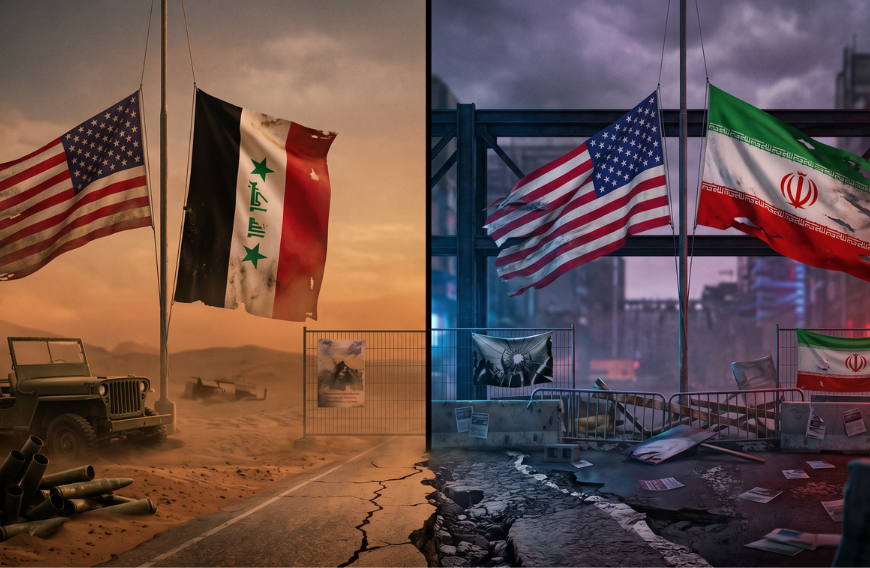
History does not repeat itself, the old line goes, but it rhymes. America has now fought two defining conflicts in the Persian Gulf across the span of a single generation, and has arrived at profoundly different places each time. Not merely different outcomes, but different Americas: different in their unity, their clarity of purpose, their ability to recognize victory when it came, and their willingness to agree on what they were watching.

The first Gulf War, launched in January 1991, was a phenomenon almost without precedent in modern military history: brief, decisive, internationally sanctioned, domestically supported, and visible on television in real time as it unfolded. The Iran conflict of 2026, prosecuted under the banner of Operation Epic Fury, has been almost its photographic negative: prolonged, contested, domestically divisive, its objectives debated before the first bomb fell and disputed long after the last ceasefire was signed. The distance between these two American moments is long, warfare has changed, our democracy’s capacity for shared perception has fractured and citizens can no longer agree on what they are seeing, even when they are watching the same event.
Justifications
Wars are fought on battlefields, but are first constructed in the realm of argument, in the halls of legislatures, the chambers of international institutions, the living rooms where ordinary citizens decide whether they believe the government that is asking them to send their children into harm’s way.
In 1990 and 1991, George Herbert Walker Bush assembled the case for war with patience and multilateral discipline. When Iraq invaded Kuwait on August 2, 1990, the international response was swift and the condemnation immediate. Bush worked the phones personally, building relationships with foreign leaders one call at a time, persuading the Soviet Union, Arab states, and European allies to align behind a common position. By January 1991, coalition forces prepared to face off against Iraq numbered some 750,000, including 540,000 U.S. personnel and smaller forces from Britain, France, Germany, the Soviet Union, Japan, Egypt, and Saudi Arabia, among others. The United Nations Security Council authorized the use of “all necessary means.” The legal architecture was solid; the moral case was nearly airtight; and then, crucially, Bush went to Congress.
He requested a congressional joint resolution on January 8, 1991, one week before the UN deadline. The debate was real and the outcome uncertain. The votes were 52-47 in the Senate and 250-183 in the House, the closest margins in authorizing military force since the War of 1812. Members of Congress invoked Vietnam explicitly, with some saying openly on the House floor that they feared another Gulf of Tonkin. The authorization passed, but it passed through genuine deliberation, not acclamation. That process, contentious, democratic, ultimately legitimate, gave the war a foundation that no subsequent controversy could easily destabilize.
The Iran conflict of 2026 was built on different terrain. Operation Epic Fury launched on February 28, 2026, without a formal congressional declaration of war, framed instead as an extension of executive authority and collective self-defense. The stated U.S. objectives were to destroy Iranian offensive missiles, eliminate Iran’s missile production capacity, destroy its navy and security infrastructure, and ensure Iran would never have nuclear weapons. These were real objectives. But they were also contested: contested in their legal basis, their strategic logic, and their factual premises. As recently as March 2025, the U.S. intelligence community had assessed that Iran was not building a nuclear weapon and that Supreme Leader Khamenei had not reauthorized the program he suspended in 2003, an assessment the President publicly rejected. The war began, in other words, with the executive branch at open war not only with Iran but with its own intelligence apparatus over the factual justification for the conflict.
READ: The Review by Ajay Raju | The Long Gaze: From Paris to NY to Bombay (June 19, 2026)
One war was built on a visible act of aggression that the world could see and name. The other was built on a contested threat assessment about a capability that did not yet exist. That difference in foundation shaped everything that followed.
A nation watching together, and then one that wasn’t
In January 1991, something remarkable happened in the American living room. As missiles streaked across Baghdad, millions of people around the world watched the First Gulf War unfold live, in real time, the first conflict projected through a cable news network as it happened. The so-called CNN Effect was born in those hours: the discovery that real-time media could transmit shared national experience across geography and class and partisan division, gathering the country around a single set of images and a single unfolding story.
Gallup polling found that 79% of Americans approved of the decision to go to war with Iraq on the opening night of the air campaign. That number reflects something about the quality of shared perception that existed in 1991, a country that could disagree about the wisdom of going to war before it started and then watch the outcome together and reach something close to consensus about what they saw. When Kuwait City was liberated in four days, when an estimated 8,000 to 10,000 Iraqi forces were killed against 300 coalition dead, when the fearsome fourth-largest army in the world surrendered in numbers so large that coalition forces struggled to process the prisoners, Americans saw it. Together. On the same screens. And they understood it.
The Iran conflict of 2026 produced no such collective moment. A University of Maryland Critical Issues Poll fielded in early February 2026 found that only 21% of Americans favored initiating an attack on Iran, while 49% opposed it. After the strikes commenced, majorities continued to say that using military force had been the wrong decision and disapproved of President Trump’s handling of the conflict. Thirty-four percent of Americans supported the war; 53% opposed it. Nearly all Democrats opposed it (84%), as did a majority of Independents (57%). Republicans supported it at 67%.
These numbers are a portrait of political polarization. They are also a portrait of epistemic fracture, of a country that can no longer agree on what is happening, even when it is happening in public. More than half the American public, including 87% of Democrats and 58% of Independents, did not believe the Trump administration was disseminating accurate information about the war in Iran. Official declarations of obliteration competed with leaked intelligence assessments of marginal damage. The President attacked unfavorable reporting as enemy propaganda. The shared screen that gave 1991 its coherence was gone, replaced by fractured information ecosystems where Americans watched entirely different versions of the same conflict and arrived at entirely different conclusions about its meaning.
What changed? Partisan politics? Common factual starting point from which to disagree? In 1991, Americans could argue about whether the war was wise. In 2026, they could not agree on whether it was working, whether its stated rationale was true, or whether the information they were receiving bore any relationship to reality.
The shape of the enemy
Wars acquire their moral texture from the nature of the enemy and the clarity of the wrong being addressed. Not every conflict presents the same quality of justification, and the difference matters enormously, not only to international coalitions, but to the domestic consensus required to sustain a long campaign.
Iraq’s invasion of Kuwait was, in the language of international law, a textbook act of aggression. Iraq invaded and occupied Kuwait within two days, annexing its territories. The moral simplicity was rare and genuine: a stronger nation had swallowed a smaller one in broad daylight, in violation of every norm of the international order, for the frank purpose of seizing its oil and canceling its debts. Saddam effectively had no allies, facing a strong U.S.-led coalition that included most major Arab powers. Even his attempt to fracture that coalition, firing Scud missiles at Israel to provoke retaliation that would force Arab states to choose between their anti-Israel convictions and their anti-Iraq alliance, failed. Israel held its fire under American pressure, the coalition held together, and the war was prosecuted on the terms the coalition had set.
This moral clarity produced a coalition of remarkable breadth. The alliance eventually encompassed figures from roughly 30 to more than 40 nations, including Arab armies standing alongside Western ones, Cold War adversaries briefly aligned around a common purpose, the United Nations functioning as it was theoretically designed to function. Saudi Arabia. Egypt. Syria. France. The United Kingdom. The Soviet Union. The shared enemy was obvious; the shared objective was binary; the shared wrong was visible. You did not need to make an elaborate argument for why Iraq should leave Kuwait. You needed only to point to the fact of the occupation.
Iran presented no such moral legibility. Its offenses, genuine and serious, were diffuse, deniable, and distributed across decades and proxies. The sponsorship of Hezbollah, Hamas, and the Houthis; the patient accumulation of nuclear enrichment capability; the sustained architecture of regional destabilization conducted through instruments Iran could always claim to only partially control constituted a genuine threat to the regional order and to American interests. But a genuine threat is not the same as a visible act of aggression, and the distance between those two things proved vast when it came to building the international architecture that Desert Storm had rested upon.
READ: The Review by Ajay Raju | 28-3 & 29 Points: The Greatest Comebacks (June 14, 2026)
The 2026 conflict extended its geographic footprint to seven countries within forty-eight hours. Bahrain, Jordan, Kuwait, Qatar, Saudi Arabia, the UAE, and Iraq were all struck by Iranian retaliatory fire. America’s Gulf allies found themselves absorbing punishment from a war they had not chosen and could not halt, a coalition, this time, of victims rather than partners. A majority of Americans came to believe the Iran war served Israel’s interests more than America’s. You cannot sustain a thirty-four-nation alliance on a premise that more than half your own citizens reject.
Chessboard has more pieces
Desert Storm’s strategic elegance rested on a feature of Iraq’s situation that Saddam Hussein could never have escaped: he had nowhere to spread the cost. His army was isolated in Kuwait and southern Iraq. His air force was grounded or destroyed within days. His one diplomatic card, firing missiles at Israel, failed. When the ground war came, the coalition lost 247 battle deaths against an enemy that had promised a war of annihilation. The prediction of mass casualties simply did not materialize, because the asymmetry of preparation and technology and coalition coherence was total.
Iran is a fundamentally different strategic problem, and it has spent thirty-five years understanding exactly how different it needs to be.
Its most important weapon is not a missile, but geography. The Strait of Hormuz, twenty-one miles wide at its navigable channel, connecting the Persian Gulf to the Gulf of Oman, is among the most consequential corridors on the surface of the planet. In 2024, approximately 20 million barrels of oil per day moved through the Strait, roughly 27% of all global maritime oil trade and approximately 20% of world petroleum consumption. Qatar and the UAE’s liquefied natural gas exports, representing nearly 20% of global LNG trade, also transit the Strait, with no alternative export routes available.
The Strait’s closure represents a supply disruption three to five times larger than the most severe previous geopolitical oil shocks in living memory: the Yom Kippur War of 1973, the Iranian Revolution of 1979, the Iran-Iraq War of 1980, and the Gulf War of 1990 combined. This is the first time in history the Strait has actually been closed. The International Energy Agency’s director called it “the greatest global energy security challenge in history.”
Brent crude surged 10 to 13% to around $80 to $82 per barrel by early March 2026. Iran’s closure disrupted 20% of global oil supplies simultaneously with significant LNG volumes. By June 2026, 64% of Americans reported that rising gas prices had materially affected their household finances, and 86% attributed the increases directly to the Iran conflict. The IRGC even established what it called the “Persian Gulf Strait Authority,” demanding per-vessel transit fees of up to $2 million, payable in Chinese yuan, Bitcoin, or cryptocurrency, a nation under sustained military assault transforming its geographic leverage into a toll regime on the global economy.
Beyond the Strait, Iran’s proxy architecture spread the cost of the war across the region with a deliberateness that no one should have found surprising. The Fifth Fleet headquarters in Bahrain sustained damage. American bases across sixteen sites in seven countries were hit, the majority of U.S. positions in the Middle East, with equipment losses estimated at $2.3 to $2.8 billion. Total infrastructure repair costs exceeded $5 billion. By May 2026, the Pentagon’s direct war costs had reached $29 billion, with a further $200 billion requested.
Iraq in 1991 could not make the war cost the world. Iran in 2026 made that its opening move.
Proving a negative
There is a reason Desert Storm endures in American memory with a quality of satisfaction that is genuinely rare in the history of war. It had a photographable objective. The liberation of Kuwait City is a fact you can film. The columns of surrendering Iraqi soldiers are images you can broadcast. Three thousand Iraqi tanks destroyed, 1,856 armored vehicles, 2,140 artillery pieces captured or eliminated are numbers that constitute a ledger, a visible accounting of what was done and what it cost. When the war ended, Americans could look at the screen and understand, without elaborate argument, that something had been accomplished. The wrong had been reversed. The occupied nation was free.
The Iran conflict aspired to a different kind of victory, and that difference is at the philosophical heart of everything that makes it so difficult to evaluate, sell, or conclude.
Iran did not possess a nuclear weapon. The IAEA had nonetheless assessed that Iran had stockpiled sufficient uranium to construct nine nuclear bombs. This is the paradox the conflict tried to resolve through force: not an existing weapon, not an active program confirmed by American intelligence, but a latent capability, the proximity of a possibility. Operation Midnight Hammer, in June 2025, struck Fordow, Natanz, and Isfahan with fourteen GBU-57 Massive Ordnance Penetrator bunker-busters and more than two dozen Tomahawk cruise missiles. Defense Secretary Hegseth declared Iran’s nuclear ambitions “obliterated.” Pentagon spokesmen said the strikes had degraded Iran’s program by one to two years. The Defense Intelligence Agency’s classified assessment, leaked to CNN and The New York Times, concluded the bombs had set Iran back by only a few months. The fate of over 400 kilograms of uranium enriched to 60% purity remained unresolved.
A congressional hearing surfaced what was, at its core, an unanswerable logical contradiction: the Trump administration had praised Operation Midnight Hammer as a decisive success, then entered a second, larger war against Iran to eliminate nuclear capabilities that the first war had supposedly already eliminated. The argument ate itself. And yet the war continued.
READ: The Review by Ajay Raju | Ask not what I can do. Tell me what you can do for me. (March 30, 2026)
A classified intelligence assessment found the nuclear strikes had set Iran’s program back by less than six months rather than eliminating it. Iran maintains approximately 30 underground missile facilities buried 400 to 1,500 feet deep in the Zagros and Alborz mountain ranges, connected by over 100 tunnel systems. You can destroy a centrifuge. You cannot destroy the physics that underlies it, or the institutional knowledge of the engineers who designed it, or the geopolitical motivation that drove its construction in the first place.
The consensus of CSIS, the Council on Foreign Relations, and the Soufan Centre is that the United States achieved tactical damage but could not reach underground infrastructure, eliminate the Strait threat, or produce the political outcome it sought. Trump claimed victory several times, falsely asserting that Iran had “nothing left in a military sense” and that the U.S. had brought about regime change, despite the fact that the Islamic Republic remained in power. Succession protocols after Khamenei’s assassination produced a more hard-line successor leadership drawn entirely from the IRGC. The regime did not fall, but it hardened.
By June 2026, only 25% of Americans said the conflict had been worth it. The memorandum of understanding, signed remotely, Trump at Versailles during a G7 dinner with Emmanuel Macron, Iran’s president in Tehran, brought a nominal close to the hostilities. What it could not bring was the visible, verifiable, photographable proof that the nuclear threat had been eliminated. That proof, by its nature, cannot exist. You cannot display, on a press briefing table, the weapon that was never assembled. You cannot broadcast the liberation of a city that was never occupied. You cannot point a laser at a map and show the American people the endpoint, because the endpoint of a war fought against a latent capability is not a place. It is a silence, an ongoing, anxious, unverifiable silence.
Last word
There is a strand of thought, not entirely wrong, that suggests the comparison is unfair, that nuclear proliferation is genuinely more dangerous than territorial aggression, that the threat Iran posed was real even if diffuse, and that the asymmetry of potential harm justifies a more preemptive and ambiguous military posture than the one available to George H.W. Bush in 1991. That argument deserves engagement rather than dismissal. The world of 2026 is not the world of 1991. The threats are more distributed, the weapons more terrible, and the geography of danger more complex.
But the argument cuts both ways. If the threat is genuinely diffuse and the victory genuinely unverifiable, then the democratic architecture required to sustain the war effort must be that much stronger, built on wider consensus, clearer shared understanding, and more transparent accounting of what is being attempted and at what cost. You cannot wage an open-ended war against a negative, against the non-existence of a capability, the permanent suppression of a possibility, without an extraordinary degree of national trust and institutional credibility. And trust, like nuclear material, is not reconstructed quickly once it has been dispersed.
Desert Storm succeeded not only because the military campaign was brilliant. It succeeded because the political architecture that surrounded it was equally disciplined, the patient coalition-building, the UN authorization, the congressional debate, the clear and bounded objective, the willingness to declare the mission complete when Kuwait was liberated and go home. That restraint, knowing what you are trying to do, knowing when you have done it, and having the institutional honesty to stop, is not a military virtue, but a democratic one.
The hardest wars are not the ones where the enemy is visible. They are the ones where victory, even if it comes, cannot be photographed, where the nation that fought the war must simply trust, without verification, that the silence that follows was purchased at a price that was worth paying.
Whether that silence holds, and whether that price was justified, are questions that the Iran conflict of 2026 will leave open long after the last ceasefire communiqué is filed and the last barrel of Hormuz oil resumes its journey east. History will have its opinion in time. For now, the two wars stand side by side in the American memory, one clean and conclusive, one vast and unresolved, like a sentence that knew exactly how to end, and a question that is still waiting, restlessly, for its answer.