



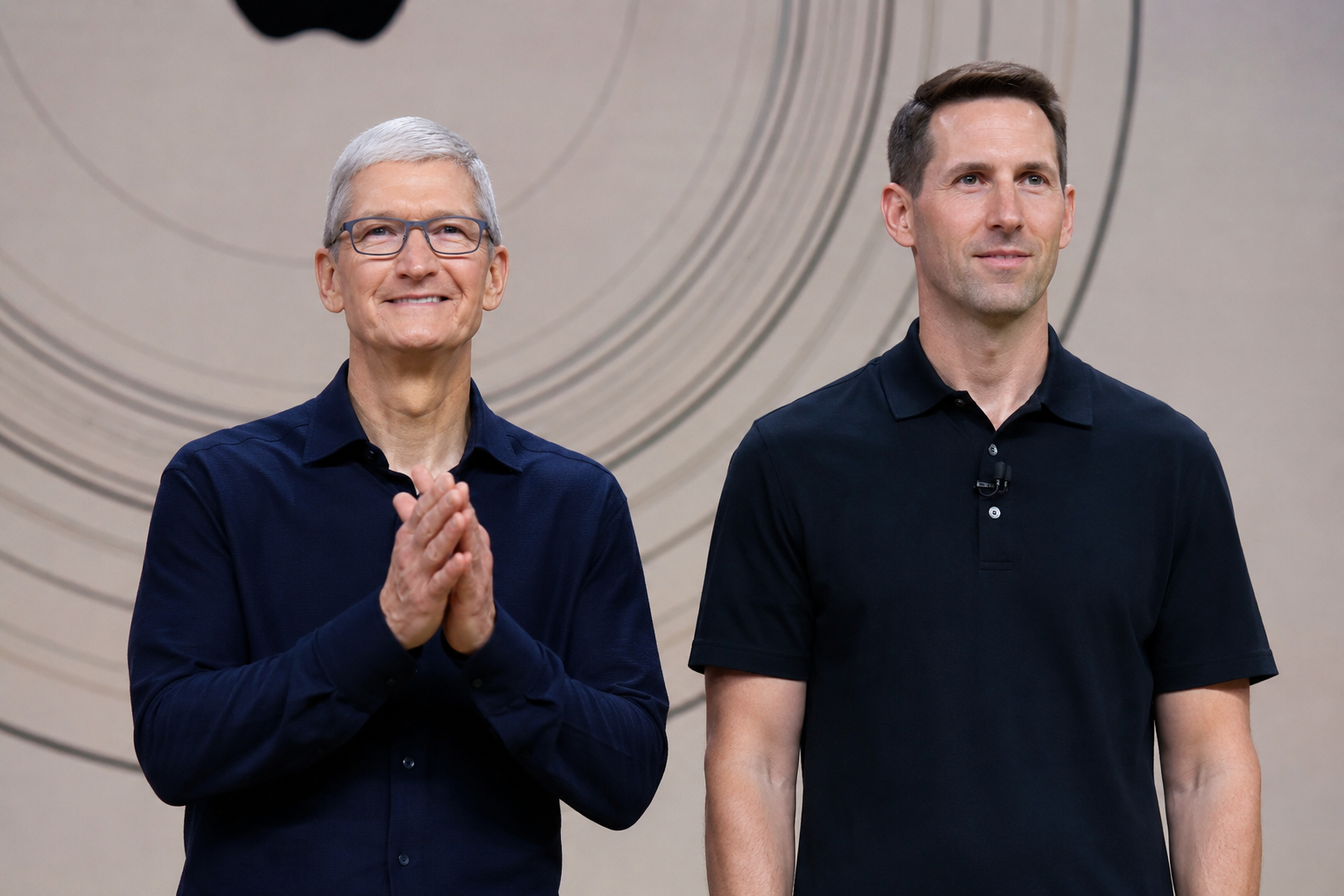
Apple CEO Tim Cook is stepping down after nearly 15 years at the helm, handing leadership of the technology giant to longtime hardware executive John Ternus as the company enters a critical new era focused on artificial intelligence.
Cook, who succeeded Apple co-founder Steve Jobs in 2011, leaves behind one of the most significant transformations in the history of corporate technology. Under his leadership, Apple expanded from a company valued at roughly $350 billion when he became CEO into the world’s most valuable technology companies, reaching multi-trillion-dollar valuations.
Apple’s leadership transition takes effect September 1, when Ternus, the company’s senior vice president of Hardware Engineering, becomes CEO. Cook will move into the role of executive chairman of Apple’s board. The company said the succession was the result of long-term planning and was unanimously approved by its board.
Cook’s tenure was defined less by the dramatic product launches associated with Jobs and more by operational discipline, supply-chain management, services growth and the expansion of Apple’s ecosystem.
When Cook took over, Apple was still heavily identified with the iPhone and the legacy of Jobs. During his tenure, the company expanded its services business, strengthened its wearable products and continued developing its own silicon and hardware capabilities.
READ: Who is John Ternus? Apple’s next CEO in 2026 (April 20, 2026)
Apple became the first publicly traded U.S. company to reach a $1 trillion market capitalization in 2018. It subsequently crossed the $2 trillion and $3 trillion thresholds, reflecting the scale of the business Cook helped build.
The transition comes as Apple faces a different technological challenge: artificial intelligence.
While rivals including Microsoft, Google, Meta and emerging AI companies have invested aggressively in generative AI, Apple has taken a comparatively measured approach. That has increased pressure on the company to demonstrate that its hardware and software ecosystem can remain competitive as AI becomes a central part of consumer technology.
Ternus enters the CEO role with a background that is closely tied to Apple’s products. He joined Apple in 2001 and has held senior hardware responsibilities across products including the iPad, Mac, AirPods and iPhone. He became senior vice president of Hardware Engineering in 2021.
His appointment therefore represents continuity, but it also allows Apple to put greater emphasis on product development as it confronts the AI race.
READ: Tim Cook: Legacy of simplicity (April 22, 2026)
The timing is significant. Apple recently unveiled upgraded Mac mini and Mac Studio computers powered by newer chips designed to handle increasingly demanding AI workloads, underscoring the importance of on-device computing and custom silicon to the company’s strategy.
For Cook, the transition marks the end of an era that saw Apple evolve from a consumer electronics company into a vast ecosystem spanning devices, services, chips, payments and digital content.
For Ternus, the challenge is different. He inherits a company with enormous financial strength and a loyal global customer base, but also one facing questions about whether it can move quickly enough in artificial intelligence.
The next phase of Apple’s growth will therefore test whether the operational model Cook built can be combined with the product and engineering focus his successor is expected to bring.
Cook’s tenure helped make Apple a multi-trillion-dollar company. Ternus now has to determine what comes next.