



For most investors, a market idea begins as a thought.
It could be a hunch that a company’s new CEO might affect its stock price, a belief that an earnings surprise could trigger a predictable move, or a theory that investor sentiment on social media might signal where the market is headed next.
Turning that thought into something that can actually be tested, however, is a very different story.
Data has to be found and cleaned. Different sources have to be connected. A backtest has to be written. The strategy has to be checked for biases. And if the investor wants to take the idea into the live market, an entirely different set of systems often has to be built.
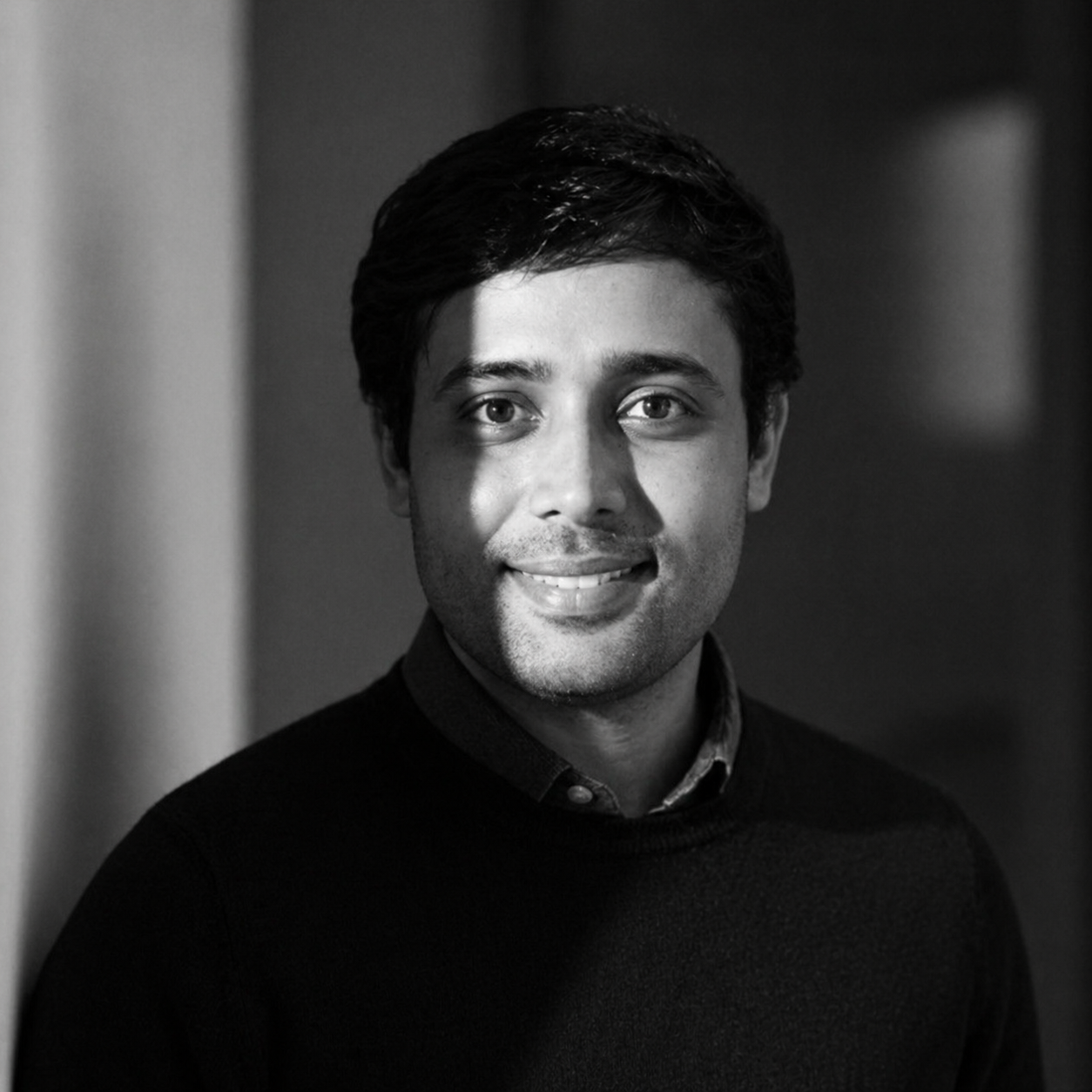
Indian American entrepreneur Ramakant Yadav believes that gap is one of the biggest opportunities for artificial intelligence in finance.
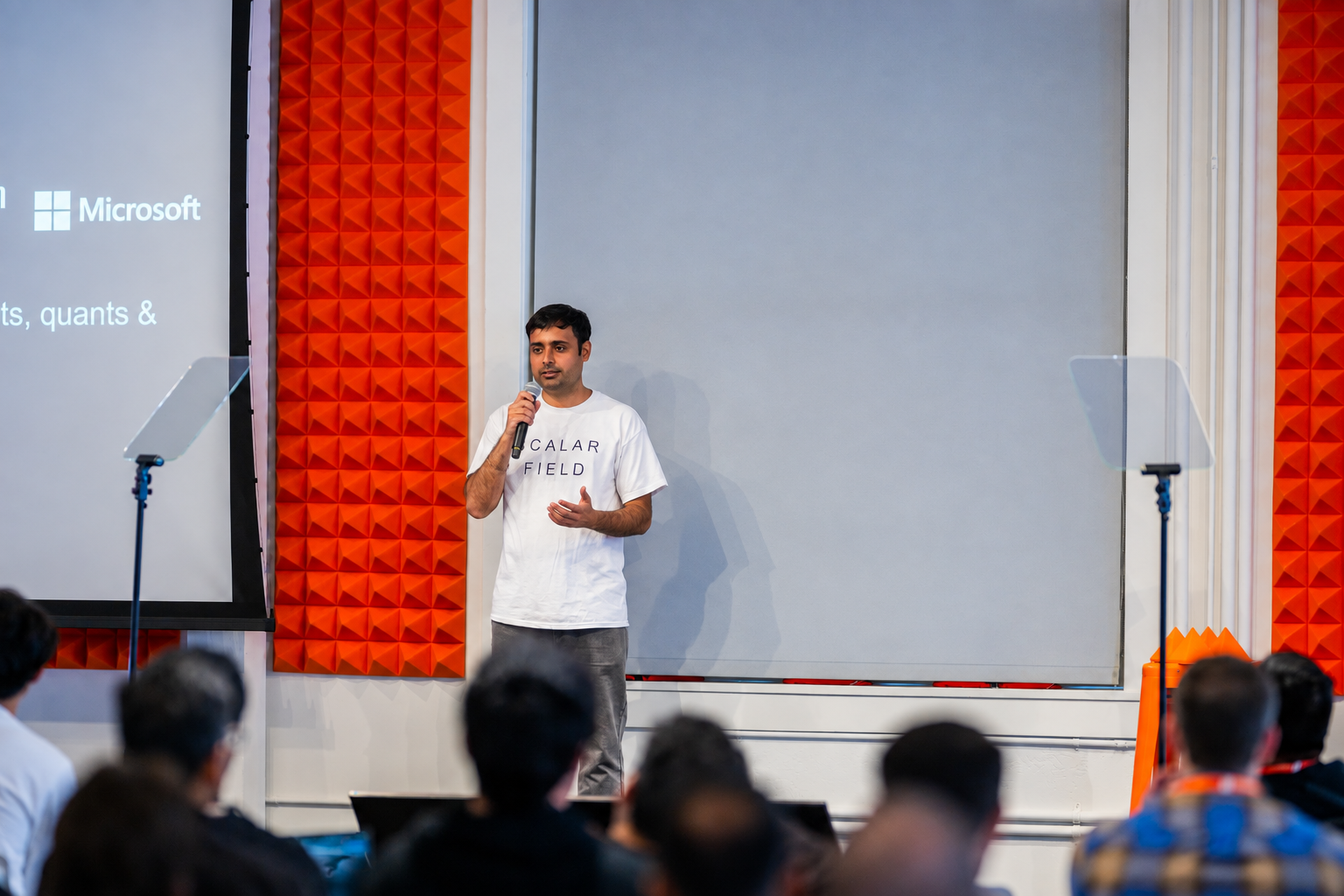
Speaking exclusively to The American Bazaar, Yadav, co-founder of Scalar Field, described his vision for what he calls an “agentic trading desk,” where an investment idea written in ordinary English can move through research, backtesting and live execution on a single platform.
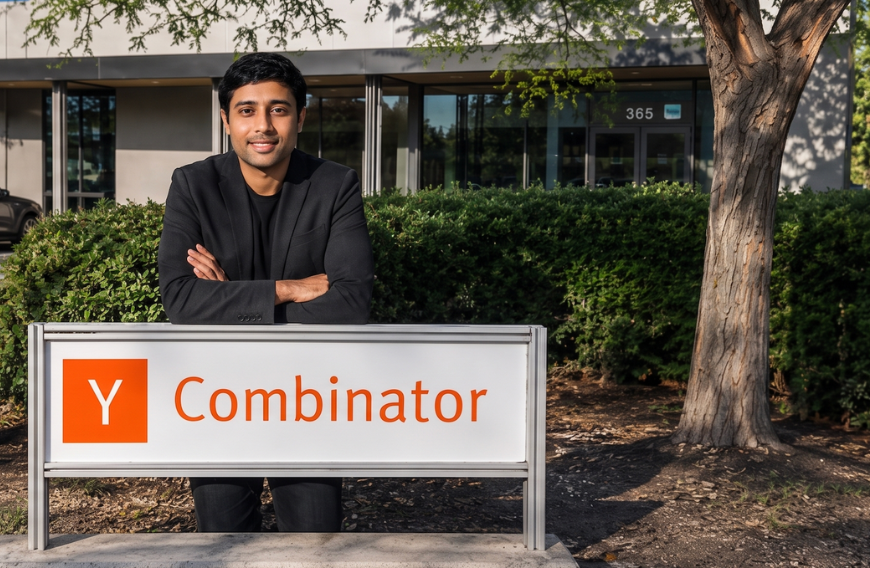
Scalar Field, part of Y Combinator’s Spring 2025 batch, was founded by Yadav and Amandeep Singh, a former trader at Tower Research and Goldman Sachs.
Yadav brings a background in software engineering, machine learning and technology leadership to the company. An alumnus of IIT Patna and IIM Bangalore, he began his career at Microsoft before moving into machine learning roles and later leading technology at a consumer research technology company.
His career, he says, has largely revolved around turning information into decisions.
“I have spent my whole career building systems that turn information into decisions,” Yadav told The American Bazaar.
That experience eventually collided with his interest in financial markets.
Yadav says he never had a shortage of investment ideas. The challenge was determining whether those ideas actually worked.
“Every idea immediately became an engineering project,” he said, describing the process of finding datasets, understanding their schemas, cleaning them, connecting different sources, writing a backtest and making sure the strategy had not introduced look-ahead bias.
READ: How India built a new model for robotic surgery: Insights from Dr. Mahendra Bhandari and Siddharth Siva (September 2, 2026)
The problem became even larger when an investor wanted to move from research to live trading.
“If you had another idea the next day, you effectively started again,” Yadav said.
That frustration led to a more fundamental realization.
“At some point I realized the problem was not that people lack investment ideas. The problem is that the distance between ‘I wonder if this is true’ and ‘I have actually tested this’ is absurdly large, and with modern AI that distance should be close to zero,” he said.
Yadav’s co-founder approached the same problem from the trading side. Singh had worked at Tower Research and Goldman Sachs, giving him experience inside professional trading environments where research, technology and execution operate as interconnected systems.
The founders saw a market where the pieces already existed, but were separated across different tools.
“Data lives in one place, research in another, backtesting in a third, execution in a fourth, and a person is expected to stitch it all together with their own hours and attention,” Yadav said.
Scalar Field was built to eliminate those gaps.
The premise is straightforward. Instead of starting with code, a user starts with an idea.
The platform’s agent can research the thesis, test whether it has historically worked and turn the resulting strategy into something that can operate in the market.
“For years, acting on a market idea meant you knew how to code, or you knew how to trade, or you paid someone who did. That was the gate. We removed it,” Yadav said.
He believes the change could alter what is required to participate in systematic investing.
“The scarce skill is no longer Python or a terminal. It is asking a sharp question,” he said.
That shift is already visible in some of the strategies users have built on the platform.
Yadav pointed to one strategy that takes a position whenever a U.S.-listed company replaces its CEO with an India-born CEO. Another mirrors Jane Street’s top 20 public holdings and updates itself when a new 13F filing becomes available.
Other strategies monitor the posts of a particular investor and turn recommendations into a portfolio. Some focus on companies increasing AI-related capital expenditure, following spending on data centers, chips and other infrastructure.
For Yadav, the significance of these experiments is not necessarily whether every strategy succeeds.
It is that people without traditional quantitative backgrounds can test their own hypotheses.
“None of that needed a quant team. It needed a question,” he said.
But Scalar Field’s vision goes beyond making financial research easier.
Yadav believes AI agents could eventually become meaningful participants in financial markets themselves.
Markets have already experienced major technological shifts. Electronic trading transformed how orders were placed and processed, while high-frequency trading introduced another generation of automated market participants.
Yadav sees AI agents as the next step.
“Agents are the next arrival, and I think within a few years they will be significant participants,” he said.
The resulting change, he argues, could be less about eliminating the human from investing and more about changing the human’s position in the process.
“The human moves up the stack, from clicking buttons to setting intent,” Yadav said.
Under that model, a person defines the investment thesis, risk limits, capital allocation and boundaries within which an agent can operate. The agent handles the continuous monitoring and execution.
“I sometimes say that a sentence is now a mandate,” Yadav said.
But the increased autonomy of AI does not, in his view, mean responsibility disappears.
“Accountability does not move, though. The human sets the mandate and the human owns the outcome,” he said.
That distinction becomes particularly important when AI systems are connected directly to financial markets.
READ: For Shashikant Gupta, philanthropy is about helping people stand on their own feet (August 21, 2026)
Yadav says one of the most important architectural decisions at Scalar Field was determining exactly where AI should make decisions and where conventional software should take over.
A typical AI agent might call a language model every time an event occurs, ask it to reason and then execute an action.
That approach, Yadav argues, does not work for trading.
“Model calls are slow and expensive, and you cannot ask a language model for an opinion every time a price ticks,” he said.
Scalar Field instead separates the reasoning layer from the execution layer.
The AI handles tasks where interpretation matters, including reading filings, parsing news, researching a thesis and developing or revising a strategy.
That reasoning is then compiled into a deterministic, event-driven system capable of monitoring markets and executing trades without putting a language model in the critical path.
According to Yadav, the system can operate at roughly 300 milliseconds from an event to a trade. Risk checks, position limits and order handling are handled by deterministic software.
“The short version is that the agent thinks slowly and acts fast, and it is never allowed to improvise at the moment of execution,” Yadav said.
The company is also working on another piece of the agentic trading puzzle: memory.
For a trading agent, Yadav describes memory as persistent state rather than an autonomous system that mysteriously becomes smarter overnight.
An agent can retain its research, previous hypotheses, portfolio history, positions, rebalancing activity and the market conditions surrounding its decisions.
It can also preserve a record of its actions and reasoning.
“I want to be honest about the limits, because there is a lot of loose talk in this space,” Yadav said.
“This is not a system mystically improving itself overnight. It is accumulated, structured context that compounds, the way a diligent analyst’s notebooks compound.”
The difference, he said, is that the agent can retain that information and revisit it when evaluating a strategy again.
Scalar Field’s ambitions have also been shaped by its experience with Y Combinator.
The company went through Y Combinator’s Spring 2025 batch at a time when the idea of AI agents moving from assistants to active participants in financial markets was still emerging.
For Yadav, early investors needed to believe in that thesis before it became mainstream.
“Conviction on the thesis before it was consensus,” he said.
He also sees Y Combinator’s value in its proximity to the broader AI ecosystem.
“YC puts you next to the people building the rest of the agent ecosystem, models, infrastructure, tooling, at the exact moment those pieces are being invented,” Yadav said.
Yadav declined to discuss specific fundraising details but said Scalar Field is focused on expanding its execution capabilities, data coverage and trading venues while continuing to strengthen the risk and safety systems surrounding live agents.
The platform already supports U.S. equities and options, prediction markets and on-chain assets, while crypto perpetuals are in development, according to Yadav.
But the bigger ambition is not simply to give investors AI-powered tools.
It is to create what Yadav calls agentic portfolios.
Today, investors can select individual stocks or buy static ETFs. Yadav believes AI could introduce another model: portfolios built around a person’s specific investment thesis and continuously managed by an agent within defined limits.
“Agentic portfolios are the destination,” he said.
READ: A 15-minute call changed everything: Indian immigrant’s US layoff inspired debut novel ‘Rerouted’ (August 17, 2026)
For Yadav, such a portfolio would be more than a collection of securities. It would be a continuously evolving expression of an investment belief.
“I think there is a third thing coming, a portfolio that is a living expression of a belief, managed continuously by an agent, and I want Scalar Field to be where those are built,” he said.
That vision also reflects how dramatically Yadav’s own career has changed.
He began by writing software inside an established technology company. Now he is trying to build financial infrastructure for a market participant that, until recently, did not exist.
“I started my career writing software inside someone else’s platform at Microsoft,” Yadav said. “Two decades later I am building market infrastructure that did not exist, for a kind of market participant that did not exist.”
The ultimate test, he says, will be whether ordinary investors can take an idea they have been carrying in their heads and turn it into a responsibly managed portfolio without needing an entire technical or quantitative team behind them.
“If in a few years an ordinary person’s idea can become a responsibly managed, fully accountable portfolio because of rails we laid, I will consider that a career well spent,” Yadav said.
“And we are just getting started.”