



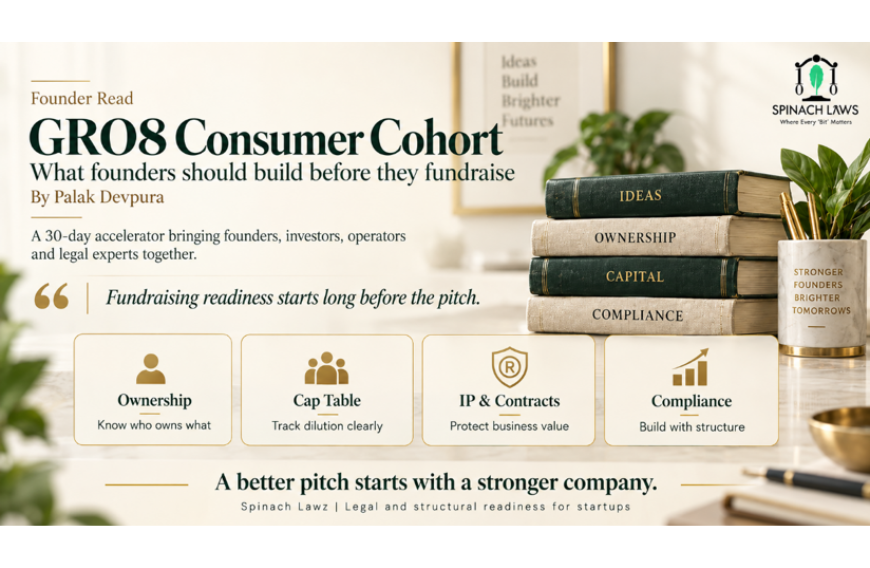
By Palak Devpura
On Aug. 19, GRO8 Ventures, 888vc, Spinach Lawz and Inflection Point Ventures came together to launch the GRO8 Consumer Cohort, a 30-day accelerator for consumer and consumer-tech startups preparing to scale.
The program runs until Sept. 19, with Demo Day scheduled for Sept. 26 in Mumbai. It brings founders into the same room as operators, investors, legal advisers, finance professionals and growth specialists.
What makes the cohort useful is not simply the number of partners involved. It is the way different parts of company-building are being brought together.
GRO8 contributes the accelerator platform and operator network. 888vc brings the investment perspective. Inflection Point Ventures adds fundraising and investor access. Spinach Lawz contributes the legal and structural readiness that becomes increasingly important as a startup grows.
For founders, there is a larger lesson here.
READ: Cognition raises $2 billion as AI coding startup hits $48 billion valuation (September 9, 2026)
Fundraising readiness is not a separate phase of company-building. It is a result of how the company has been built from the beginning.
A founder can have a strong product, growing revenue and a convincing story, but once serious investor conversations begin, the questions change.
Who owns the intellectual property? Is the cap table accurate? Are founder rights documented? Are equity promises to employees properly structured? Do customer and vendor contracts protect the business? Is compliance being maintained?
These are not merely legal questions. They are questions about whether the company is becoming dependable.
That is one area where Spinach Lawz’s role in the cohort is particularly relevant. The objective is not to make startups more document-heavy. It is to help founders understand which decisions need clarity before they become expensive to fix.
There are a few lessons founders can take from this.
First, do not wait for due diligence to discover your own company. A founder should know exactly how ownership, IP, contracts and compliance are structured before an investor starts asking.
Second, growth without structure can create hidden risk. A startup may scale customers and revenue quickly, but unclear contracts, informal founder arrangements or poorly documented equity can become serious issues later.
Third, treat your cap table as a strategic document. Every issuance, ESOP grant and dilution decision affects future fundraising and control.
READ: Ekal Dallas raises $222,000 to support rural, tribal communities in India (August 31, 2026)
Fourth, protect the assets that create the company’s value. For a technology startup, that may be intellectual property. For a consumer business, it could also include trademarks, distribution arrangements, manufacturing contracts, customer data or brand rights.
Finally, founders should learn to think beyond the next round.
The strongest companies do not prepare only for the investor they are meeting today. They create systems that can support the next employee, customer, market and financing round.
That is perhaps the most useful lesson from an accelerator like GRO8.
The goal should not simply be to produce a better pitch.
It should be to help founders build a company that is easier to understand, easier to trust and ultimately easier to invest in.