



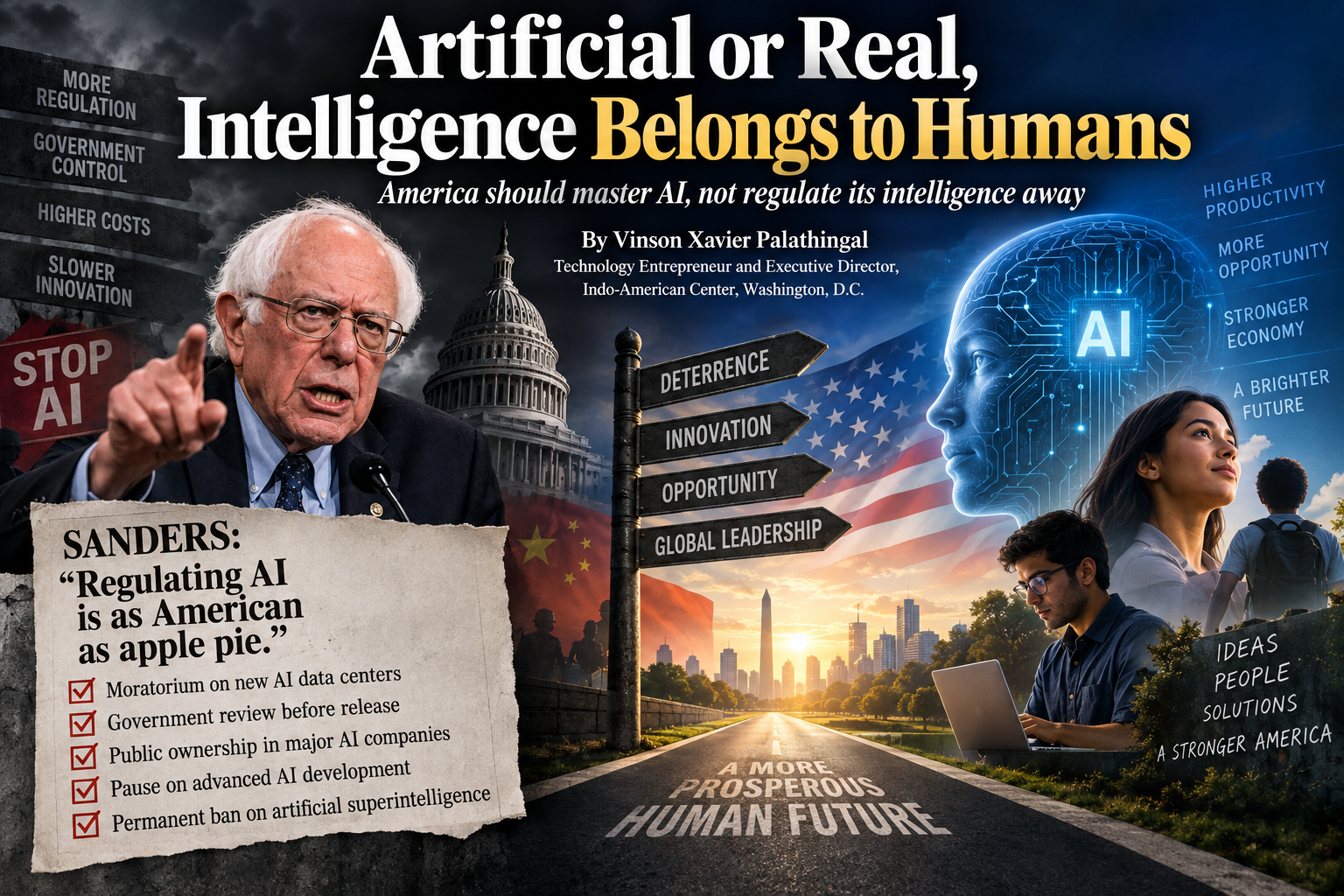
Artificial or real, intelligence belongs to humans. Deep memory, lightning-fast processing speed, and extraordinary accuracy while dealing with huge quantities of information are what AI brings to the table. Purpose, originality, judgment, ambition, and ultimately responsibility still belong to us.
I say this as a technology entrepreneur who has spent decades watching technology change how we work, and I am amazed by what artificial intelligence can already do. But I am equally amazed by how quickly we have moved from being excited about this extraordinary human achievement to being terrified of it.
Of course AI comes with dangers, including some very serious ones. Fraudsters will use it, criminals will use it, dictatorships will use it, employees will misuse it, businesses will make stupid decisions with it, and some people will become lazy because of it while others become extraordinarily productive. None of that should surprise us. Every major technology humans have invented has expanded our ability to do good things and bad things. What matters is whether we learn to manage the new capability or become so frightened by everything that could possibly go wrong that we surrender its advantages.
The answer to powerful intelligence cannot be to make ourselves less intelligent.
Think like an entrepreneur
Think about AI from the perspective of an entrepreneur. Imagine that tomorrow morning you suddenly have access to 100 incredibly capable digital employees who can research, write, program, analyze spreadsheets, read thousands of pages, translate languages, prepare presentations, organize records, help with bookkeeping, answer customer questions, research competitors, troubleshoot technology, draft correspondence, analyze contracts, help train employees, and examine data, all at a speed no human workforce could match.
READ: We’re not competing with AI on intelligence—it’s the blind spots (April 27, 2026)
What should an entrepreneur do? Put them to work.
That obviously doesn’t mean you go to sleep and let them run your company. Anyone who has built a company knows that employees bring risks along with their abilities. They can steal from you, leak confidential information, offend customers, falsify expenses, download malware, misunderstand instructions, waste time, make unauthorized commitments, learn your business and become competitors, or simply exercise terrible judgment. Two employees can fall in love, become consumed with each other, and forget that you hired them to work for you. Human beings are complicated, and anybody who has managed enough of them knows exactly what I am talking about.
Did entrepreneurs therefore decide employees were too dangerous and stop hiring them? Of course not. We developed management. We created SOPs, accounting controls, separation of responsibilities, passwords, permissions, audits, supervision, training, and insurance. We fire people when necessary, sue people when necessary, and prosecute crimes when crimes are committed.
AI requires the same entrepreneurial mentality, probably with even more vigilance because its speed and capacity are enormous. You supervise it, question it, verify important results, control what information it can access, and remain responsible for what ultimately comes out of your organization.
AI doesn’t eliminate management. It makes management more important.
Now suppose I become obsessed with everything that can go wrong when I hire employees and proudly decide to remain a one-man company forever. Meanwhile my competitor hires 100 people, manages those risks and builds a company ten times my size. I didn’t make business safer. I simply removed myself from serious competition.
A country can make the same mistake with AI. America can slow itself down in the name of safety, but our competitors don’t become slower because we do. The person, company or country willing to manage a new capability eventually beats the one afraid to use it.
Bernie, the bomb and the intelligence race
Senator Bernie Sanders recently declared that regulating AI is “as American as apple pie.” His proposals this year have included a federal moratorium on new AI data centers, government review of AI products before release, public ownership interests in major AI companies, a pause on advanced AI development until a new federal regulator establishes rules, and a permanent ban on artificial superintelligence.
None of this particularly surprises me. Senator Sanders has spent a political lifetime looking at concentrations of economic power and seeing government control as the answer. Now humanity has produced perhaps the greatest new concentration of intellectual power in generations and, predictably, Bernie has found another thing to regulate.
But his nuclear analogy is where this gets really interesting. Sanders says the potential danger from AI could be greater than nuclear weapons.
Okay, Senator. Let’s go with that analogy.
Nuclear weapons can destroy entire cities, yet America doesn’t announce that they are dangerous and therefore destroy ours. Russia has them. China has them. North Korea has them. The danger doesn’t disappear because America decides to behave itself; it may increase enormously if everybody else possesses the capability and we don’t. That is the logic of deterrence.
So if Bernie wants us to think about AI using the nuclear analogy, I am perfectly happy to do so. China isn’t going to forget AI because Bernie Sanders passed a law, and neither will Russia, Iran, criminal organizations, foreign intelligence agencies or America’s economic competitors. If somebody else’s AI is being used against us, what exactly does Senator Sanders expect us to fight it with, a congressional hearing?
Our AI will increasingly be the counter to their AI. You don’t win an intelligence race by making yourself less intelligent.
America has been building toward this moment
AI didn’t suddenly fall from the sky. The technological world America helped create over many decades has been building toward this moment through semiconductors, personal computers, software, databases, the Internet, search engines, cloud computing, smartphones, massive data centers, programming languages, and networks connecting practically the entire planet. Generation after generation of American scientists, engineers, entrepreneurs, investors and companies helped build this enormous technological infrastructure.
READ: AI was built in layers—now doctors must be trained on it fast (April 22, 2026)
For most of that history, humans still had to learn the language of the machine. We spent decades making computers easier for humans to use, and now we may have arrived at the point where the machine is increasingly learning our language instead.
That changes who gets to participate in technology. You no longer necessarily need to understand every layer underneath the machine before using the enormous intellectual infrastructure humanity has built. Increasingly, you can tell the machine what you are trying to accomplish, explain the logic, correct it when it misunderstands you, and keep directing it until you get where you want to go.
This is not the moment for America to become timid. It is the moment to capitalize on what we spent generations creating.
Will AI turn the H-1B debate upside down?
For decades, America’s technology industry has told us that we don’t have enough technical workers, that we need more programmers and engineers, more H-1B visas, and more imported technical talent from India, China, and elsewhere because these specialized skills are not sufficiently available here.
AI may turn a large part of that assumption upside down.
For most of the computer era, there was an enormous distance between having an idea and making a computer execute it. You needed somebody who knew C, C++, Java, Python, SQL, APIs, libraries, frameworks, and syntax. That knowledge became enormously valuable because the person who understood the business problem and the person capable of communicating the solution to the machine were often two different people.
AI is beginning to collapse that distance. Increasingly, I can explain the problem in English, describe the logic, and describe the result I want, while AI deals with more and more of the cryptic syntax underneath it.
That doesn’t mean America suddenly needs no programmers, nor does it mean talented immigrants have nothing to contribute. America should always want extraordinary scientists, engineers, physicians, researchers, and entrepreneurs from around the world. But if AI dramatically reduces the amount of specialized programming labor necessary to turn an idea into a working product, why should America’s future technology and immigration policies continue to be built around yesterday’s assumptions about technical labor shortages?
Maybe America’s next technology shortage isn’t programmers. Maybe it is people with ideas worth programming.
When technical capability becomes less scarce, judgment, originality, imagination, leadership, discipline and knowing which problem is worth solving become more valuable. The scarce commodity becomes human again.
Making intelligence less expensive
This has enormous implications for America because competent human labor is expensive, including intellectual and administrative labor.
Try starting a small company and hiring an accountant, bookkeeper, programmer, administrative assistant, researcher, marketing person, customer-service representative, IT technician, translator, and analyst. Most entrepreneurs cannot afford all of them, so the owner answers emails at midnight, does his own research, struggles with spreadsheets, tries to understand technology problems outside his expertise, and postpones projects because he doesn’t have the staff.
AI can attack that problem by making portions of intellectual labor radically cheaper. One accountant assisted by AI may accomplish work that previously required several people. One programmer may build what previously required a team. One entrepreneur may test an idea that previously required substantial capital before even discovering whether it worked.
That matters particularly for small businesses because large corporations have always possessed something individuals couldn’t afford: armies of specialists. AI begins giving an individual pieces of that same intellectual infrastructure. A plumber can get help understanding his numbers, a farmer can research equipment, an entrepreneur can analyze a market, and a student can have a tutor available at two o’clock in the morning.
The Industrial Revolution multiplied human muscle. Computers multiplied human calculation. The Internet multiplied human access to information. Artificial intelligence is beginning to multiply human intellectual labor itself.
That may turn out to be one of the greatest democratizations of capability in human history.
And there is an irony in Washington’s instinct to regulate this technology heavily. A trillion-dollar technology company can afford hundreds of lawyers, lobbyists, compliance officers, cybersecurity specialists, and government-relations professionals. Three entrepreneurs building something in a garage cannot. Every licensing requirement, certification process, and regulatory filing costs money, and eventually regulation doesn’t merely determine how technology can be used. It determines who can afford to participate.
The companies already dominating AI may discover something wonderful about enormously complicated regulation: they can afford it, while many of their future competitors cannot.
So before Washington creates an enormous regulatory architecture around AI, somebody should ask an uncomfortable question: Are we protecting Americans from AI, or are we accidentally protecting today’s AI giants from tomorrow’s competitors?
READ: Is AI an avatar of God? Anthropic, Mythos, and the rise of moral authority in machines (April 13, 2026)
Regulate the crime, not the intelligence
Government certainly has a role, but it should start by doing the job government is supposed to do. If somebody uses AI to defraud an elderly woman, prosecute the fraud. If somebody uses it to steal, prosecute the theft. If somebody uses it to hack a bank, prosecute the intrusion. If somebody uses it to impersonate another person and steal his money, prosecute him. If a company negligently harms people, hold the responsible people and company accountable under applicable law. Where AI creates genuinely new conduct that existing law cannot reasonably address, Congress can address that specific problem.
But there is an enormous difference between regulating harmful conduct and regulating intelligence itself.
Regulate the crime, not the intelligence.
Government also has a responsibility to educate citizens because the world around them is becoming more sophisticated. The scammer calling your grandmother may soon speak perfect English, perfect Malayalam, or perfect Spanish, reproduce somebody’s voice, and produce documents that look completely legitimate. Citizens will have to become more skeptical, technologically literate, and careful consumers of information.
That’s life in a technologically advanced society. We didn’t ban automobiles because people needed to learn how to cross a road. We learned to look both ways.
Nor do I buy the idea that AI will do all the work while humans relax. Give two entrepreneurs exactly the same AI. One asks lazy questions, accepts whatever comes back, and lets the machine think for him. The other challenges it, supplies context, checks important answers, finds contradictions, gives direction, and rejects bad work until he gets what he wants.
The human still matters, maybe more than ever. A Formula One car doesn’t make everybody a Formula One driver. Power magnifies ability, and it can also magnify stupidity.
Artificial or real, intelligence belongs to humans
America’s enormous advantage in this technological revolution is that we are a free, entrepreneurial society where people experiment, start companies, challenge established companies, fail, try again, and invent things nobody asked them to invent. That messy freedom has produced an extraordinary amount of the technology the world now uses.
We should be extraordinarily careful before replacing that culture with one in which an entrepreneur must first convince Washington that his intelligence tool is safe enough, socially acceptable enough, environmentally acceptable enough, economically fair enough and politically approved enough before discovering what it might do. While we conduct the hearing, somebody else will be building.
AI will make good people more capable and bad people more capable, good governments more capable and bad governments more capable, brilliant entrepreneurs more capable and probably some idiots more capable too. That is not an argument for stopping intelligence. It is an argument for becoming better at using it.
Humans created the machine, and humans give it purpose. We decide what questions to ask, which answers to reject, what businesses to build, what diseases to attack, what discoveries to pursue, what enemies to defend against and ultimately what future we want to create. And humans remain responsible when they use these tools to hurt other humans.
That is where I want government relentlessly focused: not on protecting me from intelligence, but on protecting my freedom to use it while holding me accountable for what I do with it.
Because artificial or real, intelligence belongs to humans.