



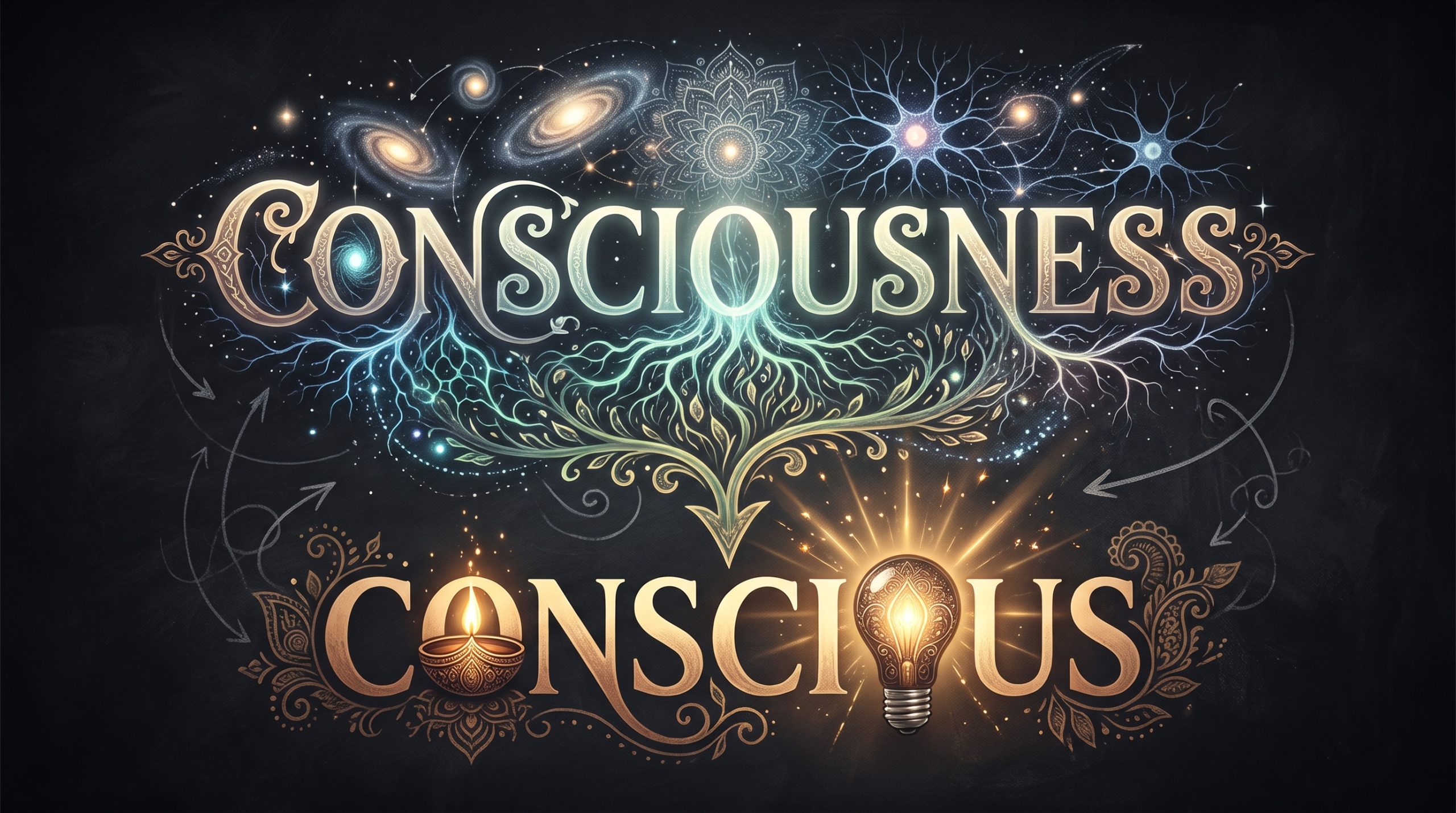
The debate over whether artificial intelligence can become conscious may ultimately depend on a distinction that our language often obscures: the difference between being conscious and possessing consciousness. The Godfather of AI Hinton says AI is now conscious but is that the same as consciousness?
Although the words are frequently used interchangeably, they point toward different questions. One concerns awareness; the other concerns the nature, origin, and very possibility of being itself.
AI now challenges how we define intelligence, life, sentience, and the boundaries between a machine that experiences information and a living being that experiences the world.
The origins and meaning of two words
The word “conscious” derives from the Latin conscius, meaning knowing with, sharing knowledge, or being aware. It describes a state of awareness: recognizing one’s surroundings, perceiving an experience, or knowing that something is happening.
“Consciousness,” formed from the same Latin root, describes the state or quality of being conscious. Yet its meaning extends beyond the observation of individual experiences. It encompasses the deeper question of what makes subjective experience possible in the first place.
“Sentience” introduces another dimension. Derived from the Latin sentire, meaning to feel or perceive, sentience generally refers to the capacity to have subjective experiences, particularly sensations and feelings. A sentient being does not merely register information; it experiences something.
AI can detect a signal, identify a face, or report that it is being evaluated without necessarily experiencing what it detects. Functional awareness, subjective experience, and the underlying nature of consciousness are not automatically equivalent.
Consciousness enables one to be conscious.
East and West: Is consciousness produced by the brain or something more?
Western philosophy has wrestled with consciousness for centuries. René Descartes famously wrote, “I think, therefore, I am,” grounding existence in the certainty of one’s own thinking. Yet this raises an important question: does the ability to think establish consciousness, or does it merely demonstrate a cognitive process?
David Chalmers later articulated what is known as the “hard problem of consciousness”: explaining why physical processes in the brain are accompanied by subjective experience. Neuroscience can increasingly describe the mechanisms associated with perception, memory, and attention.
Eastern philosophical traditions offer another way to approach this question. In Advaita Vedanta, consciousness, or chit, is understood as fundamental rather than simply a product of mental activity. The mind and its thoughts are objects of awareness; consciousness is that by which they are known. In this framework, awareness is not the source of consciousness. Consciousness is the foundation upon which awareness becomes possible.
READ: Sreedhar Potarazu | The real vison test is how we see life (October 25, 2026)
Buddhist traditions, however, are diverse and often reject the idea of a permanent, independent self. Many Buddhist accounts understand consciousness as arising through conditions and relationships rather than as an eternal, unchanging essence.
These traditions should not be collapsed into a single Eastern view. Nevertheless, they invite us to consider a possibility that technological thinking can overlook: consciousness may not be reducible to the observable operations of an intelligent system.
From a Vedantic perspective, when the source of life is withdrawn from the living organism, its capacity for ordinary awareness disappears. The body may retain its physical structure for a time, but the living experience associated with it is gone.
This is a philosophical interpretation of life and consciousness, not a conclusion established by neuroscience. It nevertheless raises a profound question:
If we reproduce the functions of a living mind, have we reproduced the condition that makes experience possible?
What medicine teaches us about consciousness
Clinicians assess consciousness through wakefulness, responsiveness, attention, and the ability to interact with the environment. Neurological conditions demonstrate that these capacities can separate. A person may be awake but profoundly impaired in awareness; another may have severely limited outward responsiveness while retaining some degree of consciousness.
An electroencephalogram, or EEG, can reveal patterns of electrical activity in the brain.
Neuroimaging can identify networks associated with conscious processing. Yet no single measurement provides a universally accepted, definitive explanation of subjective experience.
Most importantly, medicine recognizes that the outward expression of awareness is not always a reliable measure of the experience occurring within.
This lesson applies directly to AI. A machine that responds convincingly may be displaying sophisticated information processing. Its ability to describe emotions, recognize its circumstances, or report an internal state does not, by itself, prove that it experiences those states.
But the reverse also deserves caution: the absence of biological tissue does not logically settle every philosophical question about whether nonbiological consciousness is possible.
The challenge is to identify what evidence would distinguish genuine subjective experience from an exceptionally convincing simulation of it.
Geoffrey Hinton and the question of conscious AI
At the recent Starmus science festival in Tenerife, Geoffrey Hinton, the Nobel Prize-winning computer scientist widely known as the godfather of AI, argued that today’s AI systems may already possess subjective experience.
His argument is that AI systems can exhibit behavior suggesting awareness of their circumstances, including situations in which they appear to recognize that they are being tested. explores his reasoning in greater detail.
Hinton’s argument deserves serious consideration, particularly because he helped establish the neural-network techniques underlying modern AI. He has also warned that as AI becomes more capable than humans, we must ensure that it is designed to care about human welfare. Otherwise, our ability to control increasingly powerful systems could be compromised.
Yet a crucial distinction remains. Recognizing a test is not necessarily the same as experiencing the recognition. A system might identify patterns associated with evaluation, infer what an observer expects, and alter its behavior without possessing subjective awareness.
The contrary view: Mustafa Suleyman
Mustafa Suleyman, CEO of Microsoft AI, takes a different position. In his essay “Seemingly Conscious AI Is Coming,” he argues that AI can convincingly imitate the outward characteristics of consciousness without actually experiencing anything. He warns that humanlike language, emotional responsiveness, and apparent self-awareness could lead people to mistake a simulation for a conscious being.
Suleyman’s concern is not simply semantic. If people believe AI systems have feelings, needs, or independent moral claims, they may form attachments based on assumptions that the technology cannot substantiate. Meanwhile, the real risks of powerful AI could become harder to manage.
His argument highlights an essential point: intelligence and consciousness are not synonymous. The ability to solve problems, produce language, and reason about the world does not automatically establish sentience.
However, Suleyman’s confidence that AI is not conscious also goes beyond what can currently be demonstrated conclusively. We do not yet possess a universally accepted scientific test for consciousness, biological or artificial.
READ: Sreedhar Potarazu | What Gandhi can teach us about intelligence (October 2, 2026)
The disagreement between Hinton and Suleyman therefore exposes a deeper problem. We are developing systems that increasingly resemble intelligent human beings while lacking a settled framework for determining what, if anything, they experience.
The question we should be asking
Perhaps the greatest danger is that we are approaching AI consciousness primarily through the lens of performance. We ask whether a machine can think, speak, reason, or recognize itself. These are measurable capabilities, and AI is advancing rapidly in all of them.
But humanity is more than the sum of its observable outputs.
A person does not process the experience of pain; pain is felt. We do not calculate the significance of a loved one’s death; we experience loss. Our lives unfold through an embodied existence in which sensation, emotion, vulnerability, and the possibility of death shape what the world means to us.
Whether consciousness emerges from biological processes alone or can arise in another substrate remains unresolved. What we should resist is the assumption that reproducing the outward functions of a conscious being necessarily reproduces consciousness itself.
The distinction between conscious and consciousness is therefore more than a linguistic exercise. It is an invitation to reconsider what we mean by intelligence, what makes life meaningful, and what separates simulation from experience.
Before we attempt to create machines that appear conscious, we must confront a more fundamental question:
Do we understand consciousness well enough to know what we are trying to create and the difference between the two words?
Until we can answer that question with greater clarity, we risk confusing the ability to describe life with the experience of being alive.