



AI, at least as most of us have come to know it through ChatGPT or Claude, is approaching its fourth birthday. In human terms, it is still a toddler, discovering its environment, testing boundaries, making mistakes, and learning through a combination of exploration and guardrails. Of course, if we were to measure its development in dog years, AI would already be approaching middle age, having absorbed an extraordinary amount of information and experience in a compressed period of time. Somewhere between the toddler and the four-year-old dog is probably where we find ourselves today, interacting with a technology whose capabilities have developed at a pace that bears little resemblance to our own.
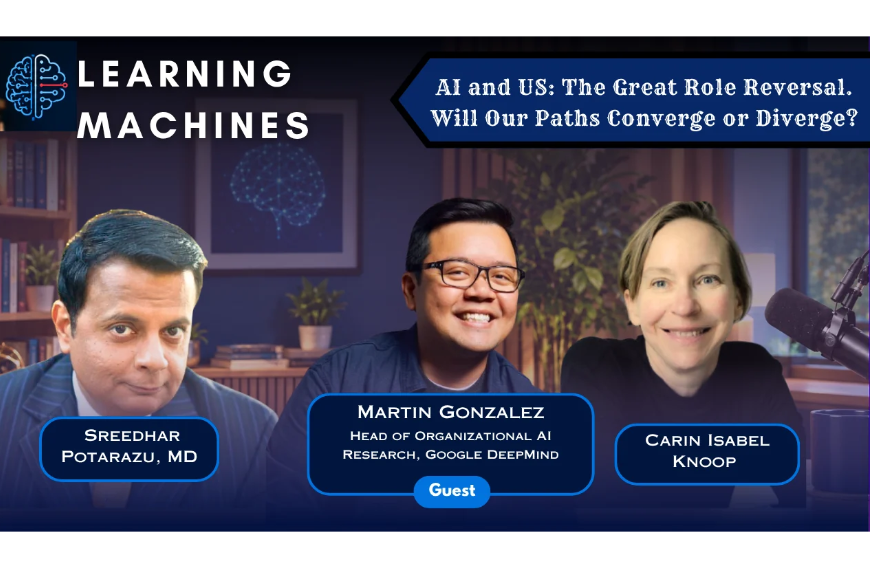
In our latest episode of “Learning Machines,” we explored these questions with Martin Gonzalez, head of organizational AI research at Google DeepMind, whose work examines how AI is reshaping organizations, human expertise, and the relationship between people and intelligent systems. What emerged from our conversation was a fascinating paradox: Machines first think in the abstract but learn social skills later, while humans (and dogs) develop social skills long before acquiring sophisticated abstract reasoning. Will these two paths converge or diverge? And what might their differences teach us about how we learn, work, and lead?
Listen to the full episode on Spotify
Watch the full episode on YouTube:
Learning to trust
Consider how we develop trust in children. As parents, we provide guidance, observe behavior, correct mistakes, and progressively delegate responsibility as the child demonstrates an understanding of consequences. The same is true when training a dog. We establish expectations, reinforce acceptable behavior, and gradually extend freedom as trust develops. In neither case do we assume that intelligence, obedience, or the ability to perform a task automatically confers the judgment necessary to act independently.
Yet we have become remarkably comfortable delegating authority to AI, even though most of us do not quite understand how the systems work or can explain their reasoning. We have become very comfortable delegating thinking to the machine either because we have developed genuine confidence in the accuracy of the models, or because the convenience of accepting their answers has diminished our motivation to investigate further. And the speed at which AI can now respond has been compressed so much that it gives us little time to reflect or validate. The question is whether our trust reflects genuine understanding or simply the convenience of not having to think for ourselves.
Ironically, when children ask why they should do something we asked them to do, our response is often, “Because I said so.” But when the machine provides an answer, rather than asking how it arrived at that conclusion, we accept its authority because, in effect, the machine “said so.”
Gonzalez introduced an important perspective on this irony through the concept of encapsulation. In computer science, the term refers to hiding complex details that end users may not need to understand. Advances in technology have allowed increasingly complex operations to become hidden beneath layers of abstraction. Early computer scientists needed to understand the math underlying their calculations. Later generations learned programming languages that concealed much of that complexity. Today, natural language allows people to instruct machines to write code without necessarily understanding the programming languages themselves. This progression has made technology more accessible, but it also raises questions about the knowledge we no longer need to acquire and the skills we may consequently lose.
Gonzalez suggested that the threshold for human verification will continue to shift, with routine, lower-risk tasks increasingly delegated to machines while more novel and consequential decisions remain subject to human judgment. But who is responsible for exercising that judgment if the skills required to develop it are increasingly delegated to AI? Human oversight becomes a comforting expression unless we can explain who that person is and what role they play, especially when AI makes mistakes or produces recommendations with significant consequences.
READ: Sreedhar Potarazu and Carin Isabel Knoop | ‘Of Us’ and ‘For Us’: Humanity under the AI microscope (October 7, 2026)
When machines make mistakes
When AI makes a mistake, our tendency is to reject the recommendations after observing an error, even when the algorithm performs better overall than human judgment. This phenomenon has been described as algorithmic aversion. We tend to view machine error as evidence of a system’s limitations while interpreting human error as an opportunity for improvement.
Attribution bias can further complicate this relationship. When AI produces a satisfactory result, we may credit ourselves for having used the technology effectively. When it disappoints, we may blame the machine. In both cases, we risk misjudging our own contribution and responsibility.
At the root of this aversion is the illusion that humans are inherently better judges. Machine error rates appear measurable and bounded, while we imagine human intelligence as perpetually capable of improvement. We recognize that people make mistakes, but we preserve a belief that with enough experience, training, or effort, we can become better.
The contradiction is that we distrust an algorithm after witnessing a single mistake while forgiving repeated errors in human judgment. Yet the opposite tendency is equally concerning: trusting an algorithm so completely that we stop questioning its conclusions. Both reactions reveal how difficult it can be to calibrate trust appropriately.
Two paths to intelligence
Machines and humans develop very differently. By the age of 3 or 4, children have already developed important socialization skills. These skills develop long before they learn calculus or solve abstract math problems. Abstract reasoning develops much later.
With AI, that sequence is reversed. We taught machines to perform complex calculations, recognize patterns, and solve abstract problems before developing systems capable of sophisticated social interaction. Will these two paths between AI and humans eventually converge, diverge, or will they continue along parallel paths, producing forms of intelligence that are increasingly capable yet fundamentally different in how they understand the world? The answer will determine whether AI becomes a collaborator or a source of growing dependence and misunderstanding.
Machines, despite their limitations, can teach us something about our own social behavior.
When AI agents collaborate, they often must communicate their objectives, assumptions, and intermediate reasoning explicitly so that other agents can understand what is required. Human teams, by contrast, often operate through unspoken expectations, incomplete communication, and assumptions about what other people know or intend.
READ: Sreedhar Potarazu and Carin Isabel Knoop | What machines can see but still cannot perceive (October 14, 2026)
Much of the dysfunction in organizations arises from these gaps. People assume that colleagues understand their motivations, priorities, or constraints without ever communicating them. Ironically, we devote extraordinary care to instructing machines. We specify their roles, define objectives, establish constraints, and describe the outputs we expect. Yet we frequently fail to extend the same clarity to the people with whom we work and live.
Effective communication requires more than intelligence. It requires clarity about expectations, responsibilities, and the needs of others. These are qualities that matter as much in managing people as they do in managing machines.
And importantly, we may not fully appreciate the role work plays in creating meaning and purpose for humans, whose relationship with work is fundamentally different from that of machines.
The meaning of work
Gonzalez described research involving professional dancers who confronted the arrival of technologies capable of reproducing elements of their craft. Their dilemma was not confined to whether machines could perform certain tasks more efficiently. It concerned the meaning of the work itself.
For someone who has devoted decades to mastering a craft, the process of learning, practicing, and performing is inseparable from professional identity. Delegating that work to a machine may improve productivity while diminishing the personal satisfaction derived from doing it.
This distinction matters beyond the arts. For many professionals, the value of work lies not simply in the outcome but also in the effort, judgment, relationships, and sense of accomplishment involved in producing it. Greater efficiency does not necessarily translate into greater fulfillment.
And oddly, eliminating routine work may have an unexpected consequence. When machines absorb repetitive tasks, humans may be left with a continuous stream of tasks that require more thinking. The routine activities once considered tedious sometimes provided intervals of mental recovery between more complex responsibilities.
Greater speed frequently produces greater expectations for speed. Emails demand immediate responses, decisions arrive more frequently, and the opportunity for sustained reflection becomes increasingly difficult to protect.
AI may accelerate this process further. The more quickly machines produce answers, the more quickly we may be expected to respond, decide, and act. Yet the human capacity to absorb information, exercise judgment, and recover from sustained cognitive effort does not necessarily accelerate at the same pace.
In a world where machines can generate immediate responses, taking the time to think carefully may become one of the most meaningful expressions of human engagement and, in turn, makes us better observers.
Expanding human intelligence
In chess, AI has helped human players improve their own performance. A chess player who studies with a computer may become a stronger player. A person who allows the computer to make every move may become increasingly dependent on it. Both are using the same technology, but the intellectual consequences are different.
Gonzalez also suggested that AI may create opportunities to expand human expertise rather than simply replace it. Throughout history, scientific tools have allowed people to explore questions previously beyond their reach. The microscope and telescope, for example, did not eliminate the need for scientists. They expanded what scientists could observe and investigate. AI may offer similar opportunities across a much wider range of activities.
One possibility is the use of AI to simulate rare and consequential situations. Most managers have limited opportunities to prepare for major crises through direct experience. Sophisticated simulations could allow them to practice decisions, test assumptions, and develop judgment before confronting such events in real life. Rather than replacing human intuition, AI could help strengthen it.
The relationship between human and machine intelligence need not be a competition over which can perform a task better. The more relevant issue is whether interaction with the machine strengthens or weakens the human capacity to perform that task independently.
The value of AI should be measured not only by the quality of its outputs, but also by what happens to human judgment through repeated interaction with these systems.
Human development unfolds over years of social experience before we acquire sophisticated abstract knowledge. AI has compressed extraordinary computational development into a few years while leaving many questions about social understanding, judgment, and responsibility unresolved.
This difference should not necessarily be viewed as a deficiency to be corrected or a competition to be won. It may instead offer an opportunity to reconsider what we value in human intelligence and how we develop it.
Whether these trajectories converge will depend on how deliberately we design the relationship between human curiosity and machine capability.
Ultimately, the question is not simply how intelligent AI will become, but whether our interactions with it will help us become more thoughtful learners, more effective leaders, and more capable human beings.