



By Soumoshree Mukherjee
Editor’s note: This article is based on insights from a podcast series. The views expressed in the podcast reflect the speakers’ perspectives and do not necessarily represent those of this publication. Readers are encouraged to explore the full podcast for additional context.
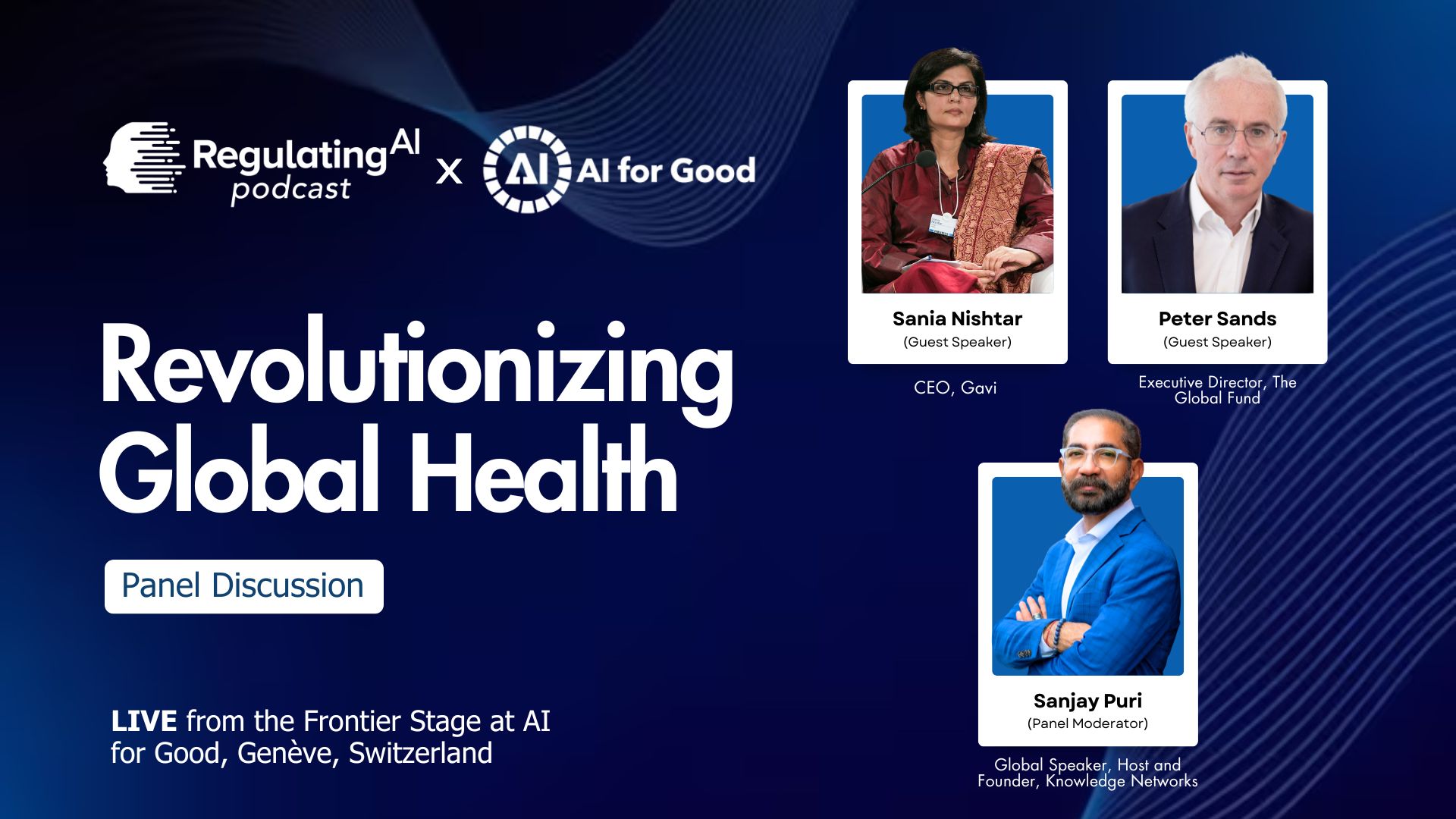
In a compelling episode of “Regulating AI” in collaboration with “AI for Good,” Sanjay Puri moderated a conversation with Dr. Sania Nishtar, CEO of Gavi, the Vaccine Alliance, and Peter Sands, Executive Director of the Global Fund to Fight AIDS, Tuberculosis, and Malaria. The discussion explored how artificial intelligence could transform healthcare delivery, particularly in low- and middle-income countries (LMICs).
READ: Knowledge Networks teams up with AI for Good to advance dialogue on global AI governance (July 18, 2025)
From the outset, Sands drew parallels between AI and past medical breakthroughs. “AI can have an impact to the scale,” he said, pointing to two key areas: diagnosing health problems in underserved environments and empowering individuals to take control of their own health. But he cautioned that such change “…that is not going to just kind happen of its own accord. It’s going to take sort of acts of leadership and commitment to make that happen, to make sure that the power of AI does not end up with a two-tiered society.”
Dr. Nishtar emphasized AI’s potential in last-mile vaccine delivery, especially where electricity and infrastructure are scarce. Citing her recent visit to a country with only two hours of daily power from the grid, she explained: “We had to engineer solar powered visas and solar powered health facilities and invest in this… And of course, you layered this with AI and you definitely will come up with that in other solutions.”
Data integrity and privacy emerged as pressing concerns. Sands admitted, “In all honesty, I don’t think we’re on top of [them], and this is particularly true when you’re talking about populations that are criminalized, stigmatized, excluded from society in different ways.” Dr. Nishtar agreed, noting the uphill task of ensuring ethical use while complying with sovereign privacy laws.
Both panelists acknowledged that AI is not a “magic wand” but can address urgent issues like drug resistance. Sands highlighted malaria treatment, explaining that AI can track resistance patterns, understand genomic changes in parasites, and guide the use of newer drugs. However, he stressed that such systems require funding, skilled personnel, and infrastructure.
Language barriers, often seen as a limiting factor, were downplayed by Nishtar: “If we make the technology fail over affordable and available at scale and market will correct for that… The English issue in AI but it is very much a secondary issue.” Sands, however, flagged “power structures” within healthcare as a bigger obstacle, warning that AI could disrupt hierarchies and income differentials, sparking resistance.
Ultimately, both leaders agreed that while AI holds transformative potential, its equitable implementation demands deliberate effort. As Sands concluded, “It’s going to require leadership and the ability to take quite courageous decisions… These are the folks who are on the front-line saving lives.”