



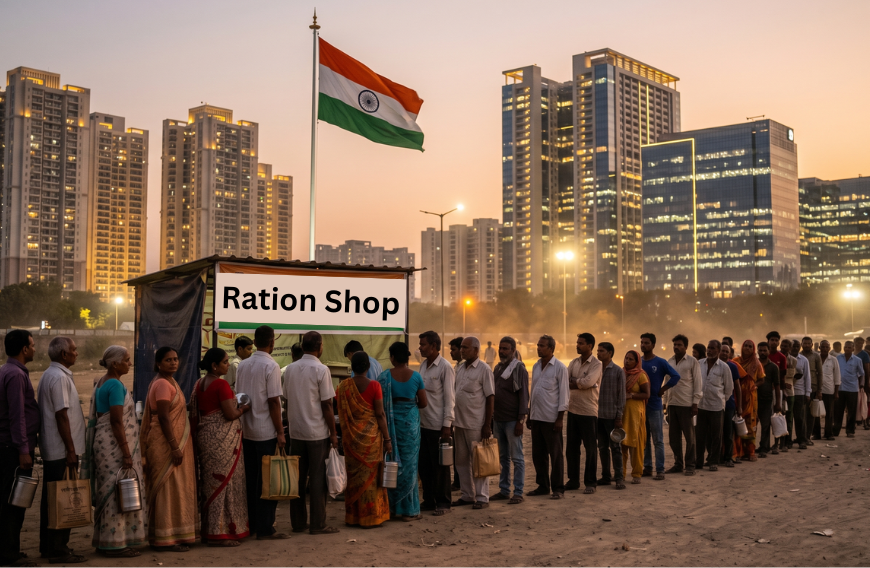
India is the fourth largest economy in the world.
This is true. India’s GDP has crossed $4.51 trillion. We have surpassed Japan. We are closing in on Germany. By 2030, if current trends hold, we will be the third largest economy on earth. The Prime Minister says it. NITI Aayog says it. The IMF confirms it. The number is real.
Also real is this number: 81 crore (810 million).
Eighty-one crore Indians — 57 percent of this fourth largest economy — receive free ration from the government every month. Five kilograms of wheat or rice per person. Completely free. The scheme costs over two lakh crore rupees a year. It has been running since 2020. It has just been extended through December 2028.
Hold both numbers in your mind at the same time.
The fourth largest economy in the world. More than half its population unable to feed itself without government assistance.
One of those two sentences is telling the whole truth. The other is telling only part of it.
Let us ask the question that Indian television will not ask and Indian politicians cannot answer.
Are these 81 crore people productive?
Read more Akhlaq Siddiqi’s column : The new East India Company has no ships (June 4, 2026)
The honest answer is — mostly, no. Not in the way a growing economy requires. They are not producing the goods, the services, the innovation, the skilled labor that generates compounding wealth. They are surviving. They are getting by. They are feeding their children on government grain and hoping that something, somewhere, will change.
And now the harder question.
Will they ever become productive?
Only if India makes a choice it has not yet made. And the evidence suggests it is not close to making it.
Productivity does not arrive by itself. It is built — through schools that actually teach, through teachers who actually show up, through healthcare that keeps children healthy enough to learn, through colleges that are affordable, through skills training that matches the jobs that exist, and through jobs that actually exist in sufficient numbers.
India has built highways. India has built airports. India has built a space program that lands on the moon. These are genuine achievements and this column will not diminish them. But highways do not make people productive. Airports do not make people productive. A moon landing does not put a skilled worker in a factory in Bihar.
What makes people productive is investment in human capital. In the child before she reaches school. In the school itself. In the teacher inside it. In the hospital that keeps the family healthy enough to learn and work. In the college that does not cost five years of a family’s income. In the apprenticeship that connects education to employment.
India has chronically, structurally, generationally underinvested in every single one of these things.
India spends approximately 2.9 percent of GDP on education. The global average for developing economies is 4.5 percent. India spends roughly 1.9 percent of GDP on public healthcare. China spends 3 percent. Brazil spends 4 percent. The United Kingdom spends 8 percent. These are not small differences. They are the difference between a population that is an asset and a population that is a liability.
Read more Akhlaq Siddiqi’s column : Eid Mubarak, if they let you (May 28, 2026)
The 81 crore on free ration are not there because they are lazy. They are not there because they lack intelligence or ambition or the desire for a better life. The comments section on any government scheme website is full of desperate, articulate people begging for jobs, for loans, for opportunity — people who want to work, who are trying to work, who cannot find work that pays enough to feed a family without supplementing with government grain.
They are there because India never built the ladder.
The cruelest proof of this is what we wrote about earlier this week.
The only ladder out of poverty that India has officially constructed is the examination system — NEET for medicine, JEE for engineering. Two tests. Two paths. For a country of 1.4 billion people, two paths out of poverty through education.
And even those paths have been compromised. The NEET paper leaked. The Supreme Court is still hearing the case. The children who prepared for years, who left home, who went to Kota, who gave up their adolescence to fluorescent classrooms and mock tests — they were betrayed by the very system they trusted.
The 81 crore on free ration cannot even reach Kota. The coaching fee alone — one and a half to five lakh rupees a year — is more than many of their families earn in two years. The ladder exists. It is guarded by a toll gate they cannot afford.
Now let us talk about what free ration actually is.
It is not investment. It is maintenance.
It keeps people alive. It prevents starvation. It is, in that narrow sense, genuinely humane — and this column will not pretend otherwise. A child who eats is better than a child who does not. The scheme has prevented real hunger in a country where hunger was, not long ago, a genuine mass emergency.
But maintenance is not transformation. Keeping someone alive is not the same as giving them a life. Five kilograms of rice per month is not education. It is not healthcare. It is not a skill. It is not a job. It is enough to survive. It is not enough to rise.
And here is where the politics become impossible to ignore.
The free ration scheme has been extended through December 2028. The next general election is in 2029. These 81 crore people are not a development priority. They are an electoral calculation. They are being fed so they do not starve and so they remember, on voting day, who gave them the grain.
This is not unique to BJP. Congress fed people too. Every Indian government since independence has maintained the poor rather than transforming them, because maintaining the poor is cheaper, faster, and more electorally reliable than the long, expensive, politically unrewarding work of actually lifting them out of poverty.
A family that receives free ration will remember the hand that gave it. A family that received a good school twenty years ago and now has a productive, employed adult child — that family’s gratitude is diffuse, delayed, and distributed across two decades of policy. Politicians work in five-year cycles. Human capital works in twenty-year cycles. The incentives will never align without conscious, deliberate, sustained political will that has so far not materialized.
India is the fourth largest economy and it is feeding 57 percent of its population for free.
Both of these things can be true simultaneously only if the economy’s growth is not reaching its people — only if the wealth being generated at the top is not trickling down to the bottom in any meaningful way, only if the fourth largest economy is being built on the labor and the patience of people who are not sharing in what they are building.
This is the India that exists behind the GDP number. Not the India of the minerals deal with America, not the India of the Quad Foreign Ministers meeting, not the India of the moon landing and the gleaming airports — though all of those Indias are real. The India of 81 crore people standing in line at a Fair Price Shop for their five kilograms of free grain. Also real. Also India.
Read more Akhlaq Siddiqi’s column : The truth does change with a headline, Byju (May 27, 2026)
The question is not whether Modi’s India has achieved things. It has. The question is whether the fourth largest economy can afford — morally, economically, demographically — to have 57 percent of its people on permanent food assistance while it counts its GDP ranking and announces its space missions.
The demographic clock is running. India has the largest youth population in the world. These young people — many of them the children of the 81 crore — are coming of working age right now. If India does not build the ladder in the next ten years — the real ladder, not the NEET exam with its 2 percent success rate, but genuine mass education, mass healthcare, mass skills, mass employment — the demographic dividend becomes a demographic disaster.
Not poverty. Unrest.
India does not need to choose between being the fourth largest economy and feeding its poor. It needs to choose to make its poor into its strength.
Japan, which India just surpassed in GDP, has almost no unemployed graduates. Germany, which India hopes to surpass next, has a vocational training system that turns ordinary young people into precision manufacturing workers who earn living wages. These countries did not become wealthy by maintaining their poor. They became wealthy by transforming them.
India is feeding 81 crore people. That is the emergency response.
The real question — the question that 2029 and 2034 and 2047 will be decided by — is when India stops feeding its people and starts freeing them.
Fed is not freed.
Until that changes, the GDP number is impressive.
And the 81 crore number is a verdict.