



By Sreedhar Potarazu and Tim Hedley
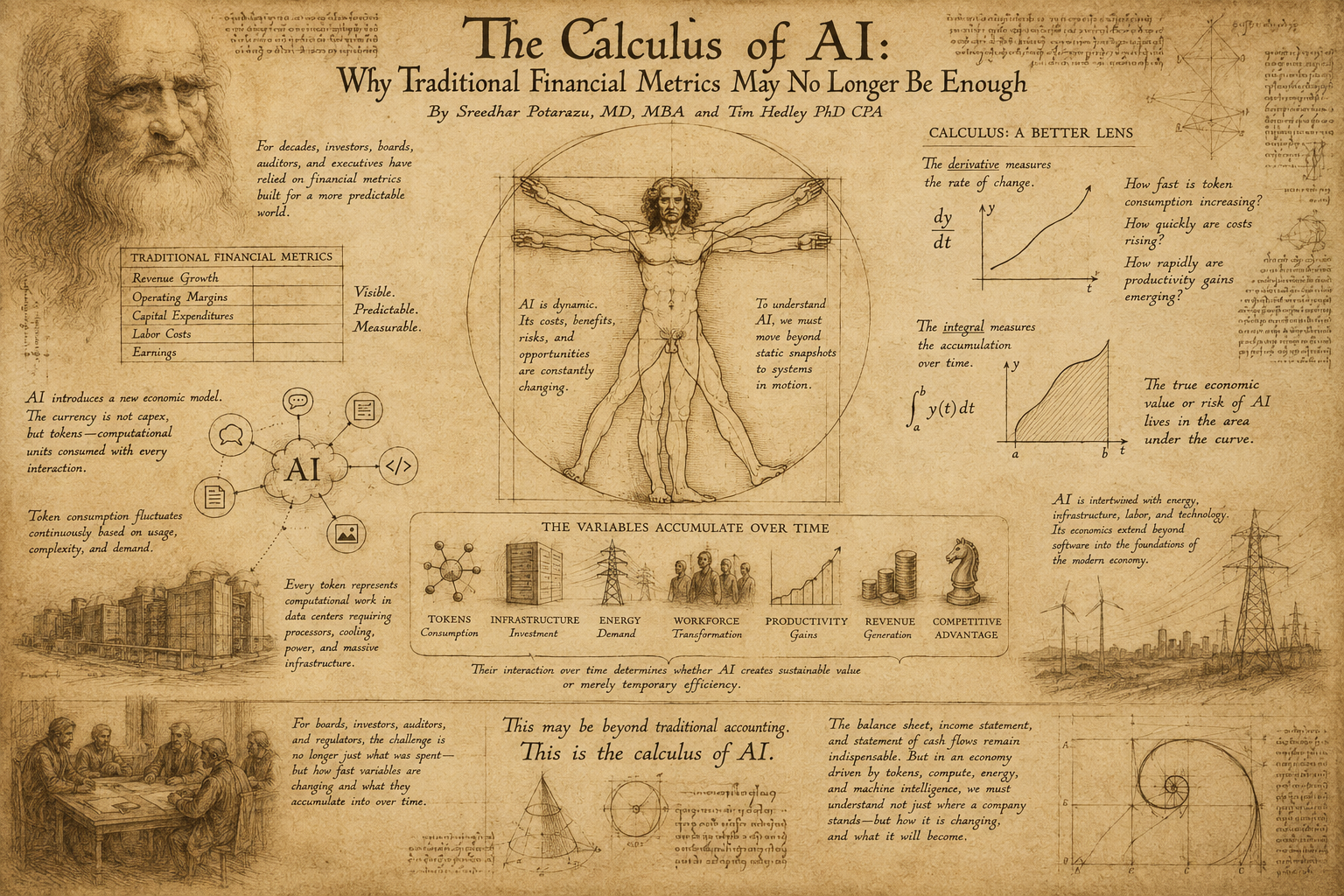
For decades, investors, boards of directors, auditors, and senior executives have relied upon a relatively stable set of financial metrics to evaluate the health and future prospects of an organization. Revenue growth, operating margins, capital expenditures, labor costs and earnings have formed the foundation upon which strategic decisions have been made and shareholder value has been assessed.
These measures matured during an era in which the principal drivers of business performance were largely visible and reasonably predictable. For example, infrastructure costs can be depreciated, labor costs can be forecast, and technology investments can be measured against reasonably well-understood returns.
The rapid adoption of artificial intelligence is beginning to challenge those assumptions. Organizations across every industry are rushing to integrate AI into their operations, products, and strategic plans. Investors increasingly expect management teams to articulate an AI strategy, while boards want evidence that AI investments are translating into competitive advantage.
Yet, a new reality is beginning to emerge. According to a recent KPMG survey, only 26 percent of companies report having a comprehensive understanding of their AI-related costs despite making AI a strategic priority. In other words, many organizations could be investing heavily in a technology whose economic impact they cannot fully quantify. For shareholders attempting to understand potential value creation and for executives attempting to allocate capital effectively, this creates a level of opacity rarely encountered in modern corporate finance.
Read more by Potarazu: Can Ozempic now also cure our addiction to AI and Social Media ? (June 7, 2026)
Artificial intelligence appears to be introducing an entirely different economic model. Increasingly, the currency of AI is measured not through capital expenditures but through tokens, the computational units consumed every time a model processes information, generates content, analyzes data, writes code, or performs reasoning tasks. Unlike traditional IT expenditures, token consumption fluctuates continuously based upon user behavior, transaction volume, model complexity, and demand for computational resources. What appears to be a simple interaction between an employee and an AI assistant may involve thousands or even millions of computational operations occurring behind the scenes.
Many finance leaders are struggling to develop effective methods for tracking token consumption and allocating AI-related costs throughout the enterprise. This creates a challenge for boards and investors because AI expenditures often do not fit neatly into traditional cost accounting categories. A department may appear more productive while simultaneously consuming significant computational resources whose costs are buried elsewhere in the organization.
The complexity extends well beyond token usage. Every token ultimately represents computational work performed within data centers that require processors, networking equipment, cooling systems, and enormous amounts of electrical power. This reality is driving one of the largest infrastructure buildouts in modern business history.
Google, Microsoft, Meta, and Amazon alone are projected to spend more than $670 billion on capital expenditures this year, much of it tied directly to artificial intelligence infrastructure. Yet even those extraordinary investments may not be sufficient.
A JPMorgan analysis found that more than 60 percent of data-center capacity planned for 2027 has not yet entered construction, while an additional 7 percent is already facing delays due to permitting issues, supply-chain constraints, and limitations in electrical power availability. These numbers reveal something profound. The economics of AI are no longer confined to software. They are becoming intertwined with energy markets, utility infrastructure, construction timelines, semiconductor supply chains, and real estate development. The cost of AI increasingly depends not only on algorithms but also on the availability of electricity.
Labor costs introduce another layer of uncertainty. Much of the public conversation surrounding artificial intelligence has focused on workforce reductions. Headlines routinely announce layoffs at companies simultaneously increasing their AI investments, reinforcing fears that artificial intelligence will permanently displace large segments of the workforce. The assumption often underlying these discussions is that labor costs removed from one side of the ledger will simply appear as increased profitability on the other.
History suggests that the reality may be considerably more complicated.
Read more by Potarazu: Anthropic wants to hit the brakes while stepping on the accelerator (June 6, 2026)
Technological revolutions do not typically eliminate labor altogether. More often, they transform labor. The industrial revolution changed the composition of work rather than eliminating workers. The personal computer altered the skills required to succeed in the workplace but did not eliminate the need for employees. Artificial intelligence appears likely to follow a similar trajectory.
As administrative and repetitive functions become increasingly automated, organizations are simultaneously creating demand for AI engineers, data scientists, cybersecurity specialists, governance professionals, compliance officers, model auditors, and domain experts capable of supervising increasingly sophisticated AI systems.
The question for investors is therefore not simply whether labor costs decline. The more important question is whether those costs migrate from lower-skilled administrative functions toward highly specialized and often significantly more expensive talent.
This is where traditional financial analysis begins to encounter its limitations. Conventional accounting frameworks excel at describing where an organization stands at a particular point and its cash flows and resurfacing operations over a specified period. Artificial intelligence, however, is fundamentally dynamic. Its costs, benefits, risks, and opportunities are constantly changing. Understanding AI therefore requires a framework that captures movement.
Perhaps the most useful metaphor comes from calculus.
At its core, calculus is concerned with two fundamental concepts: rates of change and accumulation. Derivatives measure how rapidly a variable changes at a particular moment in time. Integrals measure the cumulative effect of those changes over an extended period. Together, they provide a framework for understanding systems in motion.
The economics of artificial intelligence increasingly resemble a calculus problem rather than an accounting exercise.
The derivative represents the rate at which AI is transforming an organization. How rapidly is token consumption increasing? How quickly are computational costs rising? How fast are productivity gains emerging? How rapidly is revenue growing relative to AI expenditures? These are questions about velocity and acceleration rather than static measurements.
The integral represents something equally important. It captures the accumulated effect of those changes over time. A company may experience only modest productivity improvements in the short term while quietly building capabilities that create substantial competitive advantages over the course of years. Another organization may report impressive margins while accumulating infrastructure dependencies, energy obligations, and technology risks that are not immediately visible. The true economic value or risk of artificial intelligence may not reside in a single reporting period. It resides in the area under the curve.
READ: 3 Reasons why AI solved a math problem humans could not for 80 years (May 31, 2026)
That area under the curve may ultimately become one of the most important concepts for evaluating AI-enabled enterprises. It represents the accumulation of token consumption, infrastructure investment, energy demand, workforce transformation, productivity gains, revenue generation, and competitive advantage. Examining any one of these variables in isolation provides only a partial picture. Their interaction over time determines whether AI creates sustainable value or merely temporary efficiency.
For boards, investors, auditors, compliance officers, and regulators, this reality carries significant implications. Traditional financial reporting remains essential, but it may no longer be sufficient. The challenge is no longer simply determining what an organization spent during a reporting period. The challenge is understanding how rapidly the underlying variables are changing and how those changes accumulate across the enterprise over time.
Artificial intelligence is not simply introducing a new technology into business. It is introducing a new economic model. As organizations continue to embed AI into every aspect of their operations, the methods used to evaluate corporate performance must evolve accordingly.
The balance sheet, income statement, and statement of cash flows will remain indispensable tools. Yet in an economy increasingly driven by tokens, compute, energy, and machine intelligence, understanding a company requires more than measuring where it stands today. It requires understanding how rapidly it is changing, where those changes are leading, and what they accumulate into overtime.
This is may be beyond traditional accounting but is the calculus of AI.
(Tim Hedley PhD CPA is former Global Lead KPMG Fraud Risk Management Services and Executive in Residence at the Gabelli School of Business at Fordham University.)