



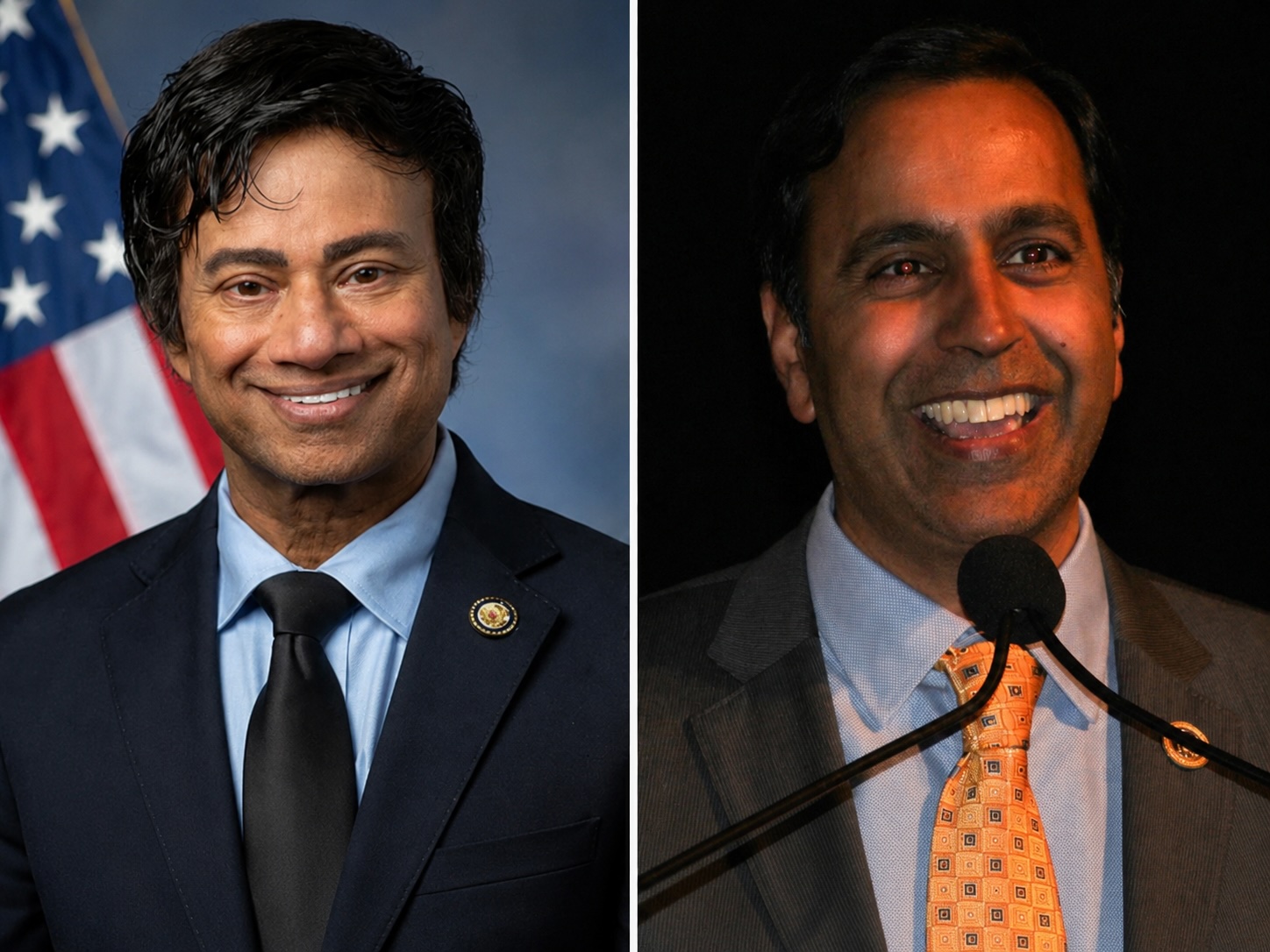
The Aug. 4 primary election in Michigan attracted national attention, largely because of the hotly contested Democratic Senate primary between Abdul El-Sayed, the eventual nominee who had the backing of the party’s progressive wing, and Rep. Haley Stevens, who was supported by much of the Democratic establishment.
 For Indian Americans, however, the biggest news to come out of Michigan was the defeat of Rep. Shri Thanedar, a two-term congressman representing the state’s 13th Congressional District. Thanedar’s loss was particularly striking because incumbents rarely lose primaries. (This election cycle, however, has proved to be an exception, with 12 sitting members of Congress losing their primaries, including seven Democrats.)
COLUMN: Frank F. Islam | How Indian Americans should respond to a shifting political climate (January 12, 2026)
Thanedar’s defeat came less than five months after Illinois Democrat Raja Krishnamoorthi lost his bid to succeed retiring Sen. Dick Durbin. For much of the race, Krishnamoorthi, a popular congressman representing Illinois’ 8th Congressional District, was considered a slight favorite to win the Democratic nomination. The primary was ultimately won by Lt. Gov. Juliana Stratton.
The defeats of Krishnamoorthi and Thanedar represent a setback for the Indian American community, whose presence in Congress now appears poised to shrink for the first time in years.
There are currently six Indian Americans in Congress, all Democrats. Besides Krishnamoorthi and Thanedar, the other members of the so-called “Samosa Caucus” are California Reps. Ami Bera and Ro Khanna, Washington Rep. Pramila Jayapal and Virginia Rep. Suhas Subramanyam.
COLUMN: Frank F. Islam | The midterms: America’s accountability election (July 22, 2026)
With Krishnamoorthi and Thanedar leaving Congress next January, the six-member Samosa Caucus could shrink to four.
One possible pickup is Arizona’s 1st Congressional District, where physician and former state lawmaker Amish Shah won the Democratic nomination. This is Shah’s second consecutive run for the seat; he narrowly lost the general election in November 2024.
Whatever happens in Arizona, the current picture looks very different from just a decade and a half ago.
Before Bera, the dean of the current generation of Indian American lawmakers, was elected in November 2012, only two Indian Americans had served in Congress. Bobby Jindal, who later became governor of Louisiana, represented Louisiana’s 1st Congressional District from 2005 to 2008. Decades earlier, Dalip Singh Saund represented California’s 29th Congressional District for three terms, from 1957 to 1963.
Saund’s election was particularly remarkable and even improbable because it came years before the Immigration and Nationality Act of 1965 opened the doors to large-scale Indian immigration to the United States. Congress at the time was overwhelmingly the domain of white men.
COLUMN: Frank F. Islam | Mamdani’s victory in New York a political earthquake (November 5, 2025)
In the 12 years after Bera entered Congress, the number of Indian American lawmakers serving at the same time grew from one to six. For a community of roughly 5.5 million people, accounting for about 1.6 percent of the U.S. population, Indian Americans had emerged as one of the country’s minority groups punching well above its weight politically.
That political ascent extended well beyond Congress. Kamala Harris, who is both African American and Indian American, served as vice president and became the first Indian American to run for the nation’s highest office as a major-party nominee.
Given that backdrop, the current setbacks are more likely a temporary electoral correction than a reversal of the broader trend. Indian American political participation has expanded dramatically over the past decade, and the community now has a remarkably deep bench of candidates and elected officials at virtually every level of government.
According to Indian American Impact, more than 250 Indian Americans serve in elected office across the country, from school boards and city councils to state legislatures, mayoral offices and Congress. Many of today’s most prominent Indian American politicians began their careers in local or state government before seeking higher office.
Perhaps the clearest indication of the community’s expanding political footprint came last year in New York City, where Zohran Mamdani won one of the most closely watched elections in the country and became the city’s first Indian American mayor.
His victory was significant not merely because New York is America’s largest city, but because it demonstrated that an Indian American candidate could build a broad coalition and win one of the most consequential elected offices in the country. Equally noteworthy, Mamdani did not shy away from his Indian or Ugandan heritage; instead, he embraced both as integral parts of his identity and campaign.
Now another major-city contest is putting an Indian American candidate in the national spotlight. This November, Los Angeles City Councilmember Nithya Raman is challenging Mayor Karen Bass, giving voters in America’s second-largest city a choice that could produce another historic breakthrough for Indian American political representation.
READ: Frank F. Islam | Trump’s H-1B crackdown puts tech and U.S.-India ties at risk (September 27, 2025)
These races underscore a larger point: even if the number of Indian Americans in Congress declines in the short term, the community’s political influence cannot be measured by its congressional delegation alone. The pipeline below Capitol Hill is larger, more geographically diverse and increasingly competitive.
But a growing political presence should not be taken for granted. Sustaining it requires continued engagement. As the old saying goes, if you are not at the table, you may find yourself on the menu. That is a lesson in politics not just in the United States, but around the world.
There is another reason continued engagement matters. If the Trump era has demonstrated anything, it is that political and civil rights won through decades of struggle cannot be taken for granted. They can be weakened or even lost. That makes continued vigilance and a willingness to stand up for those rights all the more important.
The current backlash against Indian Americans in cities such as Frisco, Texas, fueled in part by opposition to immigration and the H-1B visa program, is a reminder that the community’s growing visibility and success can also make it a target of political resentment.
READ: Frank F. Islam | Layoffs in a boom: Why America’s tech giants are cutting jobs amid growth (November 30, 2025)
The setbacks of one election cycle, therefore, should not obscure the larger story. Indian Americans, the nation’s most affluent and one of its fastest-rising ethnic groups, have come a remarkably long way politically — from Dalip Singh Saund’s pioneering election nearly seven decades ago to a generation now serving at every level of government.
Congressional representation may ebb and flow, but the community’s political footprint continues to expand. The challenge now is not simply to count how many Indian Americans hold office, but to ensure that their voices continue to be heard and that the political gains of recent decades are sustained.