



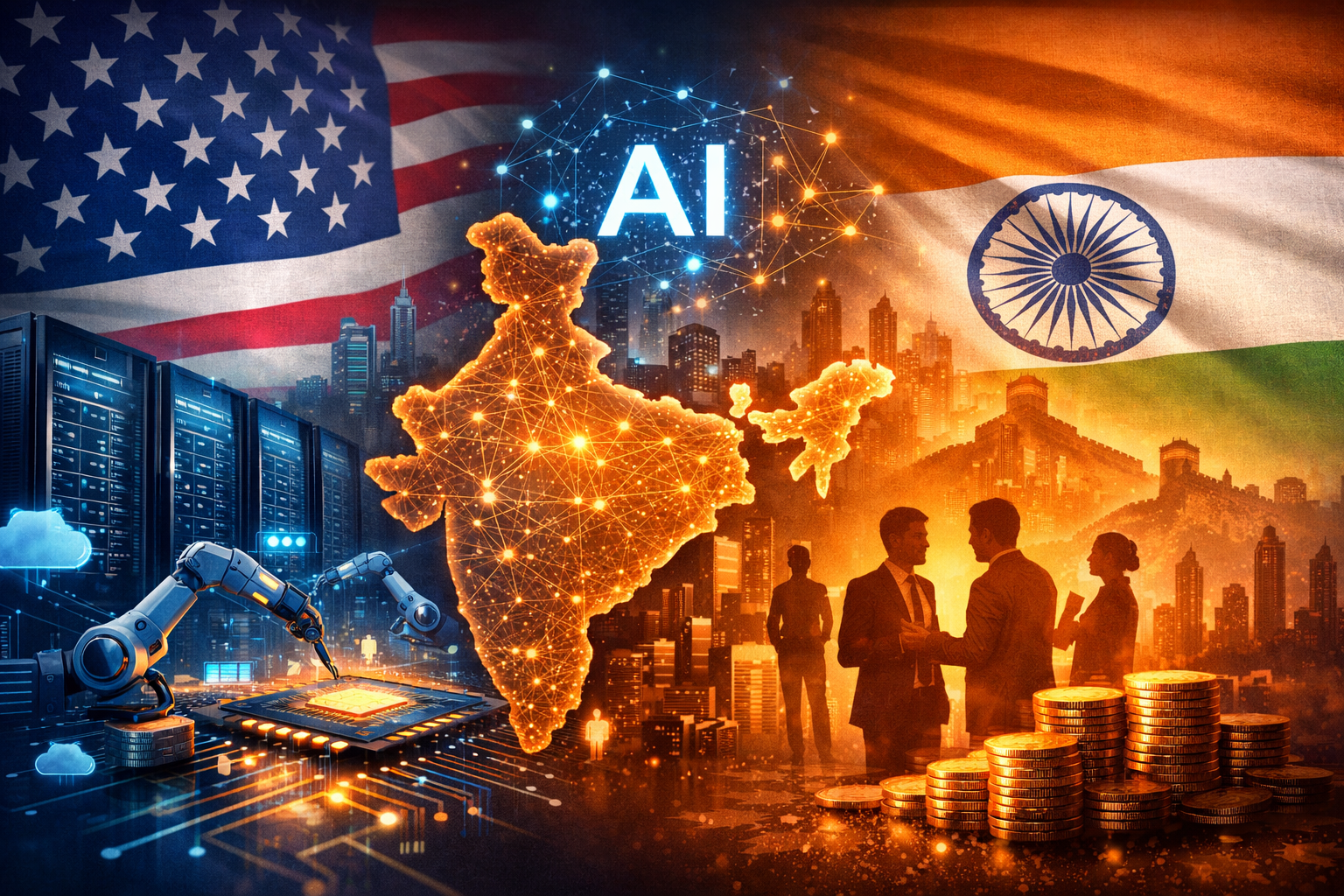
The recent announcement of investment by U.S. technology giants into India’s artificial intelligence, triggered by the lowering of tariffs, signals a pivotal moment in the global reordering of digital power.
Massive commitments to data centers, cloud infrastructure, and AI services reflect both India’s vast talent pool and its strategic position as an alternative to China in the geopolitics of technology.
Yet beneath the optimism lies a set of unresolved questions that will determine whether India emerges as a true AI power or merely as the next large platform for value extraction.
At the heart of the issue is data ownership. While AI infrastructure may be physically located on Indian soil, ownership of data, models, and monetization pathways often remains with multinational corporations.
READ: Sreedhar Potarazu | Healthcare cracking, lawmakers scrambling, consumers falling: The demise of US healthcare as we know it (January 30, 2026)
Unless India establishes and enforces clear data-sovereignty frameworks, it risks repeating an old pattern: local labor and local data generating global value that ultimately accrues elsewhere. The earlier outsourcing and IT-services boom created employment and expertise, but it did not result in enduring control over intellectual property at scale. AI, far more than software services, concentrates power where data governance and model ownership reside.
Infrastructure realities complicate the picture further. Large-scale AI systems are not abstract digital entities; they are intensely physical. They demand uninterrupted electricity, vast quantities of water for cooling, and highly reliable logistics and connectivity. Many regions in India already face grid instability, seasonal power shortages, and chronic water stress.
Even where data centers are clustered in more developed corridors, they remain dependent on regional ecosystems that are under strain. Without sustained investment in power generation, storage, and water recycling, AI infrastructure risks becoming brittle—advanced systems operating atop fragile foundations.
Climate change intensifies these vulnerabilities. Rising ambient temperatures increase cooling requirements and operating costs for data centers, while extreme heat events threaten reliability. Air pollution accelerates hardware degradation and raises maintenance costs.
Water scarcity, already a flashpoint in several Indian states, may become a political and social constraint on expansion, especially when data centers compete with agriculture and residential needs. AI scale is often discussed in terms of compute and capital, but climate resilience is rapidly becoming an equally binding constraint.
There is also the risk of uneven modernization, what might be called technological islands. It is possible to build world-class data centers in select zones while surrounding infrastructure remains underdeveloped. Such asymmetry can generate impressive headlines without delivering broad-based capacity or resilience.
READ: Sreedhar Potarazu | AI sovereignty race: US and China lead, India watches (
The danger is not merely symbolic; isolated systems are more vulnerable to supply shocks, political disruption, and social backlash when local communities see little benefit from resource-intensive facilities in their midst.
Governance adds another layer of uncertainty.
India’s federal structure means that land use, power pricing, water access, environmental enforcement, and data policy are often determined at the state or municipal level. These governments change frequently, sometimes abruptly, and policy continuity is not guaranteed. Long-lived AI assets designed to operate for decades require regulatory predictability that electoral cycles do not always provide. What is welcomed under one administration may be constrained or renegotiated under the next, especially as public awareness of data rights, environmental costs, and digital sovereignty grows.
None of this diminishes India’s genuine strengths. The country has exceptional human capital, a growing domestic digital market, and increasing strategic leverage in global technology supply chains. But AI leadership is not achieved by capital inflows alone. It requires alignment between infrastructure, climate adaptation, governance stability, and a clear national vision for who ultimately owns and controls the intelligence being built.
The central question, then, is not whether India can host AI infrastructure; it clearly can. But whether it can convert hosting into sovereignty. Without deliberate policy choices, the risk is a familiar one: cutting-edge technology layered onto uneven civic capacity, impressive in appearance yet constrained in durability. True scale demands not only ambition, but balance between growth and resilience, openness and control, speed and sustainability.
In the race for AI dominance, the limiting factors are no longer just chips and talent. They are water, heat, governance, and the quiet but decisive issue of who owns the future being trained today.