



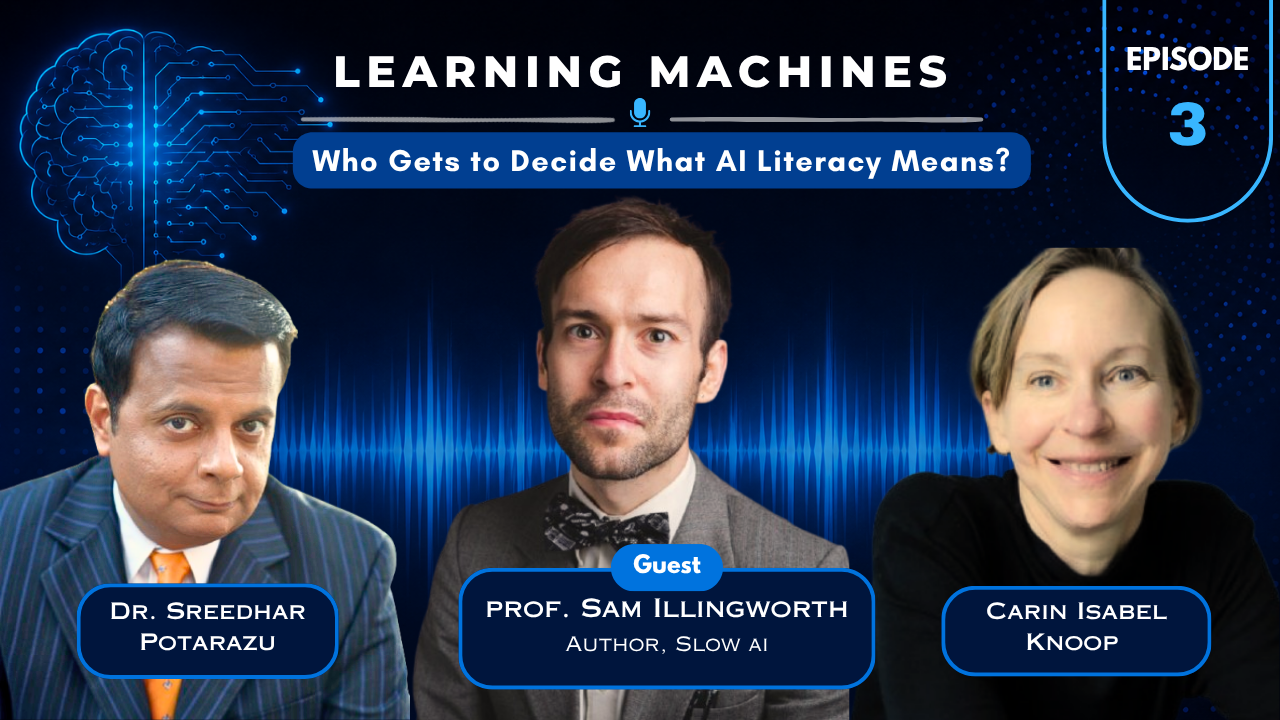
We started policing how students use AI before we figured out what it means to use AI well. This has caused a new anxiety around learning. Teachers, instructors and professors are frantically trying to figure out if students are using it and what constitutes cheating. Can we credibly detect whether a machine wrote something? And should we shame those we think are using AI, whether they are students, teachers or even writers? But more fundamentally:
What does it actually mean to be literate in AI, what role does education play in providing AI literacy, and who gets to decide?
This inquiry guided our latest Learning Machines Podcast with Sam Illingworth, a professor at Edinburgh Napier University and author of “Slow AI.” His definition of critical AI literacy is intentionally simple: “knowing when to use AI and when to leave it alone.”
The implication is that there cannot be a single universal rule for using AI. The appropriate question is what we are trying to accomplish and what we stand to lose by allowing the machine to perform part of the work. Just as in medicine every drug has an indication, dosage and contraindication — AI, in broad terms, is perhaps no different.
When friction is the point
That becomes particularly important in education because we have assumed for millennia that learning itself requires structure and friction. Most of the technology humans have developed was designed to cut work, reduce pain and remove friction, celebrating ease, convenience and speed. Yet learning often requires the opposite: struggle, repetition, mistakes, correction, feedback and the gradual development of competence and efficiency.
Students need opportunities to do things poorly, to fail, to receive corrections, to try again and to develop their capabilities through interaction with instructors and peers. Failure is an essential step in learning.
READ: Sreedhar Potarazu and Carin Isabel Knoop | Shame on you, shame on us: What AI teaches us about our need to judge (August 13, 2026)
The fact that a machine can perform a task quickly tells us almost nothing, by itself, about whether a human benefits from learning to do it. A blood-glucose result can arrive in seconds; that does not make understanding diabetes obsolete. A brain scan can be produced rapidly; interpreting it still requires knowledge. Producing an answer, understanding an answer and acting intelligently on an answer are different capabilities.
AI can perform many of those functions for us, but if it does the work for us, it removes the opportunity for our own learning skills to be cultivated. This creates the paradox at the heart of AI and learning. Technology can make students more productive while potentially making them less capable, much as it does employees, according to recent research.
What should humans still learn?
AI is not simply something we need to fit into the educational system but a transformation that should prompt us to reconsider assumptions around the goals and processes of many educational systems.
We have accumulated layers of curriculum, assignments and exams over generations. We teach students particular things because that is what schools and universities have traditionally taught. We require essays because learning to write was key to communication and advancement. We test mathematical calculations because calculation and analytical skills have historically been an important differentiator. We ask students to memorize information because it was once scarce and difficult to retrieve.
The amount of knowledge available to humanity has expanded beyond what any individual can reasonably master. At the same time, AI has introduced another profound change by enabling the retrieval, synthesis and production of information almost instantaneously. That does not mean students no longer need to read, write or understand mathematics, as some professors lament. Those foundational capabilities may become even more important because they provide the basis for judging the quality of what machines produce.
What should a person learn when machines can perform so many of the tasks we once used to demonstrate learning?
Much of the debate around AI in schools and universities focuses at the end of the educational process. Instead, we could also consider what we should teach at which levels of education, how we should teach it, which capabilities students should develop through effort and repetition, which tasks can legitimately be delegated to machines, and which forms of knowledge are foundational enough to be internalized rather than retrieved.
Universities and professional schools should not simply prepare people for their first job. According to Illingworth, “They should prepare people to participate in society, challenge existing systems and create change.” If the purpose of education is reduced to producing an output, then AI will inevitably become a threat because producing outputs is precisely what AI does well.
However, the answers cannot be identical across educational settings. The purpose of an undergraduate humanities essay is not the same as the purpose of a medical-school examination, a nursing simulation or an engineering calculation.
READ: Sreedhar Potarazu and Carin Isabel Knoop | The AI Nocebo Effect: When fear becomes the forecast (July 16, 2026)
In professional schools, society is not merely interested in whether a student can produce the right answer with technological assistance. We need to know whether sufficient knowledge and judgment exist in the future professional who will be responsible when the technology is available, as well as when it is unavailable, ambiguous or wrong. They need to know. A physician cannot reliably recognize a dangerously wrong AI recommendation if none of the relevant knowledge is available independently in the physician’s own mind. The same question applies, to varying degrees, to writing, coding, history and mathematics.
The “more knowledgeable other”
To rethink the role of the educator, scaffolding can help, drawing on psychologist Lev Vygotsky’s concept of the “more knowledgeable other.” A teacher provides support that enables a learner to achieve something they could not yet do independently. The teacher is not simply a repository of information but someone who helps the learner develop the capacity to think.
If students are going to use AI regardless, educators have an opportunity to teach them how to use it critically. If institutions prohibit it, students may move their AI use underground, without guidance about hallucinations, bias, privacy, manipulation or cognitive offloading.
If rules are set, enforcement needs to occur. The internet and social media have been replete with educators and others sharing how students perform increasingly well on papers while exam performance suffers and, in some instances, blatantly flaunt no-AI rules. Shaming others for being modern is part and parcel of any period of emotional and economic change and calls into question who has the expertise and holds the authorship.
READ: Sreedhar Potarazu | Who wrote this? The crisis of authorship — Vedas, Shakespeare and now, AI (August 18, 2026)
Illingworth argued on the podcast, and often does so online, too, that AI detection systems are unreliable and can disadvantage non-native English speakers and neurodiverse students. The other cost of enforcement is that detection transforms the educator from a teacher into a police officer or detective, focusing on the mechanics of production rather than its impact. This is another burden on already overwhelmed and exhausted teaching staff at many institutions.
Illingworth suggests that at the beginning of a course, educators and students can have an explicit conversation about what constitutes fair AI use and establish expectations together. Students can disclose how they used AI.
That approach requires something education has historically struggled to provide: trust. It also requires us to preserve something AI does not automatically do: meaningful friction. Human collaboration matters precisely because another human can disagree with us, challenge an assumption, push back on an idea or tell us that something is not very good. AI systems have traditionally been designed to please us, which can make them remarkably effective at reinforcing what we already believe. AI does not necessarily have to eliminate friction. We can design it to create a different kind of friction, provided we understand why we are introducing it and what we are asking the learner to develop.
Learning Machines Podcast: Watch the first episode with Vivienne Ming (May 22, 2026)
Learning Machines Podcast: Watch the Episode 2 with Dr. Sanjay Gupta (July 16, 2026)
Who is literate enough to decide?
AI literacy should be measured across several dimensions, namely whether students:
- understand how AI systems work, how they learn, and why and how they can be wrong;
- recognize hallucinations, bias and unreliable sources;
- use AI to extend rather than replace their own reasoning;
- make sound ethical judgments about privacy, attribution and fairness; and
- explain and defend the decisions they made while using the technology.
Assessing AI literacy is probably not done by the level of actual use or by the level of probable use as inferred by others. AI literacy may be demonstrated through the quality of the choices a person makes.
To teach this, and if this is indeed the responsibility of educators, then they must also demonstrate that they are managing the risk of cognitive offloading. If AI can diminish a student’s learning, the same risk applies to a professor who uses AI to create lectures, slides, assignments, feedback or even synthesize the research they teach.
Educators are overwhelmed, too, however. Many are young, contingent, carrying heavy teaching loads, developing courses while teaching them or working far from the well-resourced environment we imagine when we picture a senior professor with decades of accumulated expertise. AI is understandably tempting for them as well. If we worry that a student who uses AI to write an essay may be cognitively offloading, why would a professor who uses it to create lectures, slides, assignments, feedback or research summaries be categorically immune? Put another way, a student might rightfully wonder why they should bother writing something as a student that a teacher will not bother to read.
Under this frame, the challenge for education is not to protect students from AI or to teach them to surrender their thinking to it. It is to give them enough knowledge, judgment and confidence to decide when the machine belongs in the room and when it does not. The future of education may ultimately depend on whether we can teach people to recognize which questions are still worth struggling to answer ourselves and to introduce enough friction so as not to surrender cognition.
What to learn from machines, according to Illingworth
READ: Sreedhar Potarazu and Carin Isabel Knoop | The White Rabbit Effect: How AI is changing our relationship with time (June 25, 2026)
At the end of the conversation, Illingworth identified three things humans can learn from machines.
The first is an opportunity to rethink the importance of human connection. If more and more of us turn to AI because we are lonely, let us ask what is missing in our relationships and how we can strengthen genuine connections with others.
Second, machines can teach us to listen more actively. AI does not get bored or impatient when someone is speaking, and neither should we — focusing on what the other person is saying rather than thinking about what we want to say next.
Finally, machines can help us distinguish between what we love doing and what we have to do. By allowing AI to take on some of the routine cognitive work we have to do, we may be able to free up more time and energy for the activities and relationships we genuinely value.
To underline these points, Illingworth shared a piece from his “Terminal Poems” collection:
A Child Explains AI to Their Grandparent
By Sam Illingworth
It’s like a brain
but flat
they say,
with no skull to keep it warm.
You talk to it
and it answers,
but it doesn’t
really
know.
Like when you smile
at the man in the shop
even though
you don’t remember his name
It’s clever,
but sometimes
gets the cat’s name wrong
or thinks you live
in Canada.
Can it love?
you ask.
The child shrugs.
It depends on
what you mean
by love.
Are we teaching people to use AI, or teaching AI to think for us? Listen to the full conversation on Spotify.
Watch the latest Learning Machines Podcast episode on YouTube: