



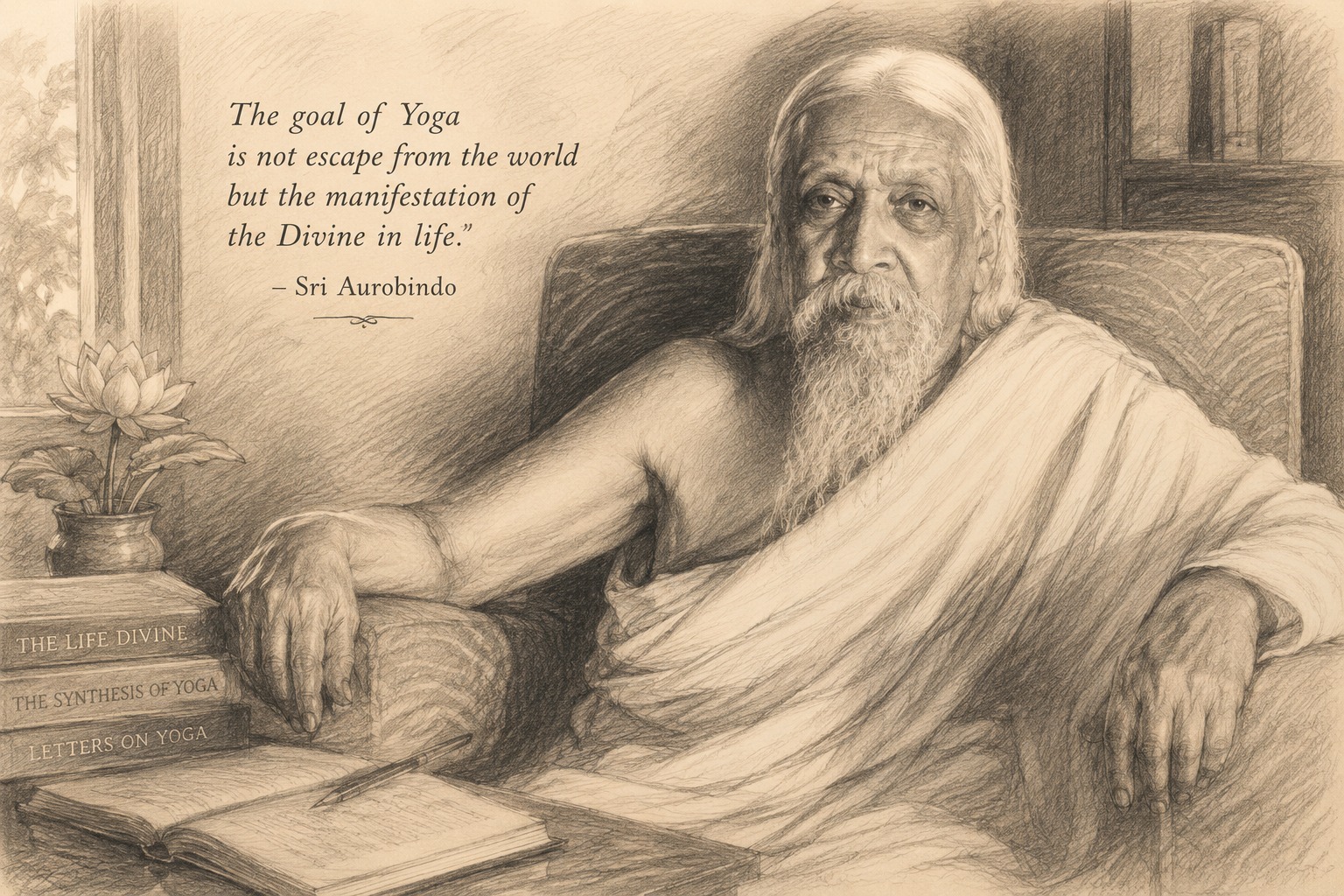
On International Yoga Day, a reflection on how Sri Aurobindo reimagined Yoga not as an escape from the world, but as a means of transforming human consciousness and earthly existence.
By Ravindra Garimella
Since 2015, June 21 has been observed annually as International Yoga Day.
Yoga, one of India’s most profound spiritual traditions, has been interpreted and practiced in various ways since time immemorial. While classical systems of yoga often emphasize personal liberation through meditation, asceticism, or disciplined spiritual practices, Sri Aurobindo Ghosh gave yoga a unique and transformative dimension.
A philosopher, nationalist, poet, and spiritual master, Sri Aurobindo developed what he called Integral Yoga, a comprehensive spiritual path aimed not merely at individual salvation but at the transformation of human nature and life itself. His interpretation of yoga represents a synthesis of ancient wisdom and modern aspirations, making it highly relevant to contemporary humanity.
As an alumnus of The Mother’s International School, Sri Aurobindo Ashram, New Delhi, I have been deeply influenced by the concept of yoga as propagated by the spiritual leader right from my primary school days. On this occasion, I wish to reflect on the philosophy of yoga as taught and propagated by Sri Aurobindo.
READ: The quiet reach of yoga: A reflection from political and personal memory (June 21, 2025)
The Pondicherry sage received a Western education in England before returning to India. Initially active in the Indian freedom movement, he later withdrew from politics and settled in Pondicherry (now Puducherry), where he devoted himself to spiritual pursuits. Through deep spiritual experiences and years of contemplation, he evolved a distinctive vision of yoga that sought to unite the spiritual and material dimensions of existence.
The central feature of Sri Aurobindo’s yoga is its integral character. Traditional yogic paths such as Jnana Yoga (the path of knowledge), Bhakti Yoga (the path of devotion), Karma Yoga (the path of action), and Raja Yoga (the path of meditation) usually focus on one principal approach to spiritual realization. Sri Aurobindo, however, believed that all aspects of human nature—mind, heart, life-energy, and body—must participate in the spiritual journey. Integral Yoga seeks the harmonious development and transformation of the entire being rather than concentrating on a single faculty.
According to the philosopher, the ultimate aim of yoga is not escape from the world but the manifestation of the Divine in life. Many spiritual traditions view the material world as an illusion or a temporary stage from which one must ultimately withdraw. Sri Aurobindo challenged this view by asserting that creation itself is a progressive expression of the Divine Consciousness. Therefore, spiritual realization should lead to the transformation of earthly existence rather than its rejection. This concept distinguishes Integral Yoga from many classical schools of thought.
A key principle in Sri Aurobindo’s philosophy is the evolution of consciousness. Just as life evolved from matter and mind evolved from life, he believed that humanity is destined to evolve into a higher state of consciousness. This higher consciousness, which he termed the Supramental Consciousness, represents a divine truth-consciousness beyond the limitations of the ordinary mind. The practice of yoga, according to him, accelerates this evolutionary process and prepares humanity for a higher stage of existence.
Sri Aurobindo’s yoga does not prescribe rigid rituals, fixed postures, or elaborate external disciplines. Instead, it emphasizes an inner psychological and spiritual transformation. He identified three essential movements in the practice of Integral Yoga: aspiration, rejection, and surrender. Aspiration refers to the sincere longing for spiritual growth and union with the Divine. Rejection involves the elimination of negative thoughts, desires, egoistic impulses, and habits that obstruct spiritual progress. Surrender means offering one’s entire being to the Divine Will and allowing it to guide and transform one’s life.
READ: Ravindra Garimella | The Janus face of nuclear power (February 3, 2026)
Another important aspect of Sri Aurobindo’s yoga is the concept of the psychic being, often described as the soul evolving through many lifetimes. He believed that spiritual progress becomes more secure and authentic when the psychic being comes forward and governs the mind, emotions, and actions. The awakening of the psychic being brings clarity, peace, love, and a deeper connection with the Divine. For Sri Aurobindo, this psychic transformation is an indispensable step in the spiritual journey.
The role of action in Integral Yoga is also significant. Unlike approaches that advocate withdrawal from worldly responsibilities, Sri Aurobindo encouraged individuals to engage actively in life while maintaining inner spiritual awareness. Work, relationships, education, and social service can all become means of yoga when performed in a spirit of dedication and selflessness. Every activity, however ordinary, can be transformed into a sacred offering. Thus, yoga becomes a way of life rather than a practice confined to specific hours of meditation.
Sri Aurobindo’s spiritual collaborator, The Mother (Mirra Alfassa), whom we knew as the Divine Mother, played a crucial role in developing and propagating Integral Yoga. Together, they established the Sri Aurobindo Ashram in Pondicherry, which became a centre for spiritual experimentation and practice. The Mother further elaborated methods for integrating spiritual consciousness into education, physical culture, and daily living. Their collective work demonstrated that spirituality could be applied to every aspect of human existence.
The relevance of Sri Aurobindo’s yoga in the modern world is immense. Contemporary society faces challenges such as materialism, social conflict, environmental degradation, and psychological stress. The philosopher’s vision offers a holistic solution by emphasizing inner transformation as the basis for outer progress. He argued that lasting social change cannot be achieved merely through political or economic reforms; it requires a change in human consciousness. By cultivating self-awareness, harmony, compassion, and spiritual insight, individuals can contribute to the creation of a more enlightened society.
Furthermore, Integral Yoga encourages the reconciliation of science and spirituality. The spiritual leader did not reject scientific inquiry but viewed it as part of humanity’s evolutionary quest for truth. He believed that future human progress would involve a deeper understanding of consciousness, leading to a synthesis of material knowledge and spiritual wisdom. This broad and inclusive outlook makes his teachings especially appealing to modern seekers.
Sri Aurobindo Ghosh thus transformed the traditional understanding of yoga by presenting it as a dynamic process of individual and collective evolution. His Integral Yoga seeks not only personal enlightenment but also the divinization of life on earth. Through aspiration, self-purification, surrender, and conscious action, individuals can participate in the unfolding evolution of consciousness. Sri Aurobindo’s teachings continue to inspire people around the world, offering a vision of spiritual growth that embraces the whole of life and points toward a higher future for humanity.
(Ravindra Garimella, a parliamentary bureaucrat, is also an author. He has been alumini of The Mother’s International School, Sri Aurobindo Ashram.)