



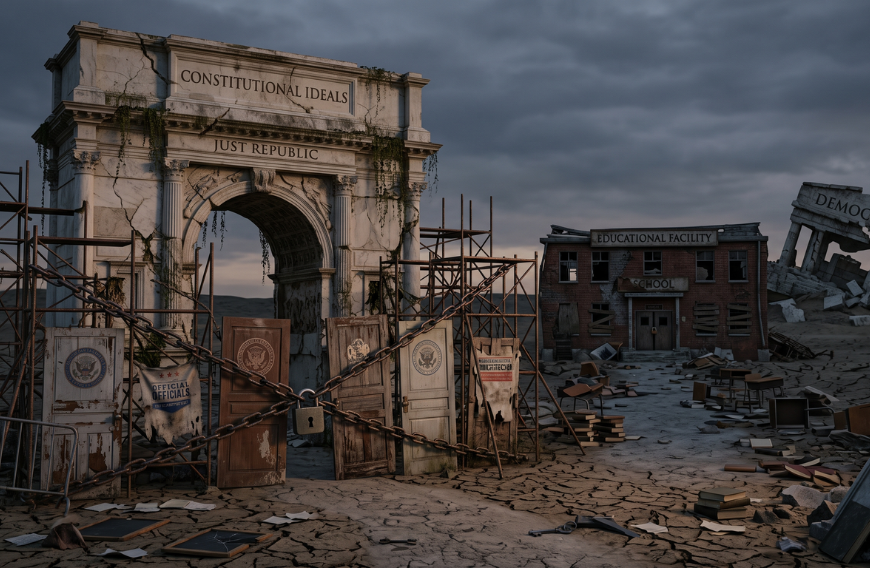
There is a profound difference between a civilization that seeks to nurture its young and a state that merely seeks to filter them.
When a republic reduces the monumental, sacred task of education to the mechanical operations of an administrative testing agency, it commits a quiet civilizational betrayal.
An entity designed around mass elimination, standardized anxiety, and administrative triage is not an educational instrument; it is a thoughtless aberration.
It treats human potential as a logistical problem to be managed rather than a flame to be tended.
A test that exists primarily to keep millions out, rather than to invite the mind into the vast landscape of thought, skill, and civic duty, misses the entire spirit of the compact on which a free society rests.
The constitution did not promise a nation of candidates awaiting an admit card; it envisioned a republic of enlightened, self-governing citizens.
When education is stripped of its soul, the state ceases to be a facilitator of growth and becomes a gatekeeper of survival.
The crisis that periodically spills onto the streets is rarely just about an exam leak, a corrupted server, or an inept bureaucrat. It is a symptom of a deeper, asymmetric struggle: the uncivil state versus the disarmed citizen.
Power, when unmoored from institutional empathy, operates by testing limits. It advances through quiet encroachments, routinely committing subtle excesses, knowing that a fragmented populace rarely finds the collective momentum to resist.
The state routinely gets away with profound indignities because it understands the attrition of daily life.
Yet, occasionally, a threshold is crossed. Random vectors align—a surge of viral satire, an unfeeling judicial remark, an act of quiet moral defiance by a fasting student—and the state suddenly finds itself exposed, forced into a temporary retreat.
It is tempting to view such moments of street victory as a permanent turning point. They are not. They are lightning strikes—luminous, terrifying to authority, but inherently unpredictable.
What occurred on the pavement was not a scalable strategy or a repeatable blueprint; it was an organic convergence of outrage.
Without structural transformation, the same state machinery that retreats today will rebuild its perimeter tomorrow by stealth.
READ: Satish Jha | The cockroach republic (July 26, 2026)
The delicate equilibrium between the citizen and the state cannot be permanently restored by the fever of an agitation alone.
To shift the balance back toward the center—where authority serves and citizens command—requires more than street-level defiance.
It requires visionary leadership that can translate the raw, chaotic energy of the street into lasting constitutional discipline.
Beyond the politics of the moment lies a more demanding question: Not merely what are we as a state, but who are we as a people?
Every society possesses the latent capacity for both its highest ideal and its most degraded self.
For decades, the systematic decay of public learning, the elevation of ideological mediocrity, and the cynicism of political survival have worked to lumpenize the young, reducing the vast creative energy of a nation to a desperate scramble for diminishing opportunities. We are repeatedly offered the worst version of ourselves, and far too often, we settle for it.
The conversation that lifts a nation out of this mire does not begin in the middle of a teargas shell or an administrative negotiation. It begins in the moral imagination of tall leadership—the rare historical figures who do not merely ride the waves of anger, but who reawaken the sleeping conscience of a civilization.
When young voices like Neha Bora step into the void, enduring cold nights and state indifference with quiet resolve, they offer a glimpse of something long missing: a moral clarity that refuses to be bought, intimidated, or coaxed into cynicism.
READ: Satish Jha | The tyranny of the immediate (July 25, 2026)
They remind us that the young are not merely victims of a broken system, but the unacknowledged trustees of our future.
A century from now, the specific administrative acronyms of our era will be reduced to footnotes in dusty archives. But the fundamental question will remain unchanged: Did we build a state that saw its youth as a problem to be controlled, or did we build a republic that saw its young as its greatest moral trust?
If a nation treats its youth as a nuisance to be filtered out through bureaucratic algorithms, it will harvest a fractured, bitter citizenry.
But if it remembers that education is an act of faith—a promise passed from one generation to the next—it will realize that no regime, no matter how entrenched, can outlast the quiet, fearless courage of a generation that has decided to claim its mind.