



By Mythili Devarakonda and Shubhangi Chowdhury
Kaia Valladares sees the world differently. Letters have colors. Words can carry tastes. A pineapple is not just something she sees. It can trigger a tingling sensation. For the 17-year-old high school senior from the Metrowest area in Massachusetts, these experiences have been part of everyday life for as long as she can remember.
What Valladares didn’t understand growing up was that her experience of the world extended far beyond what most people saw or felt. Synesthesia gave everyday sights, sounds and words additional layers of color, texture and meaning that others simply didn’t experience.
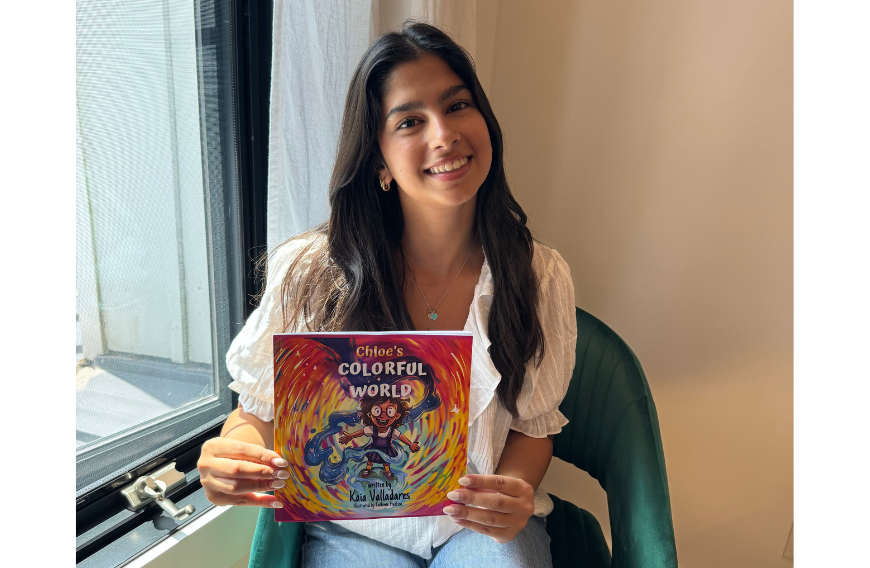
That realization eventually led Valladares to write “Chloe’s Colorful World,” a children’s picture book inspired by her own experience with synesthesia, a neurological phenomenon in which different senses overlap with each other. Through the story of Chloe, a young girl navigating life with synesthesia, Valladares hopes to introduce children to neurodiversity while encouraging empathy and inclusion.
“I found that not many people around me were either familiar with synesthesia or had it at all,” Valladares told The American Bazaar in an exclusive interview. “Ultimately, after being able to publish the book, I realized how important it is to promote equity, inclusion, no matter what it is, neurodivergent or not.”
READ: Author Chandrani Ghosh spotlights Heartlines at inaugural Jaipur Literature Festival (JLF) New York Author Spotlight Series (July 20, 2026)
The book, which she self-published on Amazon in March of 2026 after nearly two years of work, began with a conversation during a family trip to Nantucket Island near Boston. A family friend, also a physician, admitted he knew little about synesthesia despite his medical background. The exchange convinced Valladares that many others also lacked an understanding of the condition and compelled her to educate others.
“He inspired me to go ahead and to write a picture book about it to educate others, young children, young readers,” she said.
For Valladares, writing felt like the most natural way to tell her that story.
“I’ve always been really big into writing and reading,” she said. “I’ve always had a genuine interest for literature. If there was one way for me to express my own experiences and my feelings, for me, the ideal way would have been through a book.”
The picture-book format was equally intentional. Because synesthesia is such a visual experience, she believed illustrations would help readers better understand what words alone could not fully capture.
Although Chloe is rooted in Valladares’ own life, the young protagonist is not an exact reflection of her creator. One of the biggest differences, Valladares said, is Chloe’s confidence in speaking openly about her experiences.
“Chloe is a character. She’s very outspoken, willing to share her ideas, especially to her friends around her and her peers,” she said. “At a young age, I didn’t know that anybody around me didn’t experience the world the same way I did. So it was kind of hard for me to speak up.”
READ: Yale’s Rohit De wins book prize for Indian constitutional history (July 15, 2026)
By making Chloe more vocal, Valladares hopes to encourage young readers to express themselves.
“I wanted to promote the idea that it’s important to share what’s on your mind, express how you’re feeling, because that’s the only way people will understand.”
The sensory experiences Chloe describes, however, come directly from Valladares’ life.
“Those sensations were real and accurate representations of my own experiences,” she said. “The illustrations, the dialogue, it all was a culmination of true, genuine experiences from somebody who does have synesthesia.”
Her parents, Clint and Kalina Valladares, supported the 17-year-old’s creative journey while giving her the space to develop her own vision.
“I was supportive and present, but I was not involved in any way in her product,” Kalina Valladares said. “It’s something I celebrate with her… I felt being overly involved may interfere with her creative process.”
Instead, they focused on helping when needed while allowing their daughter to tell her own story.
Clint Valladares said it was important to “[give] Kaia a chance to share her story rather than her story be diluted with our input.”
For her parents, the project also became a learning experience.
“I had no idea,” Clint Valladares said of synesthesia. “I knew many musicians who see colors when they play music, but I didn’t know synesthesia was demonstrated the way Kaia experiences it.”
Creativity has long been part of Valladares’ life. She is a competitive dancer, and growing up around music and the arts shaped how she understands her condition.
“The arts have had a profound impact on my synesthesia,” she said. “It’s always been really interesting to me, the different ways that I can perceive my senses and my surroundings. Colors and shapes correlate differently in a math class than they do in a dance class.”
She also says literature has been a major influence on her creativity. Among the books that have stayed with her are “The Fault in Our Stars” and “The Anthropocene Reviewed,” both by John Green.
“When I read, rather than reading black and white letters and sentences, I perceive it in color,” she explained. “Each letter is a different color, a different taste, different sound.”
Since the book’s release, many of her friends have read it. Their reactions have reinforced why she chose to write it.
“The general reaction I’ve been receiving is, ‘Wow, we really didn’t know what synesthesia was,'” Valladares said. “It’s good to be exposed to neurodivergences and other differences at a young age so as they grow older, they include inclusion more in their lives.”
READ: ‘Kolkata is one home, and the US is the second’: Heartlines author Chandrani Ghosh on roots and identity (March 23, 2026)
Her parents hope that Kaia’s experience with synesthesia, as told through the book, encourages others to share their own stories too.
“It’s opened our own eyes to how various people perceive the world differently through their lens,” Clint Valladares said. “If we can help her tell her story and have others tell their stories of whatever they may be dealing with, it will get us all understanding each other. And that’s our goal.”
Looking back, Kaia Valladares says writing “Chloe’s Colorful World” was both challenging and deeply rewarding. She hopes readers—especially children and teenagers—come away with a greater appreciation for inclusion, empathy and the value of expressing themselves honestly. Through her protagonist, Chloe, who writes a letter to her friends to share her feelings, Valladares wants young people to understand that true friends accept others for who they are.
“Inclusion is so incredibly important, especially in today’s society and in the modern world,” she said. “I really hope that those who read the book take that away.” While the project pushed her creatively, she says it ultimately left her with a sense of fulfillment, knowing she had made “one small step to celebrate inclusion and promote that in my community.”