



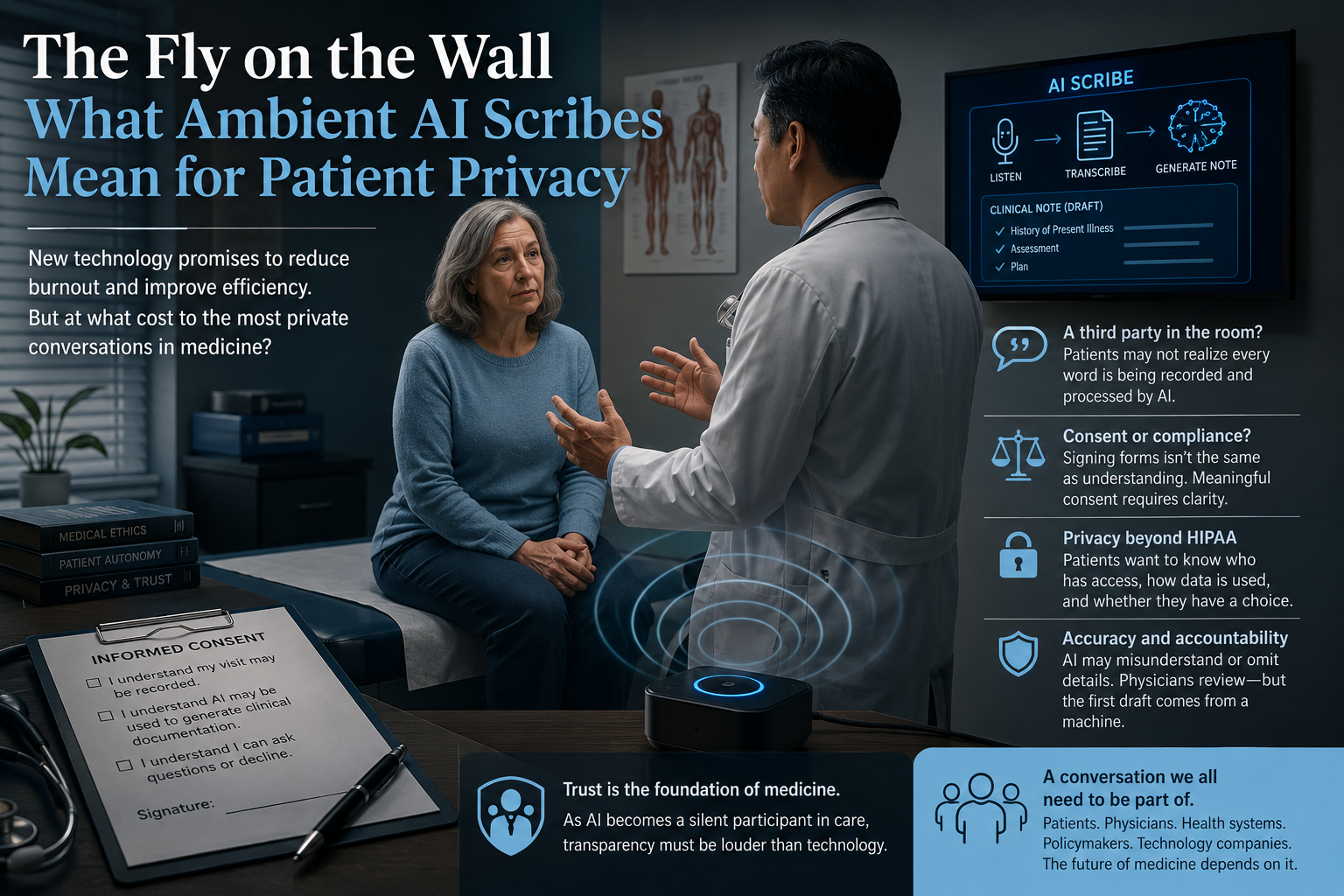
The physician-patient relationship is built on trust. Every day, patients share information that they would never disclose to employers, friends, or even family members. They discuss their fears, medical problems, financial struggles, mental health concerns, and deeply personal experiences because they believe those conversations are private. Confidentiality is not simply a legal requirement in medicine; it is the foundation that allows patients to speak openly and physicians to provide effective care.
That foundation is now being tested by a new generation of artificial intelligence tools.
Across the country, healthcare organizations are rapidly adopting ambient AI scribes such as
Abridge, Suki, and similar platforms. These systems listen to conversations between physicians and patients, convert speech into text, identify clinically relevant information, and automatically generate medical documentation. The technology promises to reduce physician burnout, improve efficiency, and allow doctors to spend more time focusing on patients rather than computer screens. Given the administrative burden that physicians face today, the appeal is obvious.
Many physicians who have used these systems report that they spend less time documenting encounters and more time engaging with patients. Healthcare executives see an opportunity to improve productivity and reduce one of the most common sources of physician dissatisfaction. Investors see a rapidly growing market with enormous potential. In many respects, ambient AI appears to be one of the most promising applications of artificial intelligence in healthcare.
READ: Sreedhar Potarazu | 3 Reasons why AI solved a math problem humans could not for 80 years (May 31, 2026)
However, the rapid adoption of these systems has raised an important question that many patients may not have considered: what happens when an artificial intelligence system becomes a constant listener in the examination room?
That question has moved to a legal reality. Recent lawsuits involving healthcare organizations that use ambient AI documentation systems allege that patient conversations were recorded without adequate disclosure or meaningful consent. The lawsuits involving Abridge and healthcare systems using its technology have attracted national attention because they touch on a sensitive issue that affects every patient. While the courts will ultimately determine the merits of these claims, the lawsuits have highlighted a broader concern that extends far beyond any single company or healthcare organization.
The real issue is not whether AI can create a better clinical note. The real issue is whether patients fully understand that a third party is now participating in what has historically been one of the most private conversations in society.
The rapid expansion of ambient AI is not limited to a single vendor. Companies such as Suki have established partnerships with some of the largest healthcare organizations in the country, including Optum and other major health systems, to deploy AI-powered documentation tools at scale.
For generations, patients knew who was present during a medical visit. They could see the physician, the nurse, the medical assistant, or the student observing the encounter. Everyone in the room was visible. Ambient AI changes that dynamic. The technology may be represented by a smartphone on a desk, a microphone connected to a computer, or software running quietly in the background. The patient may not fully appreciate that every word spoken during the encounter is being captured, processed, analyzed, and converted into structured medical documentation.
READ: Sreedhar Potarazu | What would the great Hindu sages say about AI? (May 26, 2026)
Healthcare organizations often emphasize that these systems operate within HIPAA-compliant frameworks and that vendors enter into agreements governing the use of patient information. Those safeguards are important, but compliance alone does not resolve the ethical questions involved. Patients are not simply concerned about whether a process is legally permissible. They want to know what is happening to their information, who has access to it, how it is being used, and whether they have a meaningful choice in the matter.
There is an important difference between disclosure and understanding. A patient may sign multiple forms during a medical visit without reading every page. They may acknowledge privacy policies that contain complex legal language. They may receive a brief explanation that an AI tool is being used to assist with documentation. None of those actions necessarily mean that the patient understands the full scope of what is occurring.
Meaningful informed consent requires more than a signature.
Consider a patient discussing depression, substance abuse, domestic violence, infertility, sexual health, or a recent cancer diagnosis. These are among the most sensitive conversations that occur anywhere in society. Some patients may have no concerns about AI-assisted documentation.
The healthcare industry often frames ambient AI as simply another technology tool, but the comparison is incomplete. An electronic health record stores information that a clinician enters into the system. An ambient AI scribe actively listens to conversations, extracts information, generates summaries, and creates documentation. That distinction matters because the technology is involved at the very beginning of the information-gathering process rather than at the end.
The emergence of ambient AI also raises important questions about the future of medical documentation. Traditionally, physicians were responsible for collecting information, interpreting it, and documenting it in their own words. AI scribes change that workflow by generating the first draft of the medical record. Physicians remain responsible for reviewing and approving the final documentation, but the initial narrative increasingly comes from a machine.
READ: Sreedhar Potarazu | Vance vs Rubio round 3: Medicaid fraud, India, and the battle for the GOP’s future (May 29, 2026)
The challenge facing healthcare leaders is that the technology is advancing faster than public understanding. Patients generally know that artificial intelligence exists. They may use AI-powered search engines, virtual assistants, or consumer applications. What many do not realize is that artificial intelligence is now becoming deeply embedded within routine healthcare encounters. As adoption accelerates, transparency will become increasingly important.
The irony is that ambient AI was introduced to strengthen the physician-patient relationship. By reducing documentation burdens, these systems were supposed to help physicians focus more attention on patients. In many cases, they may achieve exactly that goal. Physicians who spend less time typing may be able to spend more time listening. Patients may receive a better experience because their physician is more engaged during the encounter.
The lawsuits currently making headlines may eventually be resolved in court, but the larger debate is only beginning. Healthcare organizations, policymakers, technology companies, and physicians must work together to establish clear standards for disclosure, consent, data governance, and accountability. Patients deserve to understand when artificial intelligence is participating in their care, just as they deserve to know who else is present in the examination room.
Artificial intelligence will undoubtedly play an important role in the future of medicine. The question is not whether these technologies should exist. The question is whether their adoption will be guided by the same principles that have governed medicine for centuries: respect for patient autonomy, protection of privacy, and preservation of trust.
The examination room has always been a place where patients could speak openly because they knew who was listening. As ambient AI becomes increasingly common, healthcare leaders must ensure that patients continue to have that same confidence. Otherwise, the industry risks solving one problem while creating another.